


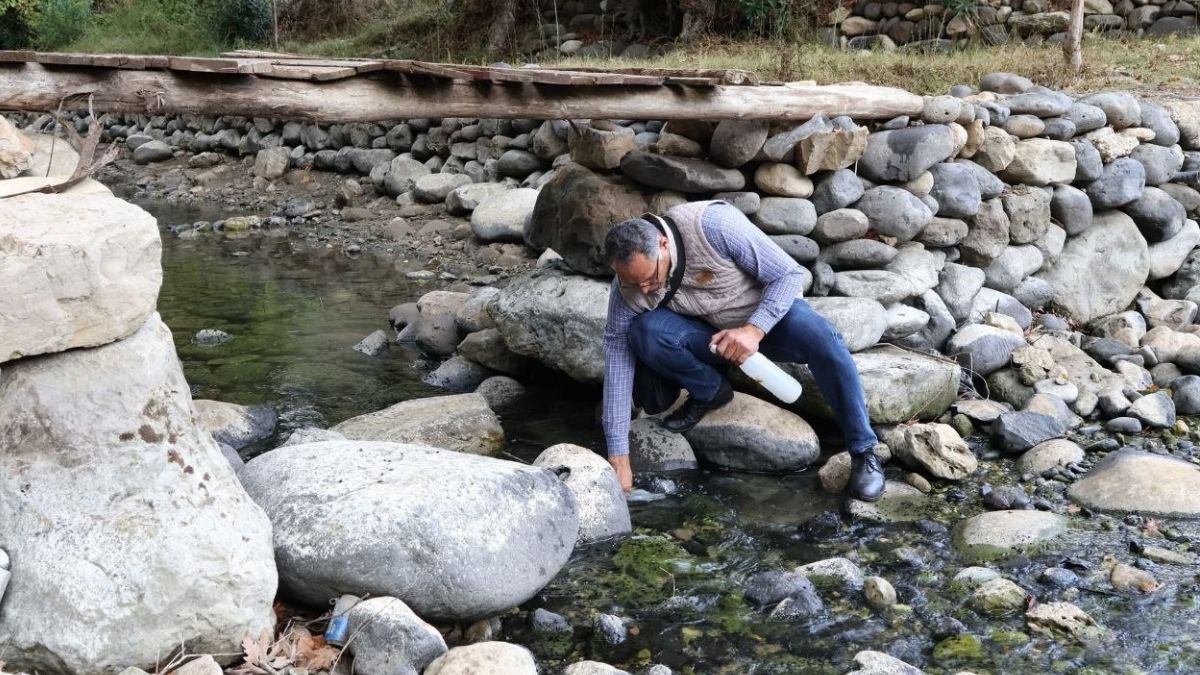
 Collecting water samples from the Draykish spring in Tartous – October 20, 2025 – (Tartous Water Resources Directorate)
Collecting water samples from the Draykish spring in Tartous – October 20, 2025 – (Tartous Water Resources Directorate)
The Water Resources Directorate in Tartous denied today, Wednesday, October 22, reports circulating on social media about contamination in the springs of Draykish, confirming that the water is “healthy and safe” according to regular testing.
The denial followed online claims that the Draykish spring water had become unfit for drinking.
In a statement on Facebook, the directorate said that “there is no truth to the information recently circulated on social media regarding contamination of Draykish spring water or the spread of diseases in the area.”
After contacting the Draykish City Council and the local health department, both confirmed that no disease outbreaks have been recorded. The directorate added that specialized field committees conduct regular inspections to monitor the water quality of Draykish’s springs.
The statement explained that the committees collect water samples for laboratory testing under an organized monitoring plan coordinated with the Tartous Health Directorate.
Should any contamination be detected, all relevant authorities would be immediately notified to take the necessary measures to contain it and protect public health.
The village of Ras al-Ain in Latakia governorate witnessed a spread of hepatitis A among residents due to contaminated drinking water.
Fatima Najjar, head of the Jableh Health District, told Enab Baladi that after reports emerged on October 6 of hepatitis A infections in Ras al-Ain’s al-Omayriyeh neighborhood, a medical team visited the site and recorded 24 cases, nine of which were in recovery.
Water samples were collected from several wells in the neighborhood and sent to the bacteriology lab at the Latakia Water Unit, where testing showed contamination likely caused by sewage leakage into local artesian wells, according to Najjar.
She added that health teams distributed around 4,000 chlorine tablets to residents and held awareness sessions about transmission and prevention methods.
Najjar stated that the Ras al-Ain municipality has begun repairing a broken sewage line in the neighborhood.
Health teams also visited the local school, where three student cases were recorded, and coordinated with the school health department to monitor the situation and track contacts.
The Health Directorate teams continue to follow up in the field until no new cases are detected, she added, noting that “the Water Unit has not yet resumed pumping through the main network despite ongoing coordination.”
The directorate urged residents to adhere to preventive measures and avoid relying on inaccurate information circulating on social media, stressing that all preventive actions will continue until the health situation in the village is fully under control.
if you think the article contain wrong information or you have additional details Send Correction


 A
A
A
A
A
A




 More Society