
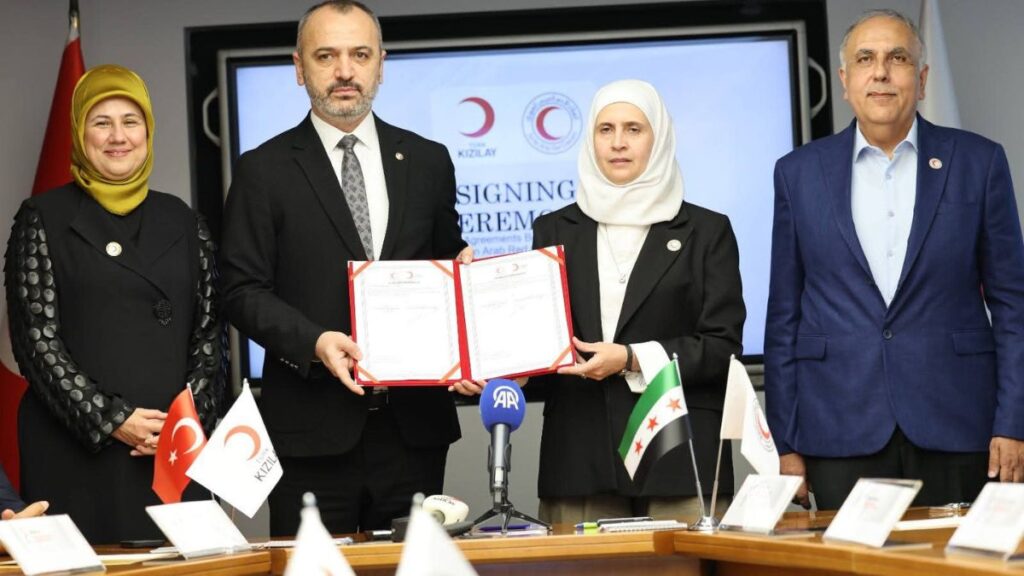

The Syrian Arab Red Crescent and the Turkish Red Crescent signed three cooperation agreements in the Turkish capital, Ankara, to enhance their humanitarian partnership.
The agreements aim to support affected and highly vulnerable groups and meet their basic needs, according to a statement the Syrian Arab Red Crescent posted on Facebook on the evening of Thursday, 23 October.
Fatma Meriç Yılmaz, president of the Turkish Red Crescent, said the cooperation protocol will include bread distribution in Aleppo, the opening of “Mahabba” charity shops in Aleppo and the capital, Damascus, and the launch of a cash-assistance program in Damascus, as reported by Turkey’s Anadolu Agency.
She affirmed that assisting the Syrian people is “a duty,” adding that work continues with the Syrian Arab Red Crescent to strengthen its capacity in this field.
Hazem Baqleh, president of the Syrian Arab Red Crescent, highlighted the need to rehabilitate infrastructure in areas where Syrians are returning, noting extensive destruction and that many people have left their homes and are living in tents and camps in Syria.
“We seek to rehabilitate infrastructure in a manner befitting human dignity. Hand in hand, and with the help of our brothers, we hope to rebuild Syria,” he said.
The signing took place during a visit by a Syrian Arab Red Crescent delegation to Turkey. The visit included reviewing Turkish Red Crescent experiences in projects that sustain humanitarian programs and activities, and meetings with Red Cross and Red Crescent national societies operating in Turkey that have provided aid and support to the most affected families in the country, according to the Syrian Arab Red Crescent.
Qatari project for dialysis
The Qatar Red Crescent launched a project to provide emergency dialysis services in Syria on 22 October, funded by the Zakat Affairs Department at Qatar’s Ministry of Endowments and Islamic Affairs, to support and ensure continuity of life-saving care for thousands of patients with renal failure.
The project will supply 80 hospitals and specialized centers across various parts of Syria with more than 70,000 dialysis kits, serving 3,000 patients at a rate of three sessions per week for each patient over two months.
Each kit includes dialysis fluids, medical solutions, blood-transfer tubing, a dialysis filter, medical needles, and sterilization supplies.
Qatar Red Crescent teams will handle procurement and distribution under a mechanism that ensures quality in line with standards approved by Syria’s Ministry of Health, coordinating with the Syrian Arab Red Crescent to facilitate delivery of dialysis kits to the targeted hospitals and centers.
The World Health Organization will provide technical support by determining actual needs and the technical specifications of the medical supplies.
The Qatar Red Crescent explained that the project’s impact goes beyond providing medical supplies. It will also help reduce mortality and complications, support the stability of essential health services, and ease pressure on already limited resources.
Mazin Abdullah, director of the Qatar Red Crescent’s representative office in Turkey, said the project is a step to ensure dialysis sessions continue for patients in Syria, since any interruption in this service could pose an immediate threat to their lives.