


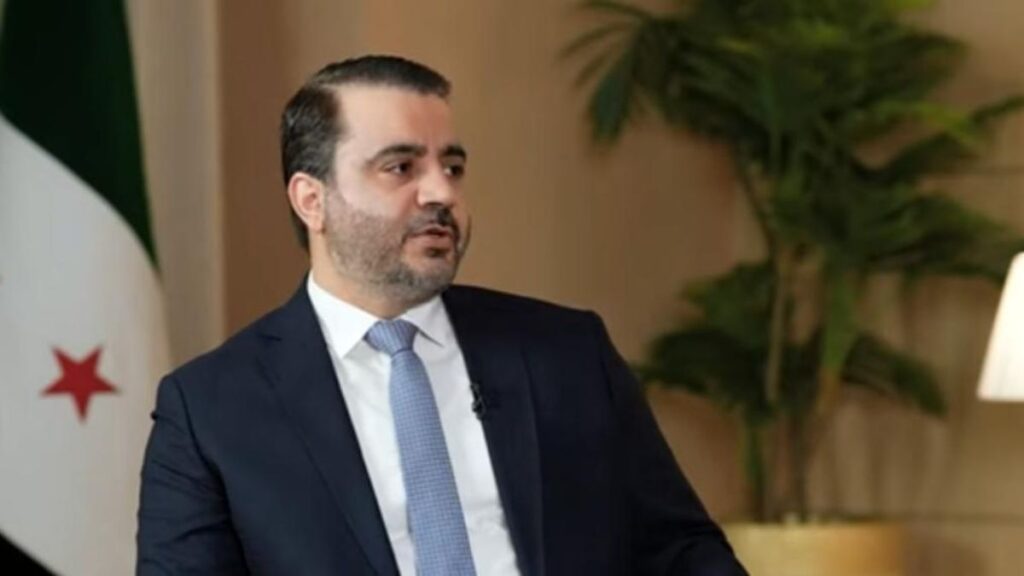
 Syrian FM Asaad al-Shibani says Syrian diplomacy has undergone a “historic transformation” in representing the country, describing Suwayda as a “Syrian wound” – October 18, 2025 (al-Ikhbariyah TV/Syria/YouTube)
Syrian FM Asaad al-Shibani says Syrian diplomacy has undergone a “historic transformation” in representing the country, describing Suwayda as a “Syrian wound” – October 18, 2025 (al-Ikhbariyah TV/Syria/YouTube)
Syrian Foreign Minister Asaad al-Shibani said the transformation Syrian diplomacy is witnessing today is a “historic” turn in representing Syria in a manner befitting the country.
In an interview with the state-run al-Ikhbariyah channel on Saturday, October 18, al-Shibani said the current government is addressing the legacy of the former regime’s “blackmail diplomacy,” explaining that the new approach favors dialogue and cooperation.
“We as a Syrian government did not come from palaces, but from the womb of the revolution and Syrian suffering,” he affirmed.
According to al-Shibani, today’s Syrian diplomacy is a tool to mitigate the impact of ongoing economic sanctions that are still affecting development. It is also a cornerstone of reconstruction and the first line of defense for Syrians’ interests, particularly by building sound relations with countries hosting Syrians to improve how they are treated.
He noted that the Foreign Ministry seeks to shield Syria from polarization and attempts to target the country’s transformation, adding that “the new Syria” is now cited in international forums as a source of pride, in contrast to the past.
The new foreign policy, he said, is based on avoiding alignment with any camp: Syria has not been placed in any axis nor in a state of hostility with any country.
Al-Shibani argued that Syria has moved from a state of war to a forward-looking phase “with steady steps,” stressing that the effort expended during war must be doubled in peace.
He spoke of ongoing work to restore Syria’s membership in several Arab and international organizations, revealing that the government was surprised by the size of debts the former regime had left in those bodies.
On Syria’s participation in the UN General Assembly, he called it essential to communicate the new government’s vision to the world, adding that President Ahmed al-Shar‘a’s address carried an emotional arc that distilled “the Syrian story.”
“We wanted to show the world a country with ambition that emerged from suffering and looks to the future with hope,” al-Shibani said, describing the UN appearance as a historic imprint that expressed the Syrian people truthfully for the first time.
Al-Shibani said the exclusion of the Syrian Democratic Forces (SDF) from state institutions only deepens the rift with the state, calling this a historic opportunity for North and East Syria to be an active part of the present phase.
He added that failure to reach an agreement with the SDF hinders civilians’ interests and delays the return of the displaced to their areas, noting that President Ahmed al-Sharaa is keen for the SDF to be an essential part of Syria’s future.
The government, he said, convinced states concerned with the SDF file that the only solution is the March 10 agreement, warning that delays in implementing it will adversely affect civilians.
Al-Shibani stressed the government rejects any form of partition or federalization, saying this is non-negotiable.
For his part, Sipan Hamo, an SDF General Command member and a member of the military committee negotiating with Damascus, said the Syrian government must understand that disregarding the will of Syria’s components will keep it from representing all Syrians. Speaking to the SDF media office on Saturday, Hamo said excluding components, especially in North and East Syria, from dialogue conferences, constitution-making, lawmaking, and cabinet formation poses a real problem for the SDF.
Separately, Syria’s transitional President Ahmed al-Sharaa said the rights of the Kurdish component “will be guaranteed in the Syrian constitution.”
Al-Shibani described the Suwayda file as a “Syrian wound,” saying what happened in the governorate “was not chosen by the Syrian government.” He added that partners approved the roadmap proposed by the government, a fact-finding committee was formed, and “progress has been made” with a restored sense of national belonging.
He urged national figures, Druze sheikhs, and all who care about the country’s interest to help transcend the crisis.
The minister emphasized the government is treating the issue as a domestic matter and that internationalization only served specific external agendas.
Events in Suwayda began on July 12 with kidnappings on both sides between residents of al-Maqous quarter (mainly Bedouin) and members of the Druze community. These escalated the next day into armed clashes.
The Syrian government intervened on July 14 to stop the fighting, but its intervention was accompanied by violations against Druze civilians, prompting local factions, including those that had cooperated with the Defense and Interior ministries, to respond.
On July 16, government forces withdrew from Suwayda after Israeli strikes, which was followed by violations and revenge attacks against Bedouin residents. In response, armed convoys arrived in “tribal relief” formations to support them.
The government and Israel later reached a US-brokered agreement to halt military operations.
Al-Shibani said Russia was a partner of the former regime and “participated in Syrians’ misery,” noting that before the “Deterring Aggression” battle there was political planning for how to handle the expected change.
He added that a key challenge in that battle was preventing Moscow from supporting the former regime in the event of confrontation.
President Ahmed al-Shar‘a visited Russia on October 15 in his first trip to Moscow since taking office. His delegation included Foreign Minister al-Shibani, Intelligence chief Hussein al-Salameh, and Defense Minister Marhaf Abu Qasra.
The visit discussed several files, foremost among them Russian bases and economic matters between the two countries.
Al-Shibani stressed the government has not placed Syria in any camp and is not hostile to any side. “We have spoken to everyone,” he said, adding that Syria is now planning its diplomacy more than reacting to it, to put the country back on the international map.
He underscored that all diplomatic moves are deliberate and calm, with no concessions on Syrians’ rights. Relations with Russia, China, and Europe are being built from Syria’s standing, and must be harnessed for the Syrian people’s benefit.
On China, he said ties have been realigned, Beijing had supported the former regime politically and used its veto on its behalf, and a formal visit to Beijing is scheduled for early next month.
Al-Shibani said the former regime left Lebanon with a poor image of Syria that does not reflect its civilization, and that the current government seeks to correct the relationship, noting there is a legacy for which it is not responsible.
He said the Syrian refugee file in Lebanon has pressured both Lebanon and Syria, and that the government is working to ensure a dignified return for Syrian refugees.
He also revealed that the case of Syrian detainees in Lebanon topped the agenda during the official visit to Beirut, saying the government has moved beyond the decision-making stage and started following up on practical procedures.
During a visit to Washington on September 18, Foreign Minister al-Shibani met members of the US Congress and Treasury officials.
He met Senator Lindsey Graham to discuss ways to enhance Syria–US relations and lift US sanctions on Syria, according to the Syrian Foreign Ministry.
Al-Shibani also met Representative Joe Wilson, described as supportive of Syria and the Syrian revolution, where the two reviewed avenues of cooperation serving Syrians’ interests, and he met Senator Chris Van Hollen to discuss strengthening cooperation with the United States.
if you think the article contain wrong information or you have additional details Send Correction


 A
A
A
A
A
A



 More Politics