


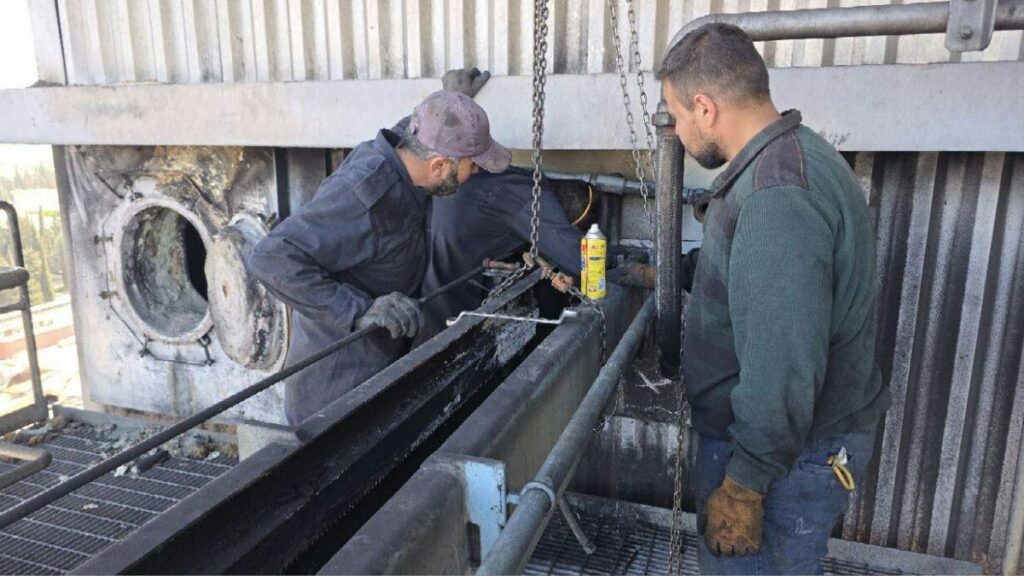
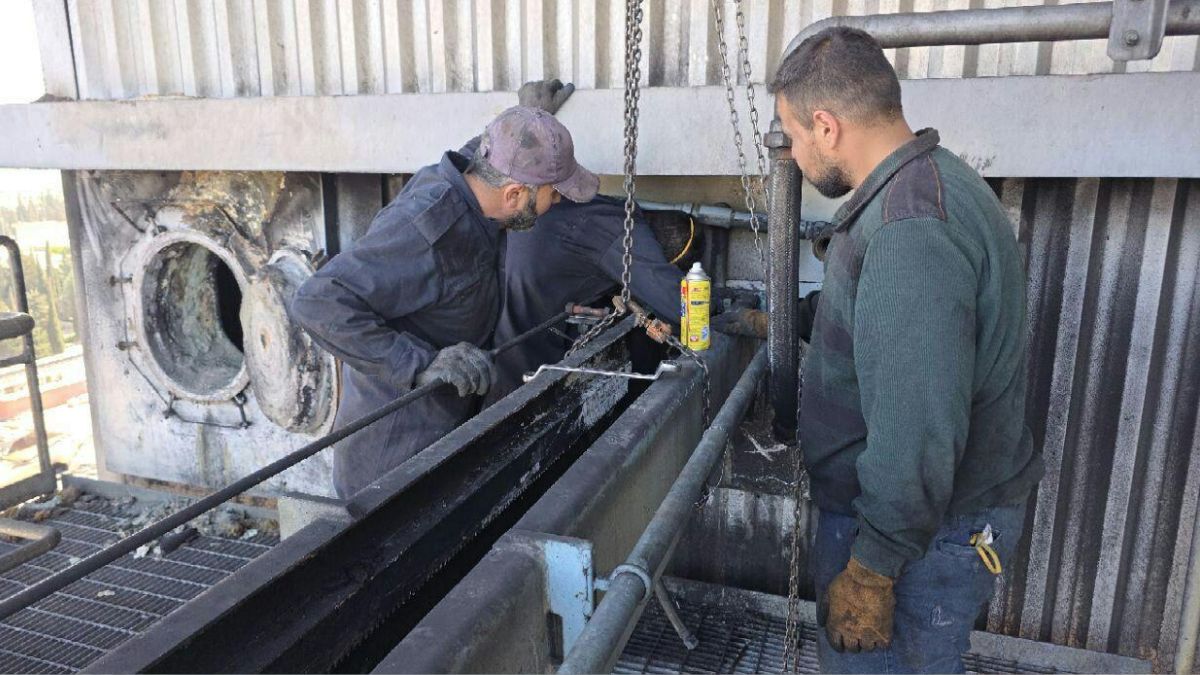
 Routine maintenance work at the al-Zara power plant in Hama (central Syria) – 22 October 2025 (Syrian Ministry of Energy)
Routine maintenance work at the al-Zara power plant in Hama (central Syria) – 22 October 2025 (Syrian Ministry of Energy)
The Syrian government is preparing to launch a plan for the electricity sector that includes adjusting household energy tariffs and introducing a tiered pricing system based on consumption, along with a new pricing category for government institutions, two government sources told Enab Baladi.
The sources stated that the step aims to improve electricity supply and service quality, increase daily power hours, and reduce the government’s substantial financial losses through better maintenance of stations and transmission lines.
According to the same sources, household electricity pricing will be restructured through a tiered system that takes into account the needs of the poorest groups, as follows:
One US dollar equals roughly 11,500 Syrian pounds.
The sources confirmed that maintaining current electricity prices causes the government losses of around one billion dollars annually, especially since daily power supply has increased from about two hours before the regime’s fall to eight hours now, leading to higher production and import costs for gas and fuel oil needed to run power plants.
Producing one kilowatt-hour of electricity costs about 0.14 USD (1,600 Syrian pounds), while it is currently sold to citizens for just ten pounds (less than 0.001 USD), resulting in major losses in the electricity sector.
The government does not intend to completely lift subsidies on electricity but will restructure them to improve service quality and move prices closer to real production costs.
The plan aims to gradually extend the daily power supply, reaching 14 hours by mid-2026, according to the two officials.
The same sources told Enab Baladi that the plan also includes replacing current meters with smart Wi-Fi-connected meters. About 6.5 million smart meters will be installed at a cost of 60–70 USD each, to be paid by consumers through installments added to their bills.
One source said Syria currently produces six million cubic meters of gas daily but needs 30 million, with total electricity generation standing at 2,200 megawatts.
As for Azerbaijani natural gas imports, the issue is not quality, since the gas is high-grade, but the deterioration of pumps at power stations, which limits operating hours.
The sources explained that variations in power rationing across provinces are due to differences in infrastructure. For example, Damascus has a better network than Rural Damascus, which suffered extensive destruction under the former regime’s bombardment.
Azerbaijani natural gas began flowing into Syria via Turkey on 2 August. At the time, Turkish Energy Minister Alparslan Bayraktar said electricity exports to Syria occur through eight points, with plans to first boost export capacity by 25%, and eventually more than double it.
Syria’s Gas Company director, Youssef al-Youssef, told Enab Baladi then that Syria will receive 3.4 million cubic meters of gas per day from Azerbaijan via Turkey, to be fed directly into the Syrian gas grid. He said quantities were introduced gradually during the first week, reaching a stable daily supply afterward.
The Ministry of Energy continues to rehabilitate Syria’s power grid through maintenance and upgrades of main transmission stations and distribution lines across all provinces. About 20% of stations have undergone full maintenance so far, and new stations are under construction.
There are 75 power conversion stations nationwide, 64 of which are operational, eight out of service, and three under rehabilitation. They include 195 transformers, 165 currently functional, according to a ministry statement on 20 October.
Khaled Abu Di, director-general of the Public Corporation for Electricity Transmission and Distribution, said the situation has “significantly improved” compared with conditions before the regime’s fall, thanks to continuous maintenance and upgrades.
Among key projects are the rehabilitation of Aleppo’s “F” power station (400 kV), two other 230 kV stations, and around 15 conversion stations rebuilt almost from scratch. These works took about a year and a half, expanding the grid’s reach and capacity, according to Abu Di.
Rehabilitation efforts include installing breakers and switches, preparing direct-current transformers, replacing cables and batteries, and repairing cooling, insulation, grounding, and lightning systems, along with introducing new mobile stations.
Abu Di added that efforts are focused on securing spare parts to complete maintenance and ensure the grid operates at maximum generation capacity in the near future.
Abu Di told Enab Baladi on 22 September that the available electricity supply varies depending on generation levels. The more power produced, the fewer rationing (cutoff) hours and the longer the supply periods, and vice versa.
He said distribution companies are responsible for rationing schedules based on available generation, though unexpected breakdowns in power plants or transmission networks sometimes disrupt the schedule, causing irregular supply in some areas.
if you think the article contain wrong information or you have additional details Send Correction


 A
A
A
A
A
A





 More Economic Reports