


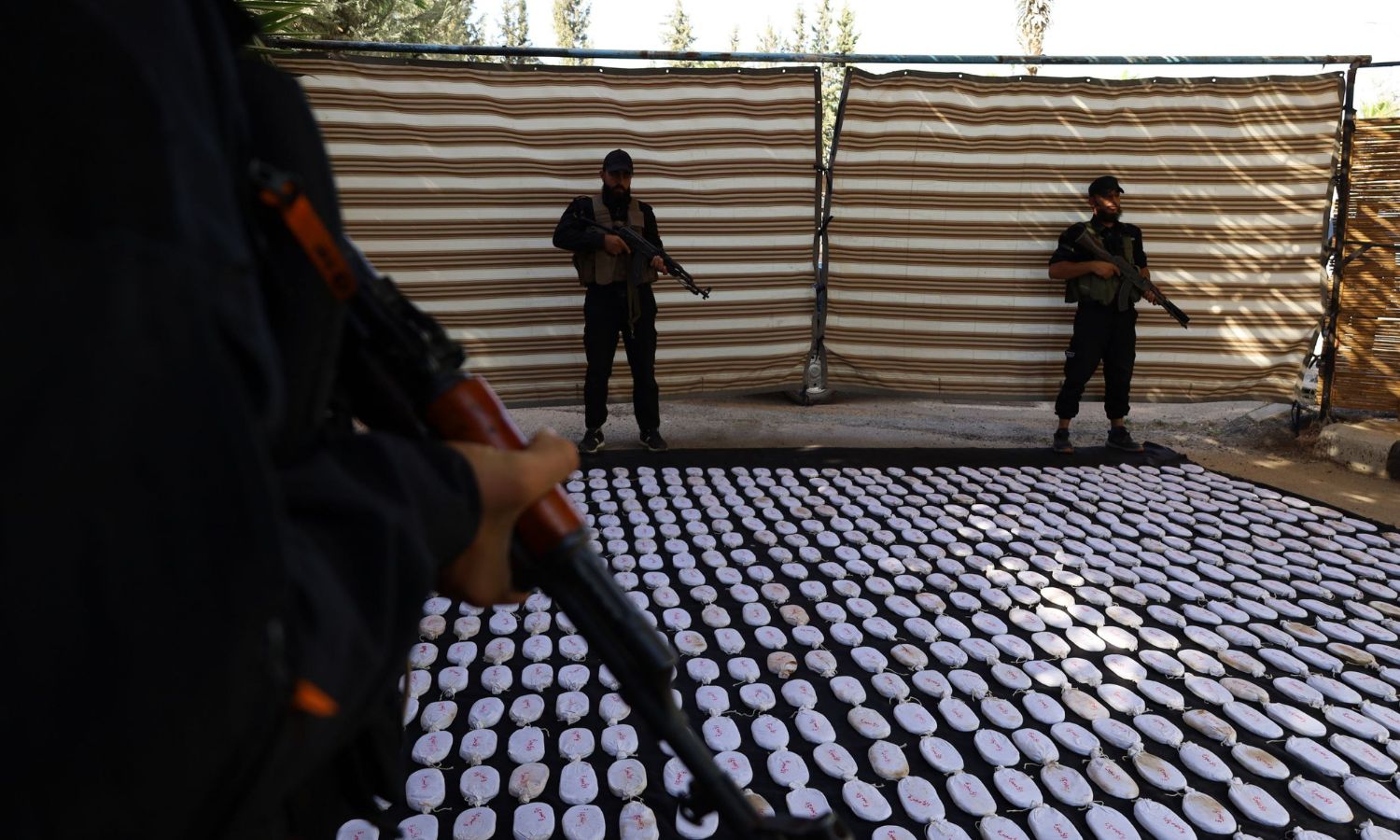
 The Anti-Narcotics Directorate in Daraa (southern Syria) discovers quantities of narcotics in the governorate - September 17, 2025 (Syrian Ministry of Interior).
The Anti-Narcotics Directorate in Daraa (southern Syria) discovers quantities of narcotics in the governorate - September 17, 2025 (Syrian Ministry of Interior).
Enab Baladi – Amir Huquq
Between official statements and on-the-ground realities, the drug file, specifically Captagon, remains one of the most acute security challenges facing Syria and the region.
Damascus says it aims to dismantle manufacturing and trafficking networks. Yet complex geography, regional entanglements, and a parallel wartime economy make the file too knotty for unilateral decisions or isolated security raids to solve.
While the Syrian government projects determination to combat the drug trade by tightening security measures and expanding cooperation with neighbors, the phenomenon continues to test it domestically.
Since the new administration took office, it has signaled a readiness to fight drug production and trade, reflected in dozens of Interior Ministry operations to seize shipments and dismantle sites. This has begun to alter how the industry is perceived locally and regionally. But has the file receded, or does it persist in familiar forms?
Political analyst Hossam Taleb argues Syria has entered a new phase in dealing with drug manufacturing and trafficking. He says the government is working visibly to dry up manufacturing sources and has already dismantled many facilities and seized large quantities of narcotics.
Taleb told Enab Baladi that smuggling has slowed markedly. In his view, much of what is intercepted at borders today is “old stock,” rather than the output of an active production surge as in the peak years of the crisis.
He adds that narcotics are now produced and smuggled by “criminal gangs,” not by the state as before, so it is natural for the government to confront them by every means. “This is not about polishing an image,” he said, “but about fulfilling a security and moral duty,” reflecting the state’s resolve to close this file.
According to Jordanian political and security expert Dr. Amer al-Sabaileh, the drug file in Syria has not been closed, but its shape and tools have changed. Smuggling methods are evolving, and new players have emerged after the former regime. The trade became an alternative economy amid sanctions and economic collapse, creating local and regional beneficiaries who seek to keep it alive.
Al-Sabaileh told Enab Baladi that smuggling will not end simply with regime change or political shifts because it has become part of a transnational criminal network.
Political writer Darwish Khalifa says the Syrian authorities’ desire to shed the “Captagon state” label has been clear since a December 2024 announcement. Yet challenges remain. He argues that despite the end of the designation, Syria’s borders, especially with Lebanon and Iraq, still see activity by sectarian militias trying to revive smuggling routes.
He points to newly uncovered production sites in Homs (central Syria) and Lebanon’s Hermel region (northeastern Lebanon), suggesting the covert economy endures.
The Syrian and Jordanian Anti-Narcotics Directorates recently announced they had foiled seven trafficking attempts along the shared border as part of ongoing security cooperation. In a joint statement on 5 October, the Syrian Interior Ministry said coordinated operations seized about one million pills intended for smuggling and distribution and led to arrests. The statement added that intelligence sharing and field coordination helped dismantle organized networks that threaten both countries’ security, calling the effort a model of bilateral cooperation.
Earlier, on 2 September, Syria’s Anti-Narcotics Directorate and Turkish intelligence seized 500 kilograms of precursors and a large quantity of Captagon pills in Yaafour (Rural Damascus governorate).
Taleb sees such cooperation as essential: no state can secure itself in isolation. Joint work with Jordan and Turkey is the real path to border control and smuggling prevention, he says, serving Syrian, Jordanian, and Turkish security and, by extension, regional stability. “Syria is not exploiting crises as in the past,” he added. “It is trying to end them, a shift that deserves to be read carefully.”
Al-Sabaileh stresses that regional coordination, especially with Syria, remains necessary to confront the phenomenon. “Regardless of the effectiveness or capacity of the Syrian side, coordination with it is better than no cooperation,” he said. Results are still limited, but any step toward joint action is positive and could improve over time with sufficient will and capability.
He believes the more capable the Syrian state becomes at running effective operations and sharing accurate intelligence on smuggling networks, the more that will bolster its international standing, especially as regional and international pressure on this file grows. In his view, the drug file could become a factor in how Syria’s legitimacy and effectiveness are assessed in its external relations, notably with neighbors like Jordan and Lebanon.
For their part, neighbors, led by Jordan and Turkey, signal readiness to support Syria’s border control. Yet, according to Khalifa, that alone is “not enough.” The real threat, he argues, emanates from inside Syria, where operations originate with sophisticated tools and organized networks. He says there has been no genuine seriousness from major powers or international organizations to craft a comprehensive strategy against this form of organized crime or to strike its political and economic roots. Without that, he warns, the fight will remain uneven in the near term.
The situation differs on the Lebanese front. The Syrian-Lebanese border still witnesses drug smuggling amid lax control at informal crossings and murky lines between perpetrators and beneficiaries.
Al-Sabaileh notes that the border has long run on the drug economy and will be difficult to secure quickly. New players emerged during the Syrian crisis, some acting as proxies for smuggling operations, complicating the landscape. The confrontation with gangs remains open-ended as their capabilities and methods evolve.
He argues Lebanon must do more to monitor the border and cooperate with concerned states, even as the international community recognizes Beirut’s internal constraints. Closing the gaps, however, requires genuine regional cooperation and field procedures, not political statements.
Taleb says the Lebanese frontier is more complicated due to armed groups and clan networks backed by Hezbollah that control several informal crossings and traffic in drugs and weapons. He adds that Syria has repeatedly asked the Lebanese Army to fully deploy along the shared border. “You cannot control the border from one side only,” he said. “It takes effective bilateral coordination and distancing armed actors from trafficking lines.”
He concludes that intertwined geography, especially in rugged mountain areas, gives smugglers advantages, making Syrian-Lebanese security cooperation urgent to shut down criminal networks.
Between the Syrian state’s attempts to control the file and the security moves of neighboring countries, the drug trade in Syria remains a shared challenge that transcends borders and politics. It demands candid regional cooperation and a comprehensive international strategy that addresses the economy and politics driving the phenomenon, not just its symptoms, the three experts say.
if you think the article contain wrong information or you have additional details Send Correction


 A
A
A
A
A
A




 More Politics