


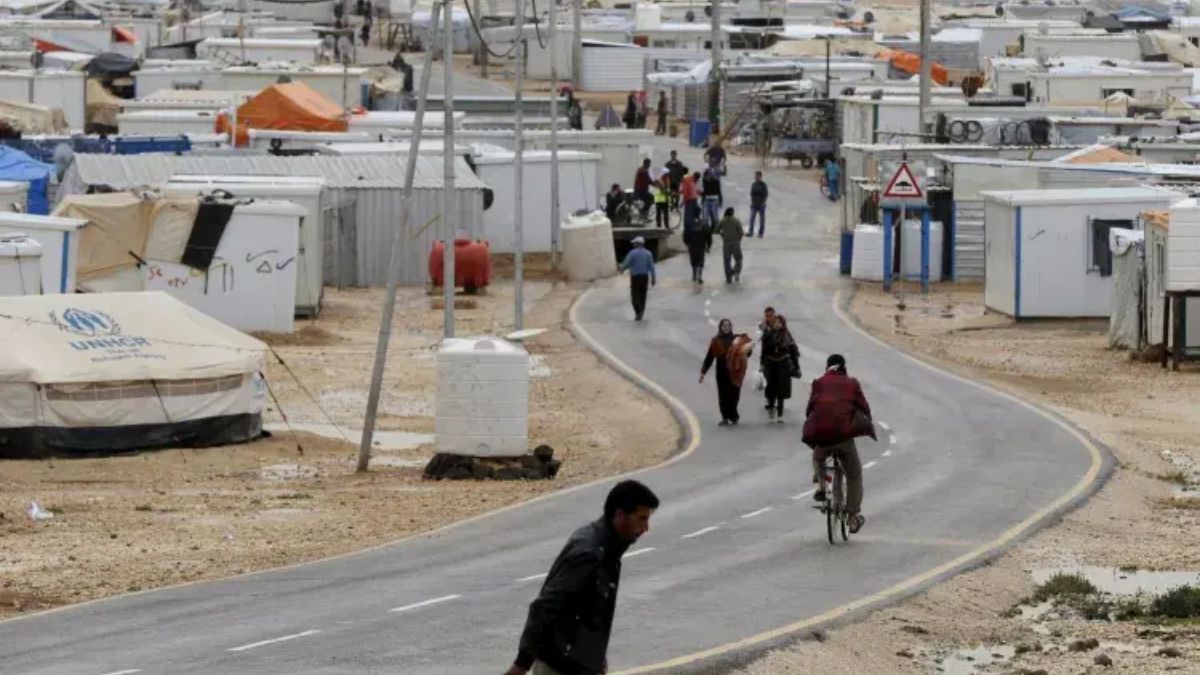
 A Syrian refugee rides a bicycle at the Zaatari refugee camp in Jordan – March 29, 2015 (Reuters/Muhammad Hamed)
A Syrian refugee rides a bicycle at the Zaatari refugee camp in Jordan – March 29, 2015 (Reuters/Muhammad Hamed)
A report by the Norwegian Refugee Council (NRC) revealed that thousands of Syrian refugees living in Jordan remain unable to return to Syria due to legal, economic, and administrative obstacles, despite more than 152,000 refugees having gone back since December 8, 2024, out of over 650,000 registered Syrians.
The report highlighted that high living costs, shrinking humanitarian aid, and strict documentation policies in both Syria and Jordan make safe, voluntary, and dignified return an unrealistic option for many families.
According to an NRC survey, initial optimism about return has faded: while 40% of respondents said they hoped to return one day, only 21% expressed clear intentions to do so, and 37% said they do not plan to return at all.
Amy Schmidt, NRC’s country director in Jordan, stated that refugees are facing “the most important decision in more than a decade: to return or not.” She added that many families lack sufficient information, cannot afford travel costs, or fear being denied entry at the border.
The NRC urged the Jordanian government to simplify procedures for registering births and marriages, regularize the status of undocumented families, and waive retroactive work permit fees. It also called for camp residents to be allowed to take their caravans with them when returning.
The Syrian government, meanwhile, was urged to remove legal barriers to reclaiming property, reinstate real estate agency mechanisms, and open transparent pathways for legal settlement and reissuing missing documents.
The report said current policies fall short in five main areas that create an unfavorable environment for return, from lack of reliable information to economic and administrative restrictions. While these challenges are interlinked and compounded, coordination between governments and international actors could make voluntary return a realistic option for more refugees.
Refugees weigh relative safety in Jordan against uncertainty in Syria. NRC data from early 2025 showed that return intentions fluctuate, with one in six families changing their minds within just four months. Many cited a lack of reliable information about security and legal conditions in Syria as a major obstacle to making informed decisions.
Refugees in Jordan struggle with civil documentation, where documents are interdependent, and the absence of one may prevent obtaining another. For example, parents may have a hospital-issued birth notification but no official birth certificate, which requires a certified marriage certificate to register with the Syrian consulate. Delayed or missing registration often leads to lengthy and costly court procedures.
Even when exemptions apply, consular certification costs $25 per document, a burden for large families. Marriage registration remains a persistent barrier, with some couples unable to validate their marriages due to lack of legal residency, underage spouses, or informal unions. Resolving such cases can take months of court hearings and fines reaching 1,000 Jordanian dinars (about $1,400). Without recognized marriage certificates, couples lose legal status and cannot register births or divorces.
Staying in Jordan means coping with high living costs, declining aid, and limited access to the labor market. Returning to Syria, however, means facing the unknown, insecurity, and high costs of starting over. NRC reported that two-thirds of Syrian families in Jordan live below the poverty line, while 93% of working refugees lack valid work permits.
Despite widespread destruction, many Syrians still view their homeland as irreplaceable. As one testimony in the report stated, “Even if the house is destroyed, it is still our home, and we are citizens there.”
The report noted a “generational gap” in return intentions, with over 214,000 Syrian children born in Jordan since 2011, many of whom consider Jordan their first home. Women face additional pressures: men often prioritize financial or property-related reasons for return, while women fear insecurity, early marriage, and the loss of support networks established in Jordan. Widows and female-headed households face particularly harsh circumstances, with many unable to imagine a possible or dignified return.
Many refugees in Jordan face legal dead ends preventing return. Thousands remain unregistered with UNHCR or Jordanian authorities, leaving them at risk at the border. Palestinian refugees from Syria face compounded barriers, excluded from Jordan’s asylum system and UNHCR protection, and lacking necessary documents to cross.
The NRC concluded that addressing these challenges requires cooperation between Jordan, Syria, and international donors. Leaving refugees with only two options, chronic poverty in exile or unsafe return, will worsen the crisis rather than solve it.
On September 19, the UN High Commissioner for Refugees (UNHCR) in Jordan announced it would need $280 million to fund its humanitarian operations in 2026.
UNHCR spokesperson Youssef Taha told Jordan’s al-Mamlaka TV that the proposed budget aims to support voluntary return for Syrians and sustain essential services for those who remain in Jordan, amid shrinking international funding and growing financial challenges.
He explained that the 2026 budget would be lower than 2025’s $373 million, due to declining numbers of registered refugees, but emphasized that needs remain urgent, particularly for the most vulnerable families.
He added that UNHCR’s strategy for the coming year will focus on sustainability, empowerment, and facilitating safe and dignified return, while ensuring refugee protection and access to basic services. The agency will also step up cooperation with local and international partners to maximize limited resources, stressing that its work remains grounded in dignity and sustainability.
if you think the article contain wrong information or you have additional details Send Correction


 A
A
A
A
A
A






 More Society