


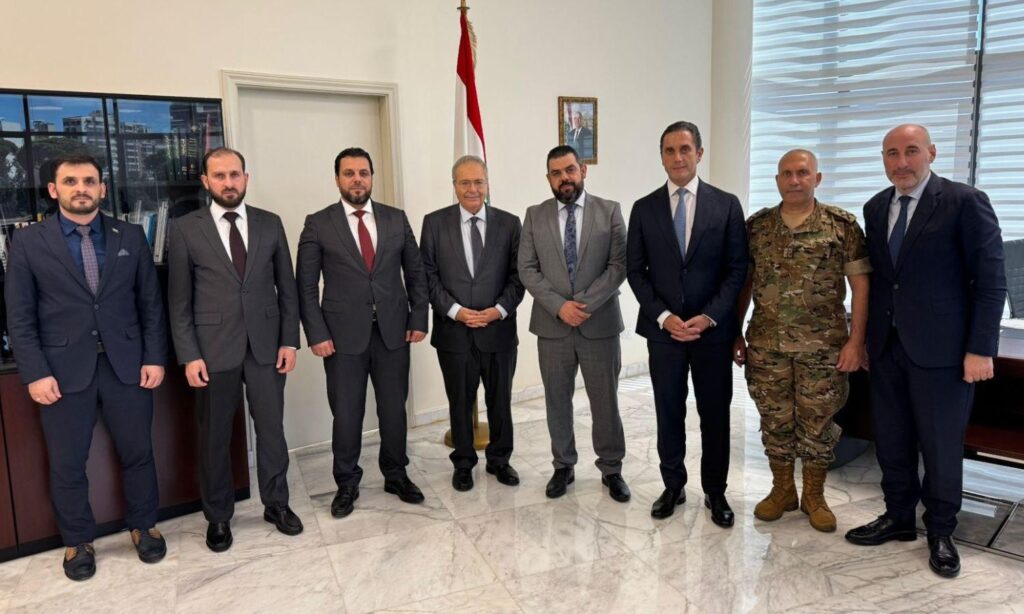
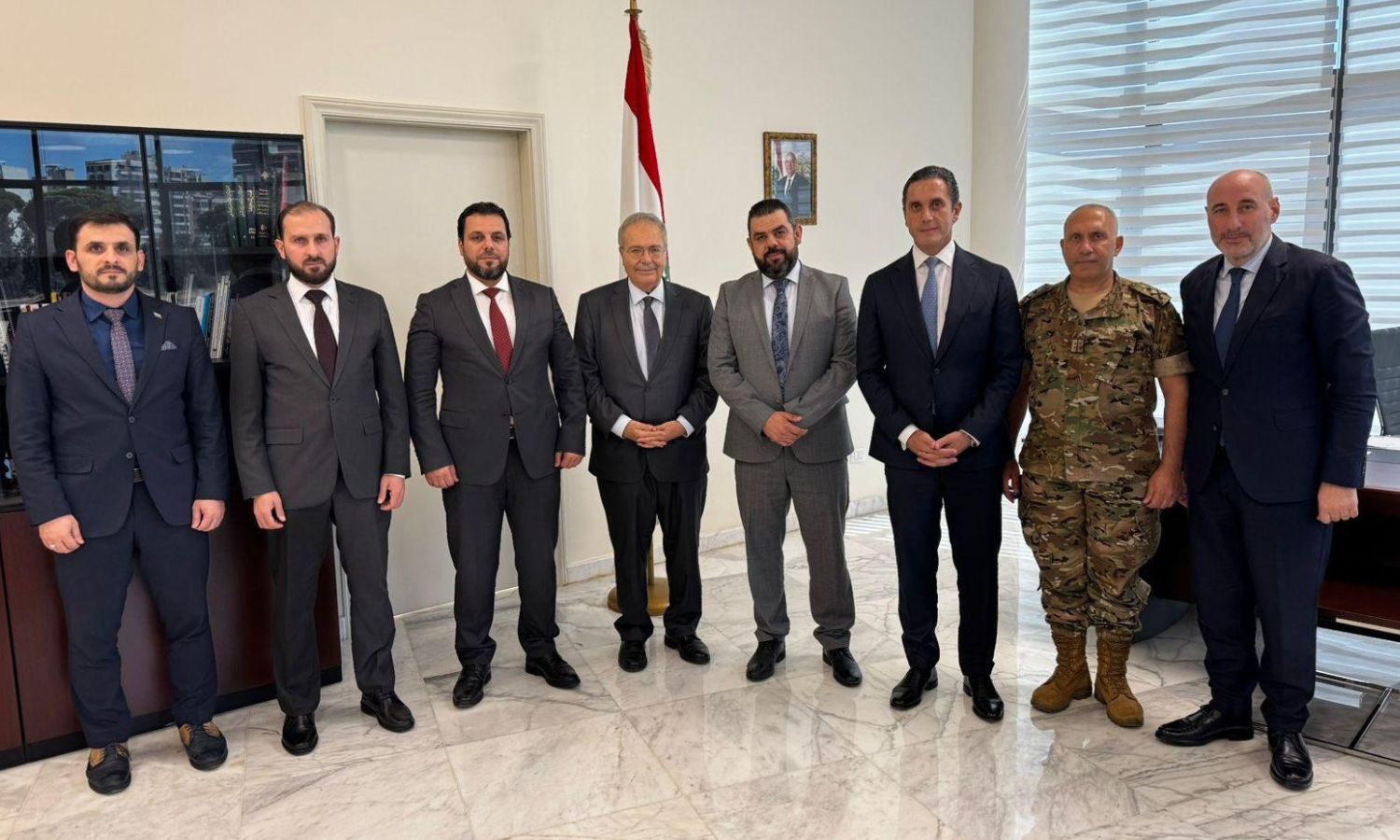
 Mohammad Yaqoub al-Omar, Director of the Consular Department at the Syrian Foreign Ministry, meets with Lebanese Deputy Prime Minister Tarek Mitri – September 1, 2025 (Mohammad al-Omar/X)
Mohammad Yaqoub al-Omar, Director of the Consular Department at the Syrian Foreign Ministry, meets with Lebanese Deputy Prime Minister Tarek Mitri – September 1, 2025 (Mohammad al-Omar/X)
Enab Baladi – Amir Huquq
The issue of Syrian detainees in Lebanese prisons has witnessed renewed momentum after years of stalemate, with the reopening of coordination between the Syrian and Lebanese governments following the fall of the Assad regime, and the launch of direct channels to discuss this humanitarian-political file.
Lebanese Justice Minister Adel Nassar said it is possible to reach an agreement with Syria regarding detainees, stressing that Lebanese families have the right to know the fate of their children detained in Syria, while Syria demands the release of Syrians held in Lebanon.
In an interview with the Saudi-owned al-Hadath TV on September 20, Nassar stated that cooperation must be reciprocal and comprehensive, conducted within each country’s legal framework.
For his part, Syrian Justice Minister Mazhar al-Wais described the issue of Syrian detainees in Lebanon as a fundamental matter of special concern for the Syrian government, affirming that it is being followed under a comprehensive plan.
He noted that in recent weeks several consultations and meetings had been held with the Lebanese side, expressing readiness for cooperation, according to a post he published on X on September 22.
The statements by both ministers gave priority to the detainee issue, which has topped Syrian-Lebanese discussions since the fall of the former regime, signaling that official engagement by the two states has begun to move in a practical direction.
Mohammad Sablouh, lawyer and director of the Cedar Center for Legal Studies in Lebanon, told Enab Baladi that the Syrian detainee issue in Lebanon began years ago as media campaigns and advocacy demands, but has now entered the realm of actual discussion following official exchanges of visits between Beirut and Damascus. This, he said, has broken a long-standing state of inertia and opened the door to the possibility of resolving this humanitarian matter.
Sablouh explained that the main problem lies in contradictions within Lebanon itself, where the issue of Syrian detainees is used to cover up other files, foremost among them accusations of “killing army personnel,” which he argued are exaggerated and fabricated by security services.
According to Sablouh, since 2011, Lebanese security agencies have carried out widespread violations, including fabricating cases against Syrians opposing the Assad regime, branding them as terrorists, forcing them to sign confessions under torture, and threatening their families, using degrading and inhumane methods.
Political analyst Hossam Taleb argued that the case of Lebanese detainees in Syrian prisons for more than four decades differs fundamentally from that of Syrian detainees in Lebanon.
After the regime’s fall, prisons were opened and no trace of Lebanese detainees was found, suggesting they no longer exist, he said. Otherwise, they would have been released alongside Syrian and Jordanian detainees held for 30 or 40 years, as seen when Sednaya prison was opened.
By contrast, the Syrian detainee issue in Lebanon is recent and humanitarian, Taleb said. He argued that they committed no crimes or violations of Lebanese law; their “only offense” was opposing Bashar al-Assad’s regime, and they were arrested at the request of Hezbollah during its period of dominance in Lebanon.
Taleb stressed that Syrian detainees endure harsh psychological and health conditions in Lebanese prisons, while Damascus demands their immediate release as political prisoners. He added that Syria has never requested the handover of Syrians involved in criminal cases such as theft or smuggling, limiting its demands to political detainees.
The Lebanese minister’s remarks sparked controversy among rights groups, as they lumped together Lebanese detainees in Syria and Syrians in Lebanon. Activists and analysts argued that the two cannot be treated under a single framework.
Sablouh criticized Minister Nassar, noting that he personally handed him documents and evidence of abuses, yet the minister did nothing, while issuing contradictory media statements calling to close the chapter of the past and release Lebanese detainees in Syria accused of killing thousands of civilians, while ignoring innocent Syrian detainees in Lebanon.
He said such contradictions undermine the credibility of the Lebanese state, stressing that the only viable path is transitional justice that acknowledges violations and provides reparations.
Families of Syrian detainees feel doubly wronged, Sablouh added, seeing that some of their sons’ fellow activists now hold leadership positions in Syria’s new government, while their own sons remain imprisoned in Lebanon on fabricated charges.
He described the Syrian minister’s stance as logical, since these detainees were never convicted of genuine crimes but paid the price for their opposition to the Assad regime.
“There can be no equation between executioner and victim,” Sablouh stressed, arguing that Syrian detainees in Lebanon are victims of a security and judicial system linked to the Syrian regime, while Lebanese detainees in Syria were involved in killings, smuggling, and massacres against civilians.
Taleb agreed, saying the contrast between the two justice ministers’ remarks reflected the differing realities of the detainee files. While the Lebanese minister’s talk amounted to a waste of time, he argued, the Syrian minister’s position was both logical and fair, framing the matter as a humanitarian issue.
He warned that the continued detention of political prisoners damages relations between the two peoples and states and risks fueling popular tensions.
Sablouh further stressed that addressing only the Syrian detainee issue would not be fair, insisting it must form part of a broader reform through a new law establishing transitional justice for all prisoners, Lebanese and Syrian alike, to put an end to fabrications and abuses.
He accused Hezbollah of trying to exploit the file politically, by inflating detainee numbers or fabricating terrorism cases, to strengthen its bargaining power with Syria and the international community.
“Justice is indivisible,” he concluded, warning that any partial solution would lead to unrest in Lebanese prisons. He called for acknowledging past violations and correcting them through a comprehensive transitional justice process that would lift injustice from victims and lay the foundations for a new phase in Lebanese-Syrian relations.
According to informed sources, joint committees from both Syria and Lebanon already hold clear lists of detainees and reasons for their detention, requiring swift resolution without bureaucracy or delay, in line with international law and the Geneva Conventions, Taleb said.
He added that Damascus considers cases involving detainees accused of drug or arms smuggling as entirely separate, since they are criminal matters unrelated to the political file or Hezbollah.
In his view, resolving the issue of Syrian political detainees in Lebanon has become an urgent humanitarian necessity and a key condition for any progress in bilateral relations between Beirut and Damascus.
Political researcher Firas Allawi argued that both sides have set conditions for resolving detainee issues, and that political or technical complications have so far prevented agreement between the two justice ministers. He said the matter requires deeper, longer negotiations to bridge the differences.
He emphasized the need to separate Syrian political detainees in Lebanon from those accused of other offenses, as well as to distinguish Lebanese detainees in Syria during Assad’s rule. Each file, he stressed, must be handled separately.
Allawi added that the Syrian government may not hold all the documents related to Lebanese detainees during the previous regime’s era, and that the detainee issue on both sides should be dealt with independently of political and economic matters, since it is purely humanitarian.
The cases of Syrian detainees in Lebanon and missing Lebanese in Syria have topped talks between the two countries. The first round began with a Syrian Foreign Ministry delegation visiting Beirut on September 1, followed by a Lebanese government delegation traveling to Syria to follow up.
Lebanese Justice Minister Nassar said that committees formed after the Syrian delegation’s visit to Beirut held a meeting in Damascus on September 8.
On September 1, a Syrian delegation visited Beirut to discuss pending issues, chiefly the fate of Syrian detainees in Lebanese prisons and border demarcation, and met Lebanese Deputy Prime Minister Tarek Mitri.
The two sides agreed to form committees to determine the fate of about 2,000 Syrians held in Lebanese prisons and to locate Lebanese citizens missing in Syria for years, in addition to addressing border demarcation, according to the Associated Press.
if you think the article contain wrong information or you have additional details Send Correction





 A
A
A
A
A
A


 More Politics