


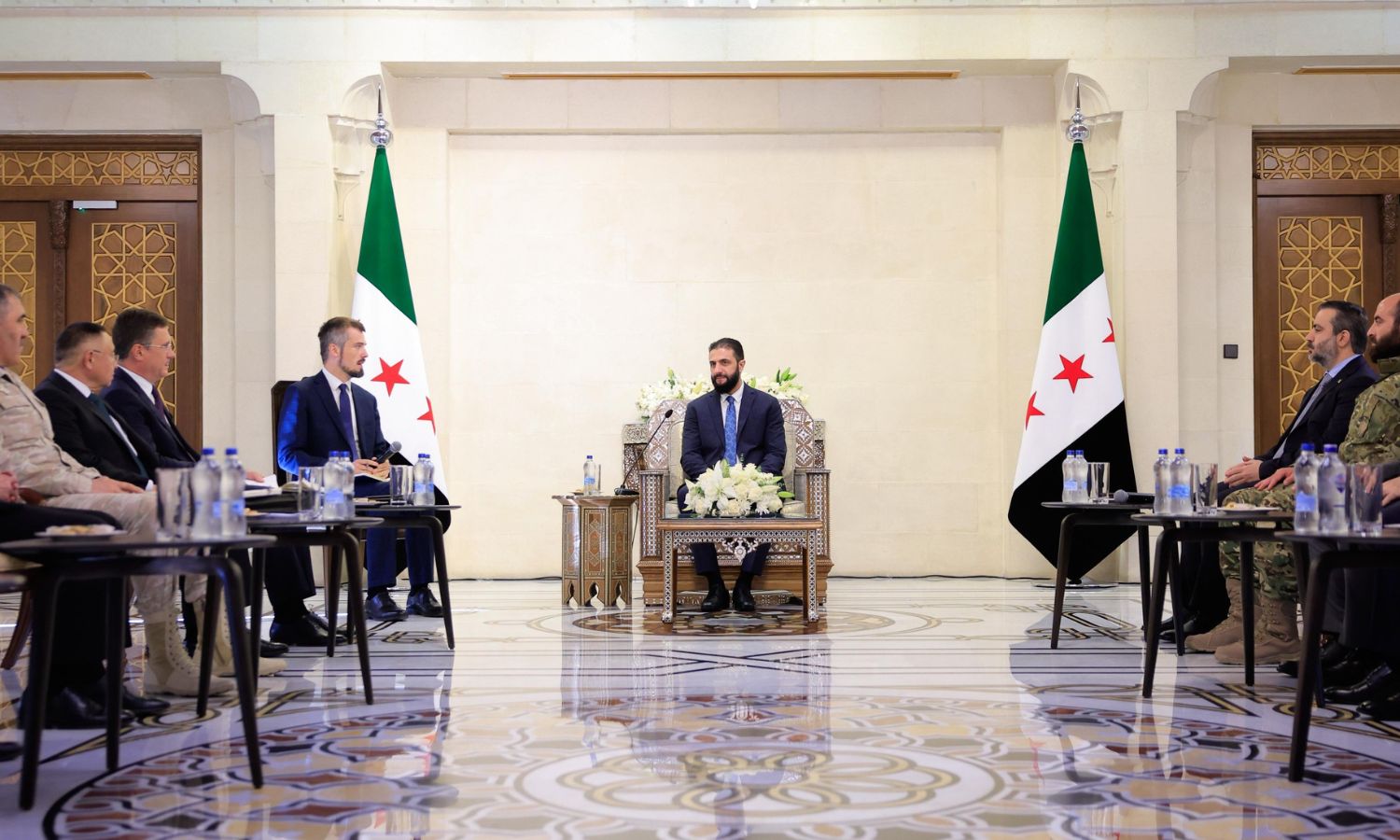
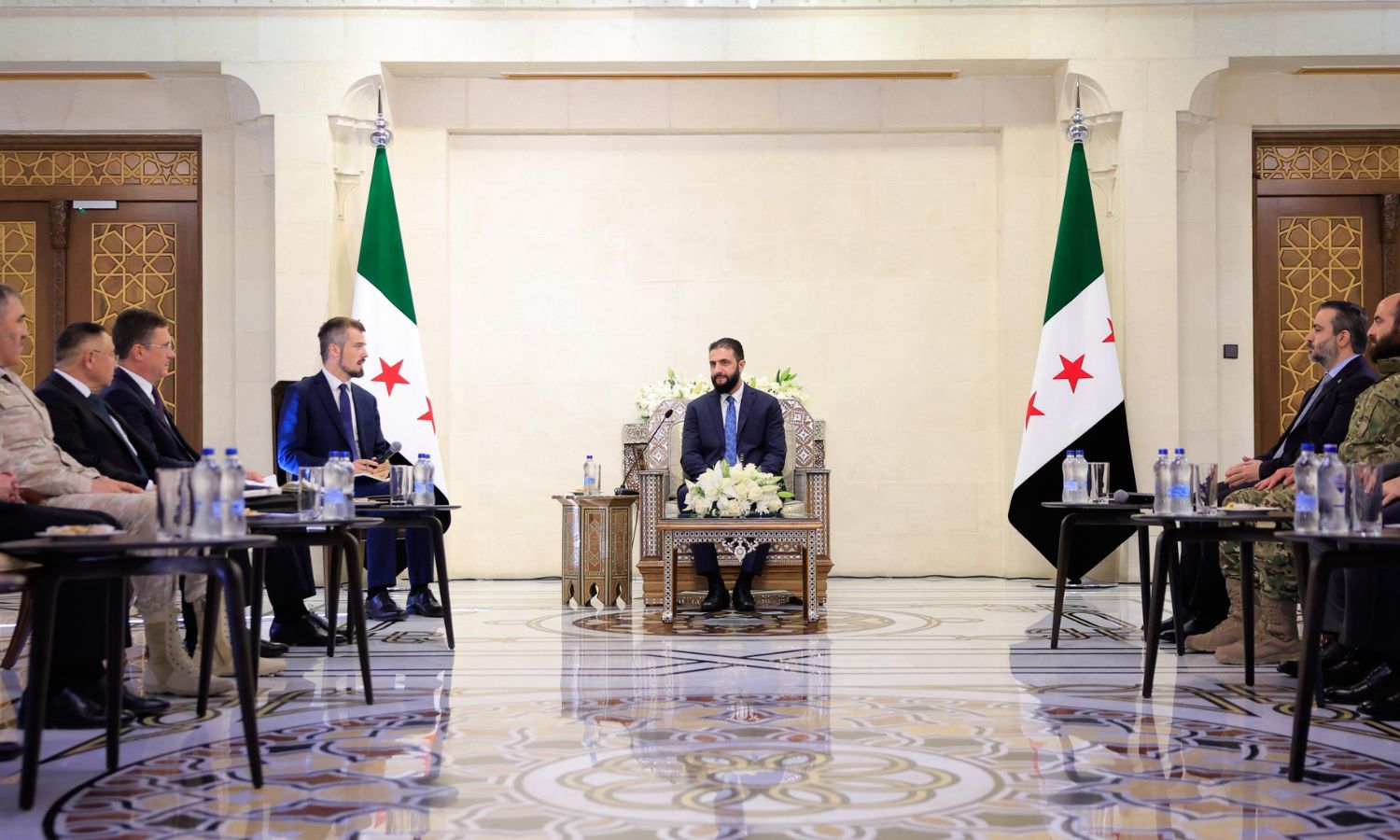
 Syrian President Ahmad al-Sharaa meets Russian Deputy Prime Minister Alexander Novak in Damascus – September 9, 2025 (Syrian Foreign Ministry)
Syrian President Ahmad al-Sharaa meets Russian Deputy Prime Minister Alexander Novak in Damascus – September 9, 2025 (Syrian Foreign Ministry)
Enab Baladi – Amir Huquq
Signs of a revival in Syrian–Russian relations have surfaced in recent weeks, following Syria’s political shift in late 2024 after the fall of Bashar al-Assad’s regime, which Moscow had long supported.
The latest developments raise questions about whether ties between Damascus and Moscow are genuinely returning to their pre-2024 levels, or whether regional and international dynamics, along with political and economic interests, will instead shape new balances.
On September 9, Syrian Foreign Minister Asaad al-Shibani met a Russian delegation in Damascus led by Russian Deputy Prime Minister Alexander Novak. Al-Shibani said Syrian–Russian relations were “deep and marked by friendship and cooperation, though lacking balance,” stressing that Russia’s “clear support” for Syria’s new path would benefit both Syria and the region.
Novak noted that ties with Syria are being developed under the direct supervision of Russian President Vladimir Putin, calling Syria a promising country in the Middle East. He said the new historical stage will see relations based on mutual respect, emphasizing the importance of bilateral cooperation.
Political observers see a marked diplomatic rapprochement between Syria and Russia. Initially, many expected the new Syrian authorities to distance themselves from Moscow, especially amid U.S. reluctance and European conditions that opposed Russia’s renewed influence in Syria.
Dmitry Bridzhe, director of the Russian Studies Unit at the Arab-Eurasian Studies Center, told Enab Baladi that post-Assad relations are entering a sensitive phase. He said this is not a mere continuation of the past but a “reframing of relations requiring mutual testing.”
Bridzhe noted there is legitimate public criticism of the rapprochement, with concerns that Russia’s role could evolve into long-term contracts that limit Syrian sovereignty and perpetuate dependency. Yet, he added, Russia has unique practical advantages: restarting the energy sector, supplying wheat and medicine, and rebuilding key infrastructure, making it an indispensable partner if Syria wants to quickly meet citizens’ needs.
Political writer Darwish Khalifa said the emerging ties reflect urgent needs on both sides, in a scene marked by clarity. He recalled that only months ago Russia was branding the current authorities (then represented by Hayat Tahrir al-Sham) as a “terrorist group,” noting the irony that one of Moscow’s main justifications for its “Deterring Aggression” operation that toppled Assad was an airstrike on a mosque where children were learning the Quran.
Analysts have linked Damascus’ turn toward Moscow to its desire for political backing, especially after Western and European rhetoric hardened in the wake of events in Suwayda (southern Syria).
Bridzhe argued that Syria’s motives are clear: the West has offered only sanctions and pressure, without any realistic rescue program. By contrast, Russia still benefits from historical Soviet-era ties, which carry credibility in Syrian national memory.
He added that the unrest in Suwayda accelerated the pivot, highlighting Europe’s and Washington’s limited influence on the ground. In his view, Syria needs practical alternatives that ensure security and stability.
He said the mutual benefits are evident: Syria gains strategic, economic, and military support to boost its domestic position and counter Israeli attacks, while Russia secures entrenched influence in the eastern Mediterranean and a stronger Arab partner in the region. Still, he cautioned that the true value of such ties will only emerge if they are grounded in transparent institutions and timelines, not vague backroom deals.
Suwayda province had witnessed mutual kidnappings between local factions and Bedouin tribes in July, escalating into clashes that drew government intervention. The government later withdrew after Israeli airstrikes targeted its positions in Suwayda and Damascus, while local factions committed violations against Bedouins, sparking anger among tribes who sent convoys to the province. On August 16, protests in Suwayda’s “Karama Square” demanded “self-determination” and even raised Israeli flags.
According to Khalifa, Damascus’ pivot toward Moscow also aims to diversify alliances, gain international legitimacy, and secure Russian support at the UN Security Council, particularly if proposals arise to lift UN sanctions on transitional president Ahmad al-Sharaa and his ministers. Syria also wants to avoid renewed pressure over its inherited Soviet-era debts.
Khalifa suggested the rapprochement may have been encouraged by Turkey, the Syrian government’s main ally, to help deter Israeli attacks on southern Syria or at least curb Israeli Prime Minister Netanyahu’s ambitions to weaken Syria beyond repair.
He added that both Moscow and Damascus have an interest in keeping communication open, allowing Syria to balance its partnerships between East and West. Western states oppose the move, but without Syria, Putin risks losing his last Mediterranean foothold after Assad’s fall.
On September 10, the Syrian embassy in Moscow confirmed to Russia’s Sputnik news agency that transitional president Ahmad al-Sharaa will head Syria’s delegation to the upcoming Russian–Arab summit in October.
The visit had already been announced during the September 9 press conference of Syrian Foreign Minister Asaad al-Shibani with the Russian delegation in Damascus, headed by Deputy Prime Minister Alexander Novak.
During al-Shibani’s earlier visit to Moscow on July 31, Russian Foreign Minister Sergey Lavrov said Russia was looking forward to the Syrian president’s participation in the upcoming Russian–Arab summit, scheduled for October 15.
Dmitry Bridzhe director of the Russian Studies Unit at the Arab-Eurasian Studies Center and a political analyst, described President Ahmad al-Sharaa’s anticipated visit to Moscow as a defining moment. He noted that it will be the new president’s first official trip to a major power that was once an ally of the former regime, making it a “double test.”
Al-Sharaa is expected to meet Russian President Vladimir Putin privately, with sensitive issues on the table, including rules of aerial engagement, limiting Israeli attacks, restructuring the military and security institutions, and devising ways to finance energy and food projects that bypass sanctions, according to Brejaj.
He added that the equation ultimately lies in balancing criticism with support—criticism is needed to avoid repeating past patterns, while support is essential because Syria needs a partner capable of delivering tangible results in months, not years.
Bridzhe concluded that the success of this path will be measured by the ability of both sides to turn slogans into institutions, promises into electricity, medicine, and bread for citizens, and political papers into mechanisms that protect sovereignty and open the way for a more stable future.
A private meeting between Putin and al-Sharaa on the sidelines of the Russian–Arab summit is meant to signal that Russia has always supported the Syrian state and people, regardless of who holds power, according to political writer Darwish Khalifa.
He believes both sides have the will to reshape their relations on new foundations, ones that do not isolate Damascus from Western capitals but at the same time preserve a degree of independence for Syria, away from Western pressures that have begun to surface in rights reports addressing events in the coast and Suwayda over the past six months.
On May 17, Russian President Vladimir Putin invited all Arab League leaders to attend the first Russian–Arab summit.
In a statement published by the Kremlin at the time, Putin said Russia intends to continue developing constructive dialogue with the Arab League and to build friendly relations with all its members. He stressed that the Russian–Arab summit will contribute to further strengthening multi-faceted cooperation that benefits all states, while helping ensure peace, security, and stability in the Middle East and North Africa.
if you think the article contain wrong information or you have additional details Send Correction


 A
A
A
A
A
A




 More Politics