


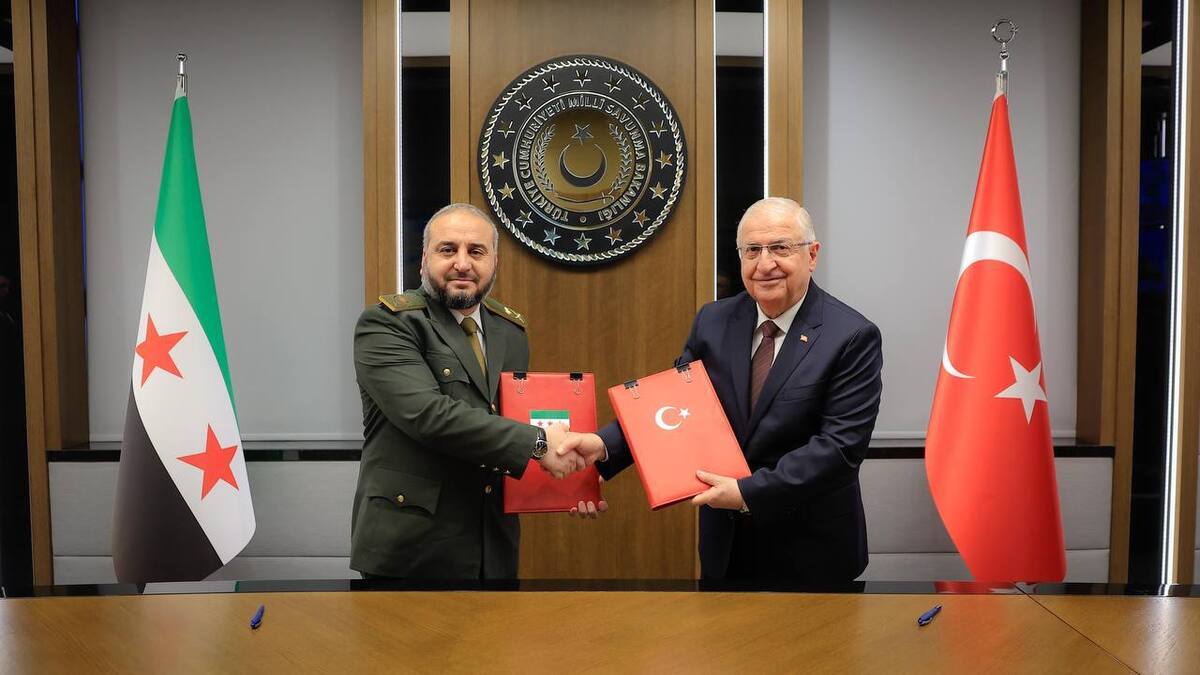
 Military cooperation agreement reflects Turkey's continued will to support Syria in “fighting terrorism” – August 14, 2025 (Syrian Ministry of Defense)
Military cooperation agreement reflects Turkey's continued will to support Syria in “fighting terrorism” – August 14, 2025 (Syrian Ministry of Defense)
Enab Baladi – Omar Alaa Eldin
Damascus and Ankara signed a military training and consultancy agreement between the Syrian and Turkish Ministries of Defense at a time when both sides hinted at escalation on the “SDF file” in northeastern Syria following stalled negotiations.
On Wednesday, August 13, the two sides signed an agreement, includes training courses, programs, and technical assistance aimed at enhancing and developing the capabilities of the Syrian army.
According to SANA, the agreement is part of the effort to develop the Syrian army by training its members professionally and according to international standards, reducing the risk of violations by untrained factions.
SANA outlined the agreement’s content as follows:
Regular Exchange of Military Personnel: Participation in specialized training courses to raise operational readiness and enhance the ability to work jointly.
Training in Specialized Skills: Programs in areas including counter-terrorism, demining, cyber defense, military engineering, logistics, and peacekeeping operations, all aligned with international best practices.
Technical Assistance: Deployment of expert consultants to support the modernization of military systems, organizational structures, and command capabilities.
The agreement marks a shift in Ankara’s approach toward relations with the new Damascus government, according to Mohsen al-Mustafa, a military-security affairs researcher at the Omran Center for Strategic Studies.
“In Ankara’s approach to the new Syria, there is a transition from previous support for certain opposition factions to an institutional partnership with the Syrian state,” he told Enab Baladi, noting this sets a new trajectory in Syria–Turkey relations.
Al-Mustafa expects the agreement to bolster the Syrian government’s role in maintaining internal security and balance, within a shared vision of rebuilding military institutions.
On August 14, the Turkish Ministry of Defense reiterated its support for Syria’s political unity and territorial integrity and endorsed the Syrian government’s calls for “one state and one army,” Turkish agency Anadolu reported.
It described the memorandum as “a continuation of the Turkish will to support Syria in counter-terrorism and strengthening its defensive and security capabilities.”
Despite political will and shared security threats, al-Mustafa sees the likelihood of a full-fledged joint defense accord between Syria and Turkey as limited in the near term.
He cites substantial obstacles:
Saudi channel al-Sharq reported in late May that “advanced discussions” had taken place between Syrian President Ahmad al-Sharaa and Turkish President Recep Tayyip Erdoğan during Sharaa’s May 24 visit to Ankara. These discussions reportedly included a draft joint defense agreement—the first such move since the fall of Assad in December 2024.
Sources suggested the agreement aims to pave the way for Turkish military bases in Syria, beginning with an infrastructure for training the “new Syrian army,” albeit without public declaration as previously planned—possibly in light of Israeli airstrikes on T-4 and Shayrat airports on March 21. The initiative reportedly emerged from broader understandings involving coordination with Moscow.
The meeting was held behind closed doors with no official statement; the Syrian presidency only mentioned that “several joint dossiers” were discussed.
Reuters reported that under the agreement, Turkey will supply weapon systems and logistical tools, and provide training if needed.
Turkey’s support includes military equipment, weapons systems, and logistical materials, as well as training and advisory services, reinforcing its commitment to Syria’s interim government
According to al-Mustafa, expected equipment may include logistical support systems, light armored vehicles, monitoring and communication technologies, and possibly limited air defense support. While these could incrementally improve the efficiency of the Syrian army—especially in stable areas—he does not anticipate a radical shift in regional power dynamics unless accompanied by advanced aerial or sophisticated systems, which the agreement does not explicitly include
Even the introduction of advanced air defense systems would not alone transform the strategic balance without consideration of the surrounding political and operational framework.
The British news outlet Middle East Eye reported in April, citing unnamed informed sources, that Turkey is preparing to build an air defense base at the Tiyas (T4) military airport near Palmyra in central Homs province, Syria.
According to the report, Ankara’s goal in establishing the base is to strike Islamic State (ISIS) cells and deter Israeli air raids on Syria.
The sources said a “Hisar” air defense system will be deployed at the T4 airbase to provide aerial coverage, enabling Turkey to consolidate air control over the area and bolster its operations against ISIS, which still maintains active cells in the Syrian desert.
Turkey also aims to set up a multi-layered air defense system at and around the base, with short-, medium-, and long-range capabilities to counter a range of threats—from fighter jets to drones to missiles.
The outlet noted that the presence of Turkish air defense systems and drones is likely to deter Israel from carrying out airstrikes in the area.
Damascus and Ankara are hinting at possible escalation regarding the Syrian Democratic Forces (SDF) in northeast Syria after negotiations between the two sides stalled.
Prior to the signing of the defense agreement between the Syrian and Turkish ministries of defense, Syrian Foreign Minister Asaad al-Shibani met with his Turkish counterpart Hakan Fidan.
According to Turkey’s Anadolu Agency, the meeting addressed the course of Syria’s political process and key security issues, most notably the activities of the Kurdistan Workers’ Party (PKK) and the SDF in northeast Syria, in addition to the situation on the ground in Suwayda province.
At a joint press conference with al-Shibani, Fidan warned that failure to meet Turkey’s security demands in Syria makes it “impossible to maintain calm,” calling on the SDF to halt what he described as “direct threats to Turkey and the region.”
For his part, al-Shibani warned against “attempts to divide the country along sectarian and ideological lines,” stressing his government’s commitment to stability through dialogue with all components.
Observers noted that Ankara’s rhetoric, both before and after the signing of the agreement, focused directly on the SDF, which appeared to sideline the Suwayda file and Israel’s repeated threats.
However, Mohsen al-Mustafa, a researcher at the Omran Center, argued that the emphasis on the SDF does not mean ignoring Suwayda or Israeli threats. Instead, it reflects Turkey’s priority of preventing the SDF from establishing a separate political-military reality, he told Enab Baladi.
According to al-Mustafa, Suwayda’s exclusion from the agreement stems from demographic and political considerations. He added that the “front with Israel” remains subject to complex regional calculations that the agreement neither endorsed nor rejected, reflecting, in his view, “a Turkish desire to avoid direct escalation on that front.”
Former Israeli ambassador Michael Harari echoed concerns from Tel Aviv, noting Israel’s fear of the emergence of an “extremist Islamist government” and of “excessive Turkish influence in Syria.”
Writing in al-Majalla magazine, Harari said that while Israel acknowledges Turkey’s role and its “assertive” intervention in northern Syria—particularly in Kurdish-held areas—Tel Aviv has seemingly drawn a “red line” against Turkish military presence elsewhere in the country.
Conversely, Harari argued, Turkey sees a “historic opportunity” to secure its border with Syria on its own terms, especially regarding the Kurdish question, including the PKK, while simultaneously increasing the Syrian regime’s reliance on Ankara.
Despite Israel’s demonstrated military and technological superiority, Harari said Turkey does not see this as an obstacle, instead viewing the present moment as its golden opportunity to strengthen its regional standing.
if you think the article contain wrong information or you have additional details Send Correction


 A
A
A
A
A
A


 More Politics