


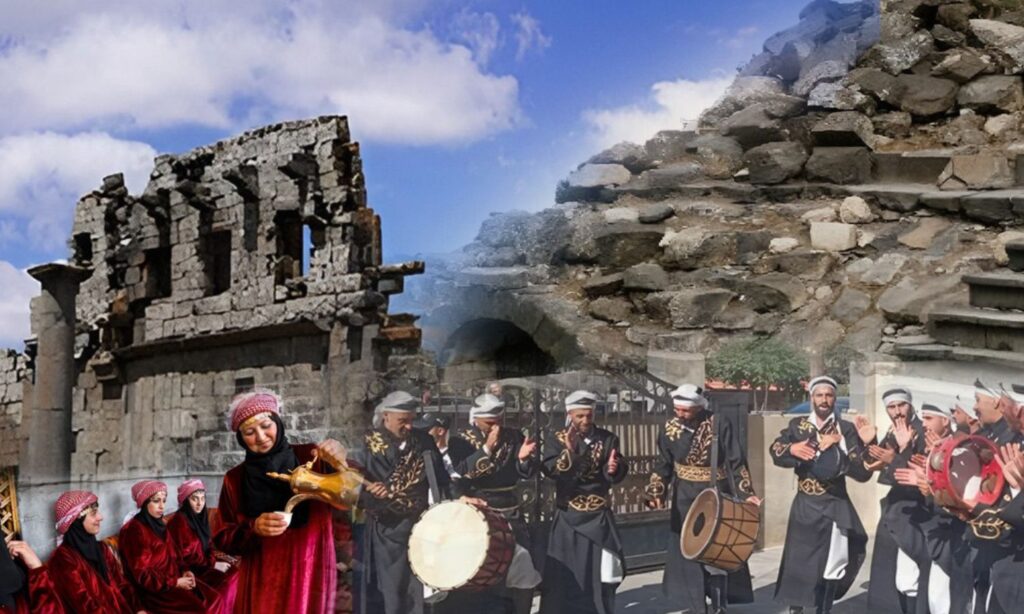
 The shared heritage in southern Syria is not limited to cuisine, hospitality, and weddings but also extends to include traditional folk singing (Enab Baladi edit)
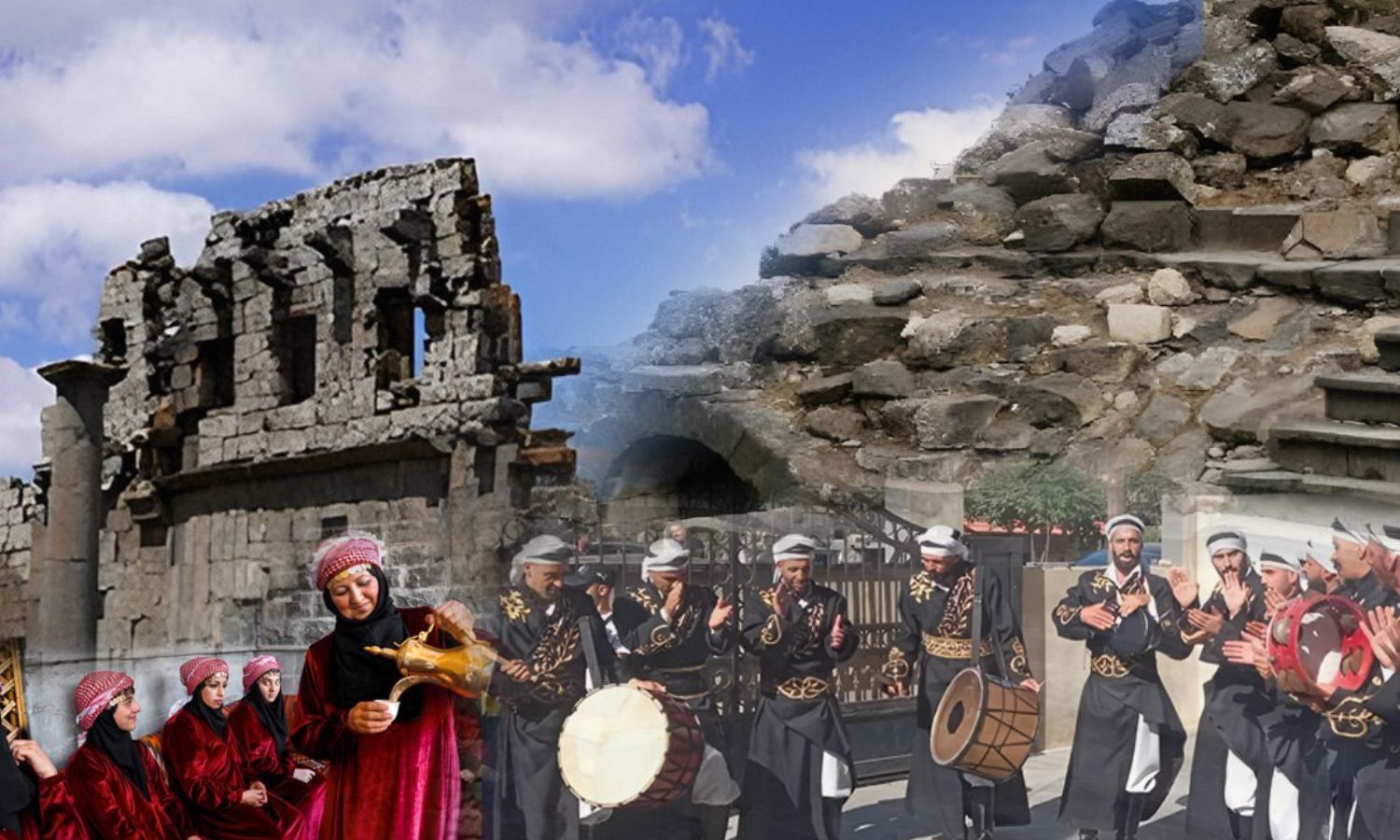
The shared heritage in southern Syria is not limited to cuisine, hospitality, and weddings but also extends to include traditional folk singing (Enab Baladi edit)
Enab Baladi –Christina al-Shammas
The folk heritage of southern Syria, spanning Daraa and Suwayda (southern Syria), forms a cornerstone for preserving a collective Syrian identity. Despite religious and social diversity, the shared customs and values of both provinces reflect a long history of coexistence and cooperation.
Over time, guest houses, weddings, traditional dress, folk songs, and communal dishes have become part of a collective memory. These shared traditions have demonstrated that geographic proximity has grown into deep-rooted human and cultural bonds capable of withstanding the hardships brought on by the country’s security turmoil.
The al-madafa (guest house) is considered the heart of social life in Daraa and Suwayda. It is a dedicated room or separate building to host visitors, with doors open around the clock. A stranger does not need an invitation—he is always welcomed as a guest.
In southern culture, the madafa is not only for hospitality but also for resolving disputes and holding reconciliation councils.
Suleiman al-Labid, a resident of Suwayda, told Enab Baladi that madafas are a place to welcome guests, hear their requests, provide shelter in times of crisis, and distribute food and drink to neighbors during hardships.
The madafa embodies social generosity, with Arabic coffee always present. Serving a cup signals hospitality and respect. “In the south, a cup of coffee could seal forgiveness in reconciliation gatherings,” said Suleiman.
Suleiman emphasized that generosity in the south is not merely a custom but an inherited identity. Visitors to any village in Daraa or Suwayda will not leave without being offered food and drink, as if every home is a small madafa.
At weddings, sheep are slaughtered, and villagers gather to prepare feasts collectively, cooking and serving together.
He recalled stories of travelers passing through southern villages who found doors open to them, receiving food and shelter without being asked about their identity. This illustrates that generosity is not an individual act but a deeply rooted social tradition.
Among the symbols of this generosity is madafa al-melihi, a communal dish central to both Muslim and Christian communities of the south. It is prepared with ingredients tied to the region’s land and economy: dried yogurt (jameed), lamb, bulgur, and flatbread topped with clarified butter (samn).
The dish is eaten communally by hand, symbolizing solidarity and sharing.
Um Wael al-Balou, from the village of al-Masmiyah in Daraa, said the dish holds great significance for Hauran’s people of both the plain and the mountain. She described how women work together to prepare the dried yogurt while men slaughter sheep and prepare the meat. “In our weddings, joy is incomplete without mansaf al-melihi. A guest’s honor is measured by how he is served this dish,” she said.
Jawfiyyat is a distinctive celebratory tradition in Daraa and Suwayda. It is a collective expression of joy and solidarity, with men and women participating together.
Dozens, sometimes more than a hundred men, gather in a large circle at weddings to chant jawfiyyat songs praising the groom and his family. Their synchronized voices create both solemnity and festivity. Women join by waving white scarves and dancing in the circle, making the event a communal rather than family-only celebration.
Ghassan Breik, from the border village of Khriba between Daraa and Suwayda, told Enab Baladi that jawfiyyat is like an official declaration of joy: “A wedding is not complete without it. It announces that the groom has become head of his household and that the entire village shares his happiness.”
He added that women would rush to carry scarves and dance alongside men, considering jawfiyyat a moment of pride and heritage. In the past, the chants were so loud they could be heard from neighboring villages, signaling that a wedding was taking place.
Southern heritage extends beyond food, hospitality, and weddings to include folk songs performed with the rababa (traditional string instrument), telling stories of generosity, courage, and honor.
The people of Daraa and Suwayda also share traditional dress. Men often wear the loose sherwal trousers for work, the jallabiya at home, and in formal settings, a headband (iqal) with a scarf (shemagh or qadoudah).
Women’s clothing is known for detailed embroidery, with a head covering or shawl. Dresses vary depending on the occasion—elaborate and ornate for weddings, simpler for daily life—with differences shaped by age, social setting, and religion.
Another inherited practice is al-‘awneh (communal labor), where villagers join forces in farming or construction. This reflects the solidarity and mutual support binding the two provinces.
Religious occasions also carry social traditions, as families prepare feasts and exchange visits regardless of sectarian differences.
The shared heritage of Daraa and Suwayda serves as a bridge between generations. Despite crises and hardships, both provinces preserve a living record of historical ties and similar revolutionary stances, proving that the values uniting the south are stronger than the circumstances threatening to divide it.
Ghassan Breik
from the border village of Khriba between Daraa and Suwayda
if you think the article contain wrong information or you have additional details Send Correction


 A
A
A
A
A
A



 More Society