


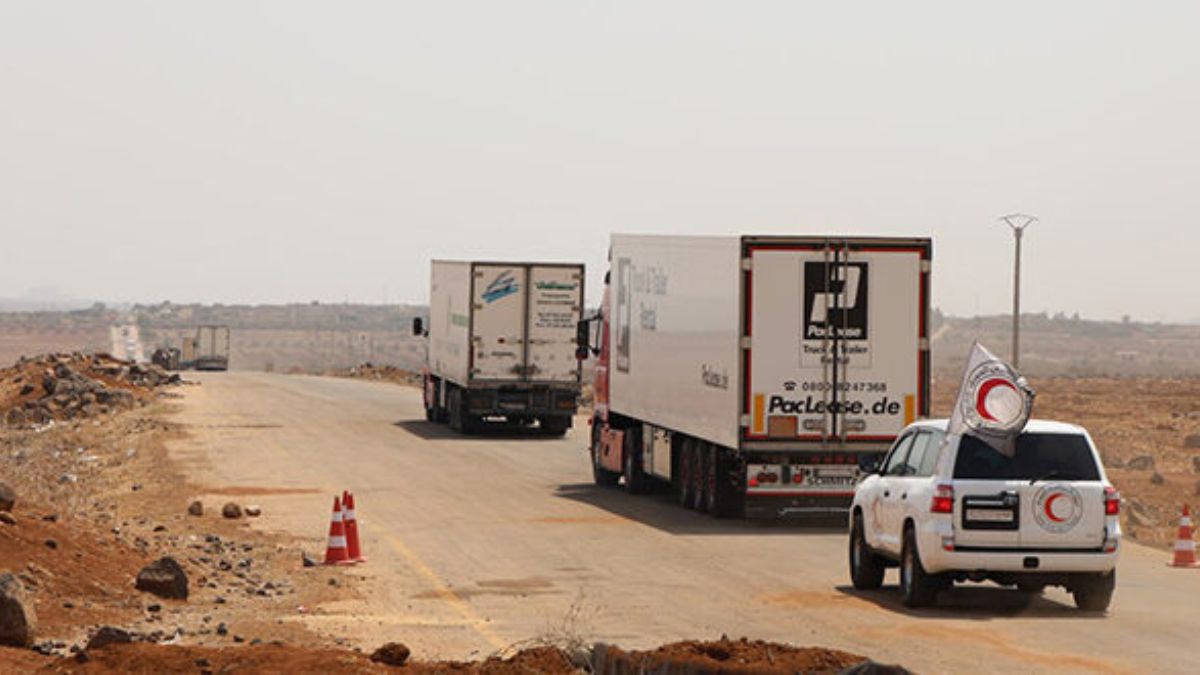
 A humanitarian convoy carrying relief, medical, and food aid, including seven dialysis machines, enters the city of As-Suwayda – August 13, 2025 (SANA).
A humanitarian convoy carrying relief, medical, and food aid, including seven dialysis machines, enters the city of As-Suwayda – August 13, 2025 (SANA).
A humanitarian convoy of 21 trucks carrying relief, medical, and food supplies, along with fuel, entered As-Suwayda province on Wednesday, August 13.
Enab Baladi’s correspondent in Daraa reported that, for the first time since last month’s outbreak of unrest in the province, seven dialysis machines were delivered to As-Suwayda Hospital via the Bosra al-Sham crossing. The convoy also included food items, bottled drinking water, vegetables, flour, and tankers carrying fuel and gas.
On August 10, As-Suwayda Governorate announced the arrival of three gas tankers, totaling around 51,000 liters, to support residents’ essential needs.
A relief and food aid convoy entered As-Suwayda province under the supervision of the Syrian Arab Red Crescent, according to a post by the governorate on Facebook.
Enab Baladi’s correspondent in Daraa reported at the time that the aid convoy consisted of 12 trucks carrying food supplies such as rice, bulgur, lentils, oil, and ghee.
The correspondent said the security situation remains “cautiously calm,” with no clashes reported in the past two days. Internal security forces in Daraa were facilitating the return of 30 people from As-Suwayda—mostly elderly—to the province and to Jaramana in rural Damascus, under armed escort.
These returns follow their protection by internal security forces after the recent events in As-Suwayda; the individuals were being housed in the former military security building in Daraa.
Earlier this month, clashes broke out in several rural areas of western As-Suwayda, including al-Mazraa, Majdal, Najran, and Dweir, between local factions and internal security forces, leaving casualties among tribal fighters.
The Syrian Ministry of Foreign Affairs announced the creation of a tripartite working group comprising Damascus, Amman, and Washington to support Syrian government efforts to consolidate the ceasefire in As-Suwayda and end the crisis.
According to a joint statement issued after a meeting between Syrian Foreign Minister Asaad al-Shibani, Jordanian Foreign Minister Ayman Safadi, and US Special Envoy to Syria Thomas Barrack on August 12, the United States welcomed Syrian government commitments to:
Conduct full investigations and hold accountable all perpetrators of crimes and violations in As-Suwayda, with UN agency involvement in the process.
Increase and facilitate the entry of humanitarian aid across the province, in coordination with relevant UN agencies.
Intensifying the work of service institutions to restore services disrupted by the events in the governorate.
The statement described the meeting as a continuation of the Amman talks held on July 19, which produced the initial ceasefire agreement between the Syrian government and local factions.
The meeting came within the framework of trilateral cooperation between the United States, Jordan, and Syria to support stability on the ground and maintain regional security.
On August 9, the three sheikhs of the Druze community in As-Suwayda issued statements declaring clear positions against the Damascus government, marking a shift by Sheikhs Yusuf al-Jarbou and Hammoud al-Hinawi from a previously conciliatory, middle-ground stance to the position adopted by Sheikh Hikmat al-Hijri.
The governorate of As-Suwayda has witnessed mutual violations between the Syrian government and fighters from Bedouin tribes, as well as local factions in the province.
The events began on July 12 with reciprocal kidnappings between local factions and residents of the al-Maqous neighborhood in As-Suwayda, which is predominantly inhabited by Bedouins.
Tensions escalated into mutual clashes, prompting government intervention. The government forces later withdrew after Israel targeted its positions in As-Suwayda and Damascus. Local factions then resumed violations against the Bedouins, sparking anger among tribal circles, which sent convoys into As-Suwayda.
The situation in As-Suwayda is now moving toward calm following a ceasefire agreement, although the province continues to suffer from dire humanitarian conditions.
The Syrian government faces accusations of imposing a humanitarian and military blockade on As-Suwayda, which it denies, affirming that it is able to send aid.
if you think the article contain wrong information or you have additional details Send Correction


 A
A
A
A
A
A


 More Politics