


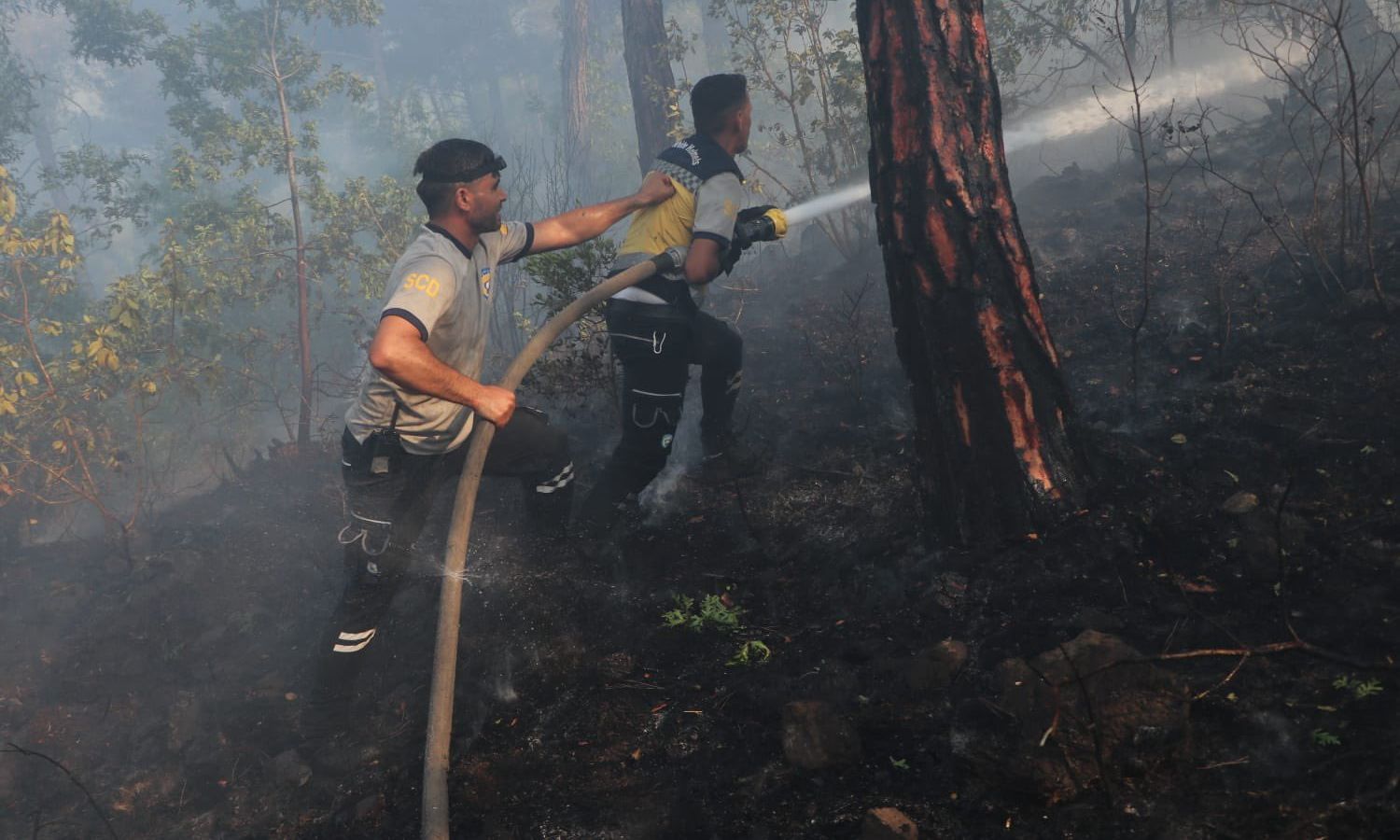
 Syrian Civil Defense teams attempt to extinguish Lattakia wildfires – 12 July 2025 (Raed al-Saleh/X)
Syrian Civil Defense teams attempt to extinguish Lattakia wildfires – 12 July 2025 (Raed al-Saleh/X)
The Minister of Emergency and Disaster Management, Raed al-Saleh, announced that Civil Defense teams had carried out preventive “fire lines” within the dense forests of northern rural Lattakia to prevent wildfires.
Al-Saleh stated via X on Thursday, 7 August, that the “fire lines” extended over 73 kilometers, covering areas such as Zahiya, Atira, Kassab, and al-Furnloq, while teams are currently continuing operations in the al-Rabi‘ah area.
He pointed out that “fire lines” are among the fundamental preventive measures in forests because they help reduce the speed of fire spread and facilitate access for firefighting teams to threatened sites.
Northern rural Lattakia is considered one of the most vulnerable areas to summer wildfires, making early intervention essential to limit losses to vegetation and forest wealth.
Abdel-Kafi Kayyal, Director of Civil Defense on the Coast, told Enab Baladi that, under the directives of the Minister of Emergency and Disaster Management, Syrian Civil Defense teams in the Lattakia Emergency Directorate continue efforts to protect forests and woodland areas in the northern countryside.
After controlling fires across the region, teams are now focusing on creating new “fire lines” and buffer roads within forests—an anticipatory step aimed at reducing wildfire risks and accelerating emergency response.
This early intervention stems from concern for protecting the region’s ecological diversity, particularly following the most recent wildfire the governorate experienced.
Emergency teams, using more than 20 vehicles, are expanding buffer roads to prevent fires from reaching wide green areas and to bolster their capability to contain any future fires.
On 15 July, al-Saleh announced full control over Lattakia’s wildfires after 12 consecutive days of operation. He described this as the end of the urgent response phase and the beginning of an equally important stage focused on protecting remaining forests and restoring what fire has destroyed.
He warned that the real disaster lies not only in what was lost, but in its future repercussions—such as soil erosion, loss of vegetation, and the threat of land degradation—amid the worst drought and climate-change wave in decades.
The Ministry of Agriculture and Agrarian Reform reported on 4 August that over 14,000 hectares were damaged by the wildfires that erupted last month in rural Lattakia.
The Ministry’s statistics on Facebook indicated that woodlands and forests accounted for the majority of the damage—11,675 hectares, or 82.55% of the total burned area. Agricultural lands followed with 2,152 hectares (15.21%), while urban lands suffered 193.78 hectares (1.37%).
Additionally, 53 hectares of water bodies were affected (0.37%), and 67.94 hectares of mixed-use lands were damaged (0.48%). Lands classified as barren, neglected, or transformed totaled 1.93 hectares, equivalent to 0.01% of the burned area.
if you think the article contain wrong information or you have additional details Send Correction


 A
A
A
A
A
A




 More Society