
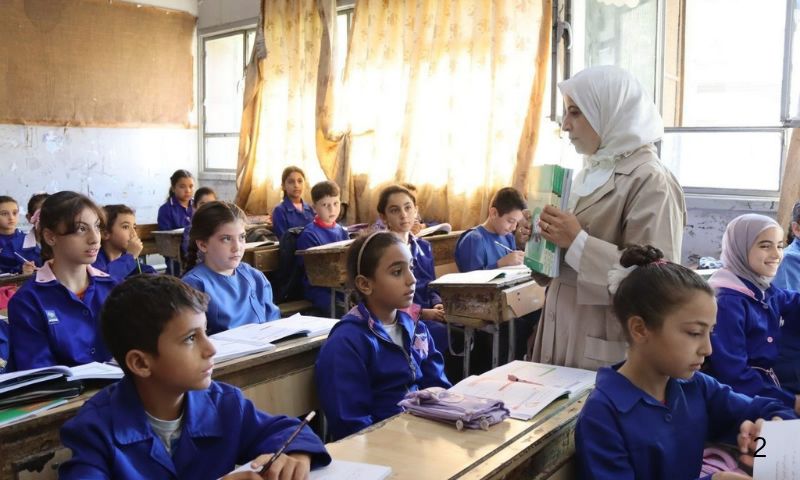

The British government has announced £25 million in funding for the third phase of its Syria education support program, which is set to run from 2027 to 2032 in partnership with Syria’s Ministry of Education.
In a statement published on its official website on Friday evening, November 27, the British government said the new phase would provide technical assistance to the Ministry of Education and local education directorates to support the recovery and strengthening of the education system and expand Syrian children’s access to quality education.
The new phase builds on the Syria Education Programme (SEP), which the UK launched in 2018 to improve access to quality, inclusive education for children in northwestern Syria amid displacement, damage to schools, and disruptions to educational services during the years of war.
The British government said the program had reached more than one million children in northwestern Syria since its launch, helping improve literacy and numeracy skills, strengthen teachers’ capacities, improve school environments, enhance safety measures, and increase accessibility for children with disabilities.
The third phase follows two earlier phases that focused on supporting education in northwestern Syria.
For the first time, the new phase will expand to communities across Syria, including hard-to-reach areas and areas to which Syrians have returned following the fall of the former Assad regime.
According to the statement, the new phase will focus on marginalized children and those returning to Syria, helping them regain access to education and recover learning lost during years of displacement and interrupted schooling.
British Minister of State for the Middle East Stephen Doughty said the efforts of Syrian teachers over the past several years had been essential in ensuring that future generations have the skills and opportunities they need for their future. He praised teachers for continuing their work despite difficult circumstances.
The British government said supporting education forms part of efforts to promote economic recovery and stability in Syria and helps address the factors driving displacement and irregular migration.
What Were the Two Previous Phases?
First Phase (SEP I)
The Syria Education Programme, in the form launched by the British government, began in January 2018, with its first phase continuing until June 2022.
The phase focused on providing safe and inclusive learning opportunities for children in affected areas of northwestern Syria, improving the quality of education, supporting teachers and educational staff, and strengthening students’ literacy and numeracy skills.
Second Phase (SEP II, Manahel)
The second phase began in July 2022 and will continue until June 2027 under the name “Manahel,” with British funding amounting to approximately £46 million, according to the program’s announced funding allocations.
It focused on supporting basic education in Idlib and Aleppo (northwestern and northern Syria, respectively), strengthening teachers’ capacities, improving the quality of education, promoting inclusive education and child protection, and providing technical assistance to the Ministry of Education in four areas:
- Inclusive education.
- Teacher training and educational supervision.
- National assessment of student learning.
- School safety and child protection.
According to the British government, UK-supported education programs have reached more than one million children in northwestern Syria since 2018. Girls accounted for 49% of the children who benefited from the program, while the number of special education centers operating in public schools has exceeded 100 since 2025.
Challenges Facing the Ministry of Education
The British grant comes at a time when Syria’s education sector faces challenges related to schools’ capacity to accommodate growing student numbers, school dropout rates, and shortages of school buildings and educational equipment.
During a hearing before the People’s Assembly, Syria’s parliament, on September 14, Education Minister Mohammad Abdul Rahman Turko said the number of students expected in the 2026-2027 academic year would reach six million, compared with approximately 4.3 million before the fall of the former regime.
He estimated that approximately two million students had dropped out of education, attributing this to economic and social factors, as well as the lack of schools in several areas.
He noted that demand for schooling exceeds current capacity, explaining that the ministry is pursuing two plans: an emergency plan to ensure access to education for every child in Syria and a strategic plan to develop the education system