
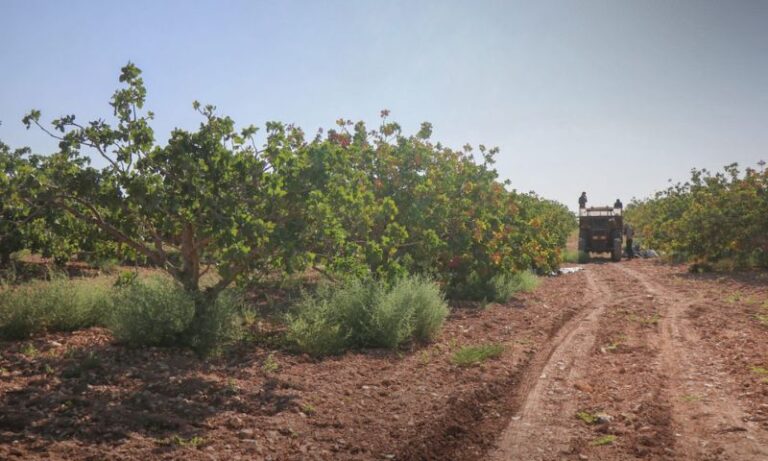

Syria’s pistachio production fell to about 34,000 metric tons in 2026, down from about 41,000 metric tons the previous season. An Agriculture Ministry official estimated that exports accounted for about 20% of the harvest. Growers and exporters face rising costs as the government works to develop the sector and expand access to foreign markets.
Adel Hawash, head of the Pistachio Office at the Ministry of Agriculture, told the state-run Syrian Arab News Agency on Monday, November 23, that several factors contributed to the decline. He cited low rainfall during the 2024-2025 rainy season, rising input costs, the uprooting and felling of trees, the displacement of farmers during the years of the Syrian uprising, and the spread of the *Capnodis* beetle.
Exports to Arab and Other International Markets
By November 22, Syria had exported 827,806 kilograms of pistachio kernels, 330,189 kilograms of in-shell pistachios, and 1,223,967 kilograms of green pistachios, Hawash said. He estimated that total exports represented about 20% of the season’s production.
Saudi Arabia is the largest importer of Syrian pistachio kernels, while Lebanon is the leading importer of green pistachios. Jordan, the United Arab Emirates, and Egypt are also buyers, as are Germany, Canada, and Malaysia.
Hawash said the amount available for export depends on domestic production and market needs, taking into account technical and health standards and the requirements of importing countries.
He stressed the importance of preserving the quality and distinctive characteristics of Syrian pistachios, improving sorting, grading, and packaging, and complying with international health standards. He also called for opening new markets and strengthening trade ties with importers.
Quality and Food Safety Requirements
In-shell pistachios for export must be intact, clean, and dry, with no abnormal moisture. Kernels must be free of insects, mold, rancidity, and unusual odors or flavors. Their moisture content must be no higher than 6.5%.
Hawash said laboratory testing screens for aflatoxin B1 and total aflatoxins, pesticide residues, and heavy metals such as lead and cadmium. Microbiological tests also check for Salmonella and E. coli.
Exporters must also ensure shipments are free of insect pests at all stages of development and obtain a phytosanitary certificate.
Aflatoxins are highly toxic compounds produced naturally by certain types of mold.
Drying and Storage to Preserve Quality
Steps to preserve pistachio quality begin immediately after harvest. Hawash said growers should remove the outer hull and start drying the nuts within 24 hours to prevent moisture buildup and mold growth, aiming for a moisture content of about 5% to 7%.
Pistachios can be dried using suitable equipment or in the sun on clean surfaces that keep them out of contact with the soil. The nuts should be turned regularly and kept well ventilated throughout drying.
Storage facilities must be clean, dry, and well ventilated, with controlled temperature and humidity. The nuts must also be protected from insects, odors, and contamination.
Hawash said food-grade packaging should meet applicable standards. Vacuum or nitrogen packaging can help limit oxidation and rancidity, particularly in kernels. Labels should list the origin, production and expiration dates, and batch number.
Production Challenges and the Government’s Development Program
Pistachio growers face rising costs for fuel, pesticides, and fertilizers, as well as difficulty obtaining supplies for orchard maintenance, Hawash said.
Exporters face difficulties entering new markets and making Syrian pistachios more competitive. They also face transport and shipping costs, quality requirements, and laboratory testing.
The Ministry of Agriculture is providing technical guidance through the Pistachio Office. It also supplies seedlings at nominal prices through nurseries run by local agriculture directorates and provides pistachio scions for grafting at almost no cost from nurseries that maintain parent trees.
The ministry is implementing a national development program with relevant agencies, covering the sector from seed and seedling supply through production and marketing.
Hawash said higher production in future seasons would depend on better weather, access to inputs, farmers returning to tend their orchards, and efforts to control agricultural pests.
He said improving sorting, drying, packing, and processing, along with opening new export markets, could increase the value of Syrian pistachios and make them more competitive internationally.
Hama Has the Largest Area Planted With Pistachios
Syria has about 68,000 hectares planted with pistachios and around 10.5 million pistachio trees, about eight million of which bear fruit.
Hama governorate (central Syria) has the largest planted area at about 27,000 hectares, followed by Aleppo (northern Syria) with about 23,000 hectares and Idlib (northwestern Syria) with about 11,000 hectares. About 3,000 hectares are spread across the remaining governorates.
Higher Prices, Lower Profits
Pistachio prices rose this year, but higher costs and lower yields kept farmers from making the profits they had hoped for. Imported varieties also competed with locally grown pistachios, putting pressure on prices for the Syrian crop at a time when production costs were already high.
Ghassan Douba, a farmer who owns about eight hectares in the Azaz area (northern Aleppo governorate), previously told Enab Baladi that growers should be getting better prices given this year’s higher costs and their reliance on the domestic market because they could not sell abroad.
Ready-to-eat pistachios sell for $6.50 to $7 per kilogram, while pistachios sold in clusters fetch $4 to $4.50 per kilogram.
Pistachios sold in clusters fetched $2.75 to $3 per kilogram last year, when growers earned higher profit margins.
Douba said ready-to-eat pistachios should sell for about $9 per kilogram this year and pistachios sold in clusters should fetch more than $5 per kilogram.
Douba said the cost of crop treatments, fuel, fertilizers, and labor had risen sharply. He described the increases as “exorbitant” and said the cost of some supplies had risen by more than 40%.
Douba said imports of Iranian pistachios hurt Syrian growers and the wider economy. He said the imports push down domestic prices until Syrian and Iranian pistachios sell for about the same amount, even though he considers Syrian pistachios superior in quality.
Douba said confectioners prefer Iranian pistachios because they are drier and absorb sugar syrup, while Syrian pistachios retain their oil.
Hawash said the Pistachio Office had contacted Syria’s General Authority for Border Crossings and Customs to regulate exports.
He previously told Enab Baladi that a committee made up of several ministries and authorities makes decisions on imports and exports based on market needs.
He said the ministry draws up an annual agricultural calendar based on available supply and production. The calendar sets the periods when imports are permitted or suspended.
Hawash said the Pistachio Office issues certificates of origin exclusively for Syrian-grown pistachios after thorough inspections. The checks aim to prevent foreign pistachios from being exported as Syrian, regulate the market, and protect the reputation of the domestic product.