
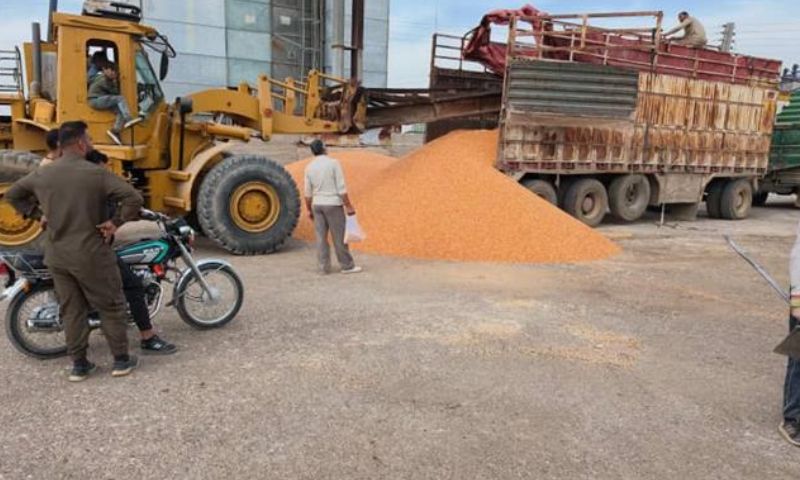
As the procurement of yellow corn from the 2026 agricultural season continues, Syria’s General Establishment for Feed has acknowledged a gap between crop production and the capacity of government-operated drying facilities.
Corn production increased by 42% compared with last year, while several drying facilities remain out of service or operate at limited capacity.
Hussein Shihab, director general of the General Establishment for Feed, told Enab Baladi that the establishment operates three corn dryers in Raqqa (northern Syria), with a combined drying capacity of 500 tons per day.
The establishment also owns another continuous-operation dryer in the governorate with a capacity of 1,000 tons per day, but it is currently out of service.
Shihab said the establishment also owns three dryers in Deir Ezzor (eastern Syria). However, they are in poor technical condition due to theft and missing components. One of the dryers was also damaged by shelling during the years of the former regime’s rule. Their combined capacity is approximately 600 tons per day.
Shihab explained that the destruction of drying facilities over the past several years had deprived the establishment of a significant portion of its original capacity.
He noted that the establishment could face challenges arising from the gap between drying capacity and actual production, as crop output exceeds the capacity of operational government dryers.
Shihab also pointed to additional challenges related to rising costs and financing difficulties.
He explained that the establishment is currently focusing on rehabilitating and maintaining existing dryers rather than acquiring new ones, with priority given to restoring available facilities to operation and recovering their production capacity.
According to Shihab, yellow corn production and cultivated areas have also increased significantly.
However, the shortage of dryers and the limited number of drying centers remain obstacles to handling large quantities of the crop, he said.
Rehabilitating non-operational dryers or purchasing new equipment requires funding, spare parts, and substantial operating expenses, particularly amid rising drying, storage, and energy costs, according to Shihab.
Despite these difficulties, Shihab confirmed that the establishment had managed to rehabilitate some dryers using local technical personnel and resume their operations.
On November 15, the General Establishment for Feed announced the rehabilitation and maintenance of yellow corn dryers in Raqqa after 14 years out of service, making them ready to receive and dry the harvest.
Rising Production Increases Pressure on Drying Facilities
The establishment’s remarks come as the Ministry of Agriculture announced that yellow corn production had risen to 475,232 tons in 2026, compared with 332,573 tons last year, an increase of 42%.
According to remarks by Maher al-Daj, director of plant production at the ministry, reported by the state-run Syrian Arab News Agency (SANA) on November 4, domestic production covers approximately 50% of Syria’s corn requirements.
Al-Daj added that cultivated areas reached 84,381 hectares, while the average yield of hybrid varieties was approximately six tons per hectare.
According to al-Daj, Raqqa led the country’s corn-producing regions, accounting for 35% of total production, followed by Aleppo (northern Syria) at 27% and al-Hasakah (northeastern Syria) at 13%.
Shortage of Drying Facilities Forces Farmers to Dry Corn on Roads
Agricultural economics expert Abdul Razzaq Habza linked the shortage of drying facilities to farmers resorting to drying their corn crops on roads.
Habza told Enab Baladi that the expansion of yellow corn cultivation over the past several years had led to a significant increase in production.
According to Habza, this occurred at a time when government institutions were ill-equipped to handle such quantities due to a shortage of dryers, prompting some farmers to spread their crops on roads to dry them.
As a result, farmers found themselves facing abundant harvests but inadequate infrastructure for drying and marketing their crops, contributing to the spread of this practice across agricultural areas, according to the expert.
Crop Procurement Continues Amid Ban on Roadside Drying
On November 16, the General Establishment for Feed began purchasing yellow corn from all farmers for the 2026 agricultural season, and procurement remains ongoing.
The establishment set the purchase price for dried yellow corn at 43,500 Syrian pounds per ton with a moisture content of 14%, with the price adjusted according to moisture levels upon delivery.
In a related development, the Raqqa District Administration issued a circular on October 11, 2026, prohibiting the spreading and drying of yellow corn on public, main, and secondary roads within cities, villages, and towns under its jurisdiction.
According to the circular, the measure aims to protect public safety, ensure smooth traffic flow, and reduce accidents caused by agricultural crops obstructing roads.
Enab Baladi previously reported objections from several farmers who described the decision as “unfair.” Basel al-Khalil, a farmer from the eastern Raqqa countryside, said spreading yellow corn on roads had been the most widely used method for years, particularly after government dryers that previously received crops directly after harvest ceased operating.
He added that drying and transportation costs could exceed $30 per ton, consuming a substantial portion of the profit farmers expect after months of work and spending on the agricultural season.