
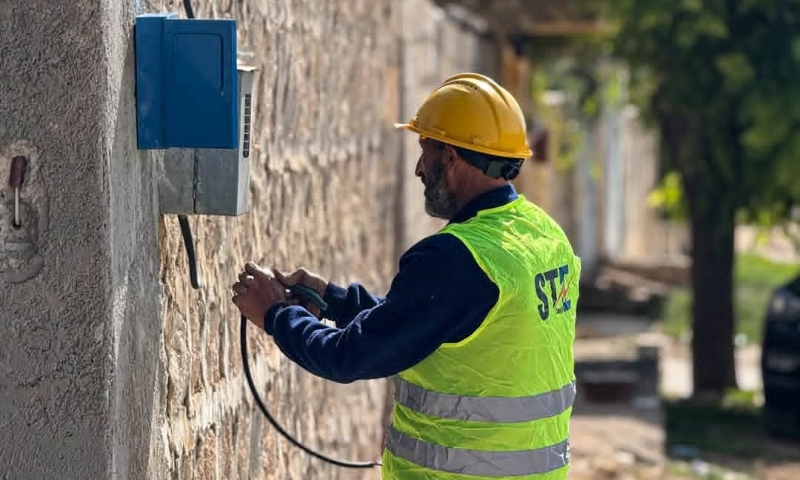

The Syrian Electricity Company signed an agreement with China’s Wasion Group Limited on Sunday, November 8, to supply 6.5 million prepaid smart electricity meters.
According to the company, the agreement aims to modernize Syria’s electricity metering system and improve mechanisms for managing energy consumption.
The contract was signed at the company’s headquarters in Damascus and provides for deliveries over three consecutive years through regular monthly shipments.
The contracted shipments include six million single-phase meters and 500,000 three-phase meters, along with the software systems and technical equipment required for their operation.
The company said the project aims to improve energy efficiency, reduce electricity losses, and strengthen smart metering systems to ensure more reliable electricity supplies and services for subscribers.
Real-Time Consumption Monitoring
Omar Shaqrouq, CEO of the Syrian Electricity Company, said the development of the smart metering system would allow the company to monitor electricity consumption data across the Syrian grid and for all subscribers simultaneously in real time.
Shaqrouq told the state-run Syrian Arab News Agency (SANA) that the new system would enable subscribers to monitor their electricity loads and view their power consumption directly, as well as recharge their meters through mobile phone applications.
He added that subscribers would also be able to access the necessary data and check their remaining meter credit or available electricity capacity, helping them manage and reduce their consumption.
Shaqrouq said the first shipment of meters would arrive within four months, confirming that the company was ready to begin installing them immediately upon arrival. The installation process is expected to continue for three years.
Regarding the distribution plan, the CEO said priority would be given to areas that currently lack meters and rely on circuit breakers. He explained that the measure would significantly reduce electricity waste and promote fairer distribution among subscribers.
The agreement comes as Syria’s electricity system faces major challenges because a large proportion of consumers lack electricity meters. Approximately 1.2 million subscribers out of a total of six million nationwide do not have meters, according to previous statements by Khaled Abu Di, director-general of the General Establishment for Electricity Transmission and Distribution.
Abu Di previously said the establishment aimed to install meters for between 80% and 90% of these subscribers by the end of 2027. He added that efforts to secure prepaid electronic meters were continuing alongside the expansion of the smart metering system.
For his part, Elie Khouri, a representative of China’s Wasion Group Limited, which is implementing the project, announced that work had already been underway for a full year under the signed contract.
In a recorded video published on the Syrian Electricity Company’s official social media accounts, Khouri emphasized the Chinese company’s commitment to the highest international quality standards and to supplying the project with the latest software and technologies available in the smart metering sector.
Wasion Group Limited is one of China’s leading companies providing integrated solutions for measuring and managing energy consumption, including electricity, water, gas and thermal energy. It also develops smart grid systems and energy efficiency management solutions.
Founded in 2000, the company is headquartered in Changsha, in China’s Hunan province, where its technology complex is also located. It has been listed on the Hong Kong Stock Exchange since 2005 and operates in more than 50 countries, including markets in East Asia, South America, Africa and North America.
Memorandum of Understanding with Saudi Company
On March 9, the Saudi Industrial Export Company (SADIRAT) announced the signing of a non-binding memorandum of understanding with Globaltronics to cooperate on a project to supply smart electricity meters in Syria.
According to a statement by Sadirat published on the Saudi Exchange, the memorandum provides for a feasibility study into forming a consortium, defining the roles of its participating parties and exploring financing options for a project to supply and install single-phase and three-phase smart electricity meters in Syria.
Mohammad Bakr, a member of the Syrian Economic Sciences Association, said in a previous Enab Baladi report that the smart meter project requires comprehensive infrastructure, including electricity networks, fiber-optic communications networks and a fifth-generation (5G) internet network. He also stressed the need to adopt electronic payments through bank accounts rather than local payment services such as Sham Cash and Syriatel Cash.
Regarding Syria’s electricity infrastructure, Bakr said the current system had suffered extensive deterioration and did not meet the requirements for installing a smart metering system.
Ensuring the Success of the Smart Meter Project
Bakr explained that the most important step toward ensuring the success of the smart meter project and maximizing its benefits for the Syrian economy was to move away from publicity-driven announcements of agreements that would not be implemented.
According to Bakr, any project requires certain conditions before implementation can begin, including financing and adequate infrastructure.
He also stressed the importance of involving experienced specialists more extensively, noting that their knowledge could save time and effort and help move the project toward actual implementation.
Technical Challenges
Regarding technical challenges, Bakr highlighted several problems, including:
- Electricity network: The grid needs rehabilitation, and technical electricity losses must be addressed.
- Communications network: Coverage remains unavailable in many devastated areas, while reliance on copper cables severely limits network efficiency and cannot adequately support smart meters.
- Internet network: Internet coverage does not extend across all Syrian territory, and connections remain unstable and unreliable in many parts of the country.
- Electronic payments: Licensed banks have been excluded, while payment companies that charge commissions and suffer from technical weaknesses in their applications have been allowed to operate.
Bakr concluded that the project was large-scale and required financing and cooperation among several companies to ensure high-quality implementation and maximize the benefits of installing smart electricity meters.
Syria-Turkey Electricity Interconnection at 500 Megawatts
On October 29, the Syrian Electricity Company’s deputy CEO for distribution affairs met representatives of the Turkish Electricity Transmission Corporation (TEİAŞ) to discuss technical arrangements and upcoming stages of the electricity interconnection project between Syria and Turkey.
The meeting followed the completion of technical and structural rehabilitation work on the 400-kilovolt Aleppo F-Birecik electricity interconnection line.
Discussions focused on determining the next steps for connecting the two networks and agreeing on operational mechanisms in preparation for transferring up to 500 megawatts of electricity in islanded mode to supply the targeted areas.
During the meeting, both sides reviewed developments in engineering coordination and operational safety requirements to ensure stable electricity supplies and efficient performance.
Increased Electricity Rationing in Syria
On October 28, the Syrian Electricity Company attributed declining electricity supplies and longer power rationing periods to a reduction in available generation capacity caused by several overlapping factors, particularly scheduled and emergency maintenance on some generating units and the continued shutdown of the Tishreen power station.
In a statement issued at the time, the company also explained that shortages in Azerbaijani gas supplies intended to operate power plants had contributed to reduced electricity generation. It confirmed that technical teams were continuing repair work and efforts to bring suspended generating units back into service, aiming to gradually improve electricity supplies within available resources.