
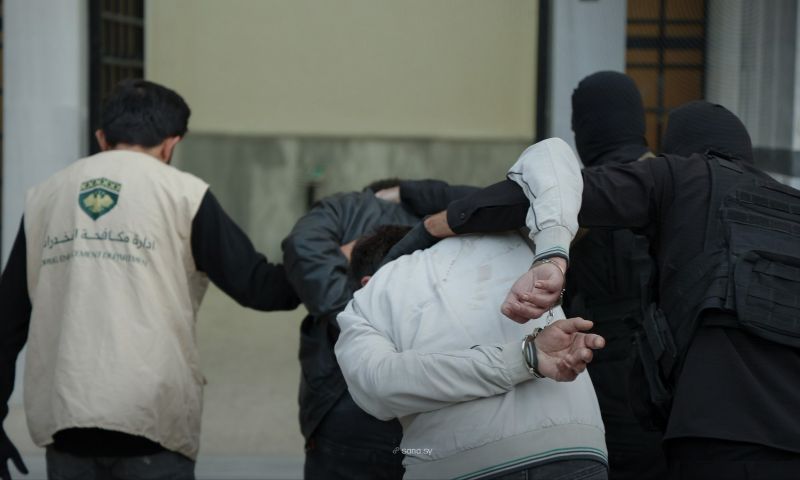

Syria’s Interior Ministry announced on Sunday, November 1, the results of its Anti-Narcotics Department’s operations during October, including the seizure of millions of narcotic pills and the dismantling of drug smuggling networks.
The operations involved the seizure of millions of narcotic pills, along with quantities of hashish and crystal meth, and the dismantling of domestic smuggling networks. Meanwhile, Jordanian authorities announced that they had thwarted an attempt to smuggle two million narcotic pills through the Jaber border crossing with Syria.
In a statement on Sunday, November 1, the Anti-Narcotics Department said it had carried out 157 security operations during the previous month and dismantled 30 domestic smuggling networks.
According to the published figures, the department seized 4.3 million Captagon pills, 28,000 narcotic pharmaceutical tablets, seven kilograms of crystal meth and 582 kilograms of hashish.
Separately, Jordan’s Public Security Directorate announced on Sunday that it had thwarted an attempt to smuggle two million narcotic pills concealed inside a cargo vehicle attempting to enter the kingdom through the Jaber border crossing with Syria. The operation was carried out in coordination with the Customs Department and relevant security agencies.
At the Jordanian Border
According to Jordan’s official news agency, Petra, the spokesperson for the Public Security Directorate said authorities had received information that raised suspicions about the vehicle.
Officers stopped the vehicle, detained those inside and searched it, discovering narcotic pills concealed in specially prepared hidden compartments within the vehicle’s structure. The pills were intended to be smuggled onward to a neighboring country.
The spokesperson added that the relevant authorities had launched an investigation to establish the circumstances of the operation and identify those involved.
Drug Smuggling Through Jisr Qamar Crossing With Lebanon
Customs officers at the Jisr Qamar border crossing with Lebanon also thwarted an attempt to smuggle narcotics during routine inspections of passengers’ luggage at the crossing.
Mazen Alloush, director of International Relations and Cooperation at the General Authority for Border Crossings and Customs, told the Syrian Arab News Agency (SANA) on Sunday that a thorough inspection had uncovered 2,600 grams of hashish and 17 grams of heroin. The drugs had been carefully concealed inside a loudspeaker in an attempt to avoid detection and bypass customs procedures.
Alloush said customs officers had documented the seizure and taken the necessary legal measures. He stressed that the authority would continue its efforts to combat drug smuggling and the trafficking of prohibited substances, while tightening inspections at all border crossings to help protect public safety and security.
Recommendations for Addressing Drug Trafficking
The US-based New Lines Institute issued several recommendations for addressing Syria’s drug trafficking problem in a report published on February 10, 2026.
The institute recommended strengthening cooperation on counternarcotics and border security between the Syrian government, Jordan and Lebanon. Its proposals focused on intelligence sharing and exchanging reports that could support raids and seizures, joint training in border surveillance, and routine forensic testing of confiscated drug shipments.
According to the institute, the United States and its regional partners should also pursue a political and security solution to the crisis in Suwayda (southern Syria) by facilitating an agreement between the factions controlling the governorate and the Syrian government.
Such an agreement would make it easier to strengthen counternarcotics operations in southern Syria, helping disrupt cross-border drug trafficking and reduce the need for direct Jordanian strikes on Syrian territory.
The institute also called on the United States and its partners to encourage continued progress in combating organized crime in Lebanon and identify opportunities to invest in the capabilities of Lebanese security forces.
These efforts would include identifying tools to improve intelligence collection and sharing, providing equipment such as night-vision goggles, and developing platforms capable of mapping organized crime networks.
The institute urged the US Congress to continue updating and adapting the interagency task force established in 2023 under the Captagon Act. It also called for ensuring that US agencies expand their monitoring efforts to include actors in Lebanon, Turkey, Iraq, Jordan, and other regional locations vulnerable to Captagon-related activities.