
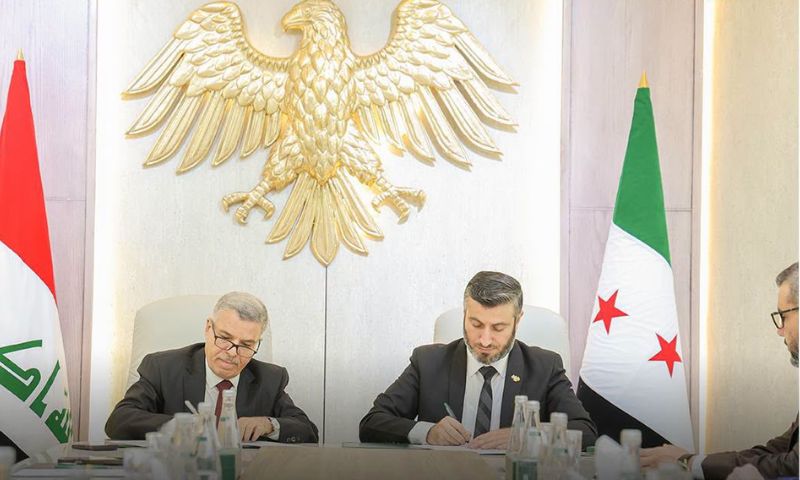

Syria and Iraq signed the minutes of a technical meeting in Damascus on Thursday evening, November 5, to strengthen the management of shared water resources. The document included an agreement to activate three-way coordination with Turkey over Euphrates River water.
The two countries also agreed to prepare for a meeting between Syria, Iraq and Turkey in March 2027, amid growing challenges to water security in the region.
The minutes outlined several agreed measures to strengthen the management of shared water resources, most notably activating coordination between Syria, Iraq and Turkey over transboundary waters in the Euphrates.
They also included establishing joint hydrological monitoring stations along the river, strengthening exchanges of water data and information, and conducting regular joint water quality tests.
The document also provided for expanding technical cooperation, building capacity and exchanging expertise in water resource management and dam monitoring and operation.
Both sides agreed to prepare for a forthcoming three-way meeting involving Turkey in March 2027, according to the minutes.
According to a statement from Syria’s Ministry of Energy, the signing reaffirmed both countries’ commitment to developing cooperation and joint coordination and expanding exchanges of expertise and information to improve the management of shared water resources and support water security in both countries.
The Syrian side was led by Deputy Energy Minister for Water and Electricity Affairs Osama Abu Zeid, while the Iraqi side was headed by Hussein Abdul Amir Bakka, technical undersecretary at the Ministry of Water Resources. Technical delegations from both countries participated.
Continuing Coordination
The signing in Damascus followed an earlier technical meeting held in Baghdad from June 22 to 25, during which the two sides signed similar minutes providing for the activation of the joint technical committee with Turkey.
Receiving a technical delegation from Syria, Iraqi Deputy Water Resources Minister Raed al-Jashami told the Iraqi News Agency (INA) that the delegation’s visit was part of efforts to strengthen bilateral relations and cooperation in water management.
In August 2025, Syrian Energy Minister Mohammed al-Bashir discussed coordination over Euphrates water with Iraqi Water Resources Minister Aoun Dhiab Abdullah. The discussions included a proposal to hold a three-way meeting between Syria, Iraq and Turkey to address issues concerning the river’s waters.
For decades, water relations between the two countries have been governed by two main agreements. The first is the 1987 protocol signed by Syria and Turkey, which provides for more than 500 cubic meters per second of Euphrates water to flow across the Syrian-Turkish border. The second is the 1989 Syrian-Iraqi agreement, which allocates 58% of incoming water to Iraq and 42% to Syria.
Between Drought and Flooding
These understandings take on added importance amid the sharp climatic fluctuations experienced by the Euphrates basin in recent years. After years of drought and declining water flows, the basin experienced sudden floods this year that highlighted the need for greater coordination among countries sharing it.
Turkey and Syria experienced heavy rainfall during the winter and spring of 2026, raising water levels in Turkish dam reservoirs.
The effects were particularly evident in eastern Syria, where water submerged earthen bridges and residential neighborhoods and damaged crops in the al-Bouhamad areas of eastern rural Deir Ezzor (eastern Syria).
Flooding also disrupted parts of the infrastructure and put more than 50 of the 210 water stations along the Euphrates basin out of service.
In Iraq, the Ministry of Water Resources reported high inflows into the Tigris and Euphrates rivers due to rainfall and water releases from Turkey. However, this temporary increase does not dispel concerns about the country’s chronic water crisis.
Iraqi studies indicate that withholding each billion cubic meters of water flowing from Turkey results in the loss of around 1.6 million dunams of Iraqi agricultural land, making any regional understandings on water resource management strategically important to Baghdad.
Both sides await the outcome of the three-way meeting scheduled for March 2027 and whether it can turn technical understandings into practical measures that improve Euphrates water management and support water security in Syria and Iraq, amid mounting challenges facing the region’s water resources.