
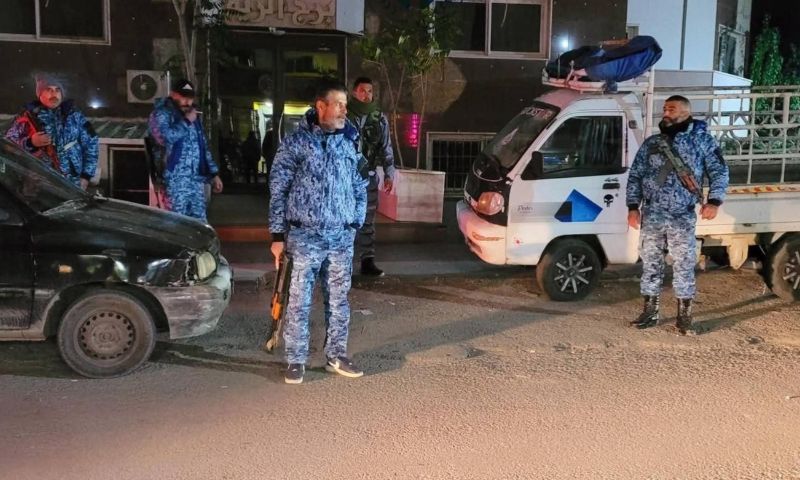

Government Internal Security Forces and members of the National Guard, affiliated with Sheikh Hikmat al-Hijri, exchanged fire in the countryside of Suwayda (southern Syria) on Wednesday evening, November 11.
A local source in Suwayda told Enab Baladi that a National Guard member named Ali Zaid Saif sustained a gunshot wound to the thigh and was taken to Suwayda National Hospital after coming under fire from Syrian government forces, according to the source.
The source added that there had been no clashes in the area and that Saif had been hit by a sniper’s bullet.
Qutaiba Azzam, director of media relations at the Suwayda Media Directorate, gave a different account, saying the ceasefire violation began when “the groups,” referring to National Guard forces in Suwayda, opened fire on Internal Security positions on Tal Hadid, west of Suwayda, in the governorate’s countryside.
Azzam told Enab Baladi that government positions then returned fire at the sources of the shooting.
Around the same time, an explosion was heard west of the city in government-controlled territory. It was believed to have been caused by a landmine.
A Recurring Pattern
Positions along the lines of contact in Suwayda between government Internal Security Forces and the National Guard, an armed group affiliated with Druze spiritual leader Hikmat al-Hijri, have witnessed recurring clashes, renewing tensions whenever the governorate moves toward implementing de-escalation measures and restoring calm.
Behind these developments, Suwayda appears to face a problem extending beyond military clashes. It concerns the future relationship between the central government and local armed forces, the connection between the impasse and external intervention, particularly Israel’s role, and the limits of the government’s ability to assert its authority in the governorate, while the National Guard insists on retaining its local security and military role.
Politically, the roots of the tensions appear linked to two conflicting visions of security authority in Suwayda. One insists that state institutions operate under a single central authority, while the other holds that the governorate’s experiences require the continued presence of a local force capable of providing protection.
Dr. Samir al-Abdullah, a researcher at the Arab Center for Contemporary Syria Studies, places the tensions in this context, viewing them as a reflection of an unresolved conflict between state authority and local protection, rather than an isolated security breach.
In an earlier interview with Enab Baladi, al-Abdullah said the government seeks, in principle, to end the existence of competing armed forces and restore effective institutions under a single central authority. The National Guard, meanwhile, insists on its local protection role, drawing on fears that accumulated after the events of 2025 and a conviction that state guarantees and accountability for violations remain incomplete.
Ammar Jello, a researcher at the Washington-based Hewar Center for Research and Studies, views the developments in the broader context of Damascus’s desire to regain control over all Syrian territory, considering the south the most significant region remaining outside government control.
Jello believes government movements may have been intended to “test the waters” with forces in the area and explore the possibility of pursuing a path toward reunifying Syrian territory. He doubts, however, that they stemmed from government forces becoming overconfident after their successes. He considers it more likely that they were an attempt to break the deadlock and reach a national solution bringing together Syrians from across the country’s communities.
What Does Renewed Fighting Mean?
The significance of the continuing tensions extends beyond the immediate losses caused by each round of fighting. Their recurrence keeps relations between the two sides unstable and prevents a transition to a lasting security arrangement.
Al-Abdullah believes that the continued presence of armed forces outside a unified legal framework transforms protection from a temporary necessity into a parallel authority, allowing any checkpoint encounter or individual incident to become a flashpoint for wider escalation.
The researcher warned that recurring clashes could entrench what he calls the governorate’s “functional separation,” leaving Suwayda geographically within Syria but detached in terms of security, services and politics.
Jello, for his part, warned that the two sides’ continued reliance on military force to strengthen their positions or press their demands could lead to further escalation.
He pointed to mobilization and heightened tensions, alongside the absence of political solutions, as factors keeping open the possibility of events spiraling out of control, although he considers that possibility remote at present.
Jello said the recent tensions primarily reflect continuing hostility, discord and a breakdown in relations between the two sides. Escalation could result from incidental events or, in some cases, convey a deliberate message, he said, stressing that determining which is difficult without knowing the nature and circumstances of each incident.