
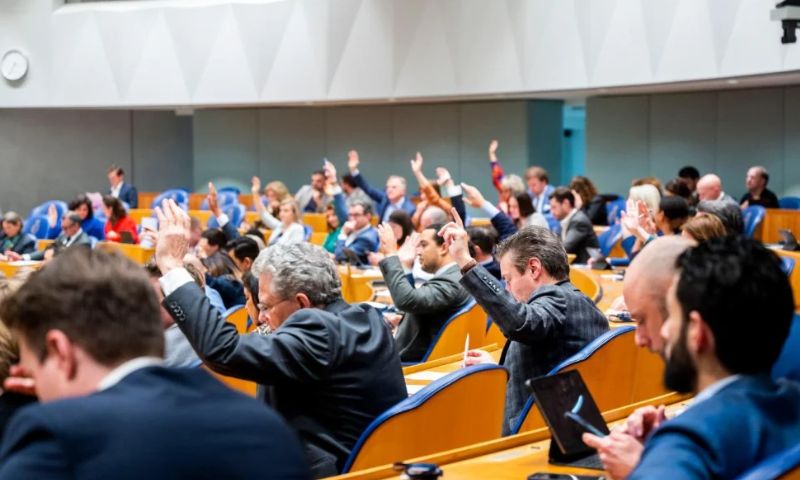

The Dutch House of Representatives approved a motion on Tuesday, November 24, calling on the government to develop a program that offers Syrians with temporary residence permits €10,000 each in exchange for voluntarily returning to Syria. The money would be paid in installments after beneficiaries have left the Netherlands.
Ulysse Ellian, a lawmaker from the People’s Party for Freedom and Democracy (VVD), introduced Motion No. 21, together with Don Ceder of the Christian Union and Jelte Stratemans of the Christian Democratic Appeal (CDA). It was among the motions put to a vote during Tuesday’s parliamentary session and was subsequently approved.
According to the text of the motion, the lawmakers are calling on the government to develop a return mechanism for Syrians holding temporary residence permits, under which each beneficiary would receive €10,000. Payment would be conditional on their actual departure from the Netherlands and would be made in installments rather than as a lump sum.
The motion also calls for conditions to prevent beneficiaries from returning to Europe after receiving financial assistance and to ensure that the program does not encourage further migration to the Netherlands. It could be financed through existing allocations for return programs or other resources within current budgetary frameworks.
The motion asks the government to inform parliament within two months of the details of the mechanism it intends to adopt. Its approval therefore does not mean that payments have begun or that applications are open to Syrians. Rather, it mandates the government to study the program and develop a framework for its implementation.
Efforts to Reduce Refugee Reception Costs
The proposal targets approximately 71,000 Syrians holding temporary residence permits in the Netherlands, according to a November 18 report by the Dutch news outlet Hart van Nederland, citing Ellian.
The outlet reported that the party hopes several thousand Syrians will benefit from the program as part of its efforts to reduce refugee reception costs and encourage returns to Syria.
In justifying their proposal, the lawmakers pointed out that Syrians account for approximately one-third of residents at asylum reception centers operated by the Central Agency for the Reception of Asylum Seekers (COA). More than 60% of Syrians granted asylum receive social assistance after four years of residence, according to figures cited in the motion.
The lawmakers argued that encouraging voluntary return would be less costly than continuing to fund the reception and accommodation of Syrians, while also allowing returnees to contribute to rebuilding their country.
Legal Challenges
During parliamentary discussions, Dutch Minister of Asylum and Migration Bart van den Brink expressed his willingness to examine the proposal and develop a return mechanism. However, he pointed to legal challenges concerning efforts to prevent beneficiaries from returning to the Netherlands or Europe after voluntarily leaving.
The minister explained that entry bans cannot be imposed in all cases of voluntary departure, as their application is subject to specific legal conditions, including an individual’s failure to cooperate with departure procedures.
He said he would explore alternative ways to prevent those receiving financial assistance from returning, while also examining the potential effects of increasing financial incentives. He plans to present further details to parliament in the spring of 2027.
The minister also noted that implementing a large-scale program could require discussions within the cabinet, meaning that parliamentary approval does not necessarily guarantee the adoption of all aspects of the proposal in its current form.
Programs Encouraging Voluntary Return
The Dutch government has previously adopted programs to encourage Syrians to return voluntarily by providing financial assistance to returnees.
Approximately 945 Syrians left the Netherlands to return to Syria in 2025. Under a temporary program, the government provided €5,000 per adult and €2,500 per child before restoring assistance to its previous levels.
The new proposal comes amid a broader Dutch policy of encouraging Syrians to return while increasing the country’s contribution to Syria’s reconstruction. The government previously expressed its desire to increase support for reconstruction efforts, linking this to the creation of conditions that encourage Syrians to return and participate in rebuilding their country, as reported by Enab Baladi on May 10, 2026.
In a judicial development related to Syrian asylum cases, the Dutch Council of State, the country’s highest administrative judicial authority, ordered the Minister of Asylum and Migration on November 12 to reassess the overall security situation in Syria. The council found that the previous policy had not taken all relevant circumstances into account, particularly humanitarian conditions and the consequences of years of war.
The council did not issue a ruling declaring Syria safe or unsafe, instead leaving the reassessment to the government. The issue of Syrian returns is thus proceeding along two parallel tracks: a political effort to encourage voluntary return through financial incentives and a judicial process calling for a reassessment of the grounds on which asylum decisions concerning Syria are based.