

Enab Baladi, Rkkan al-Khder
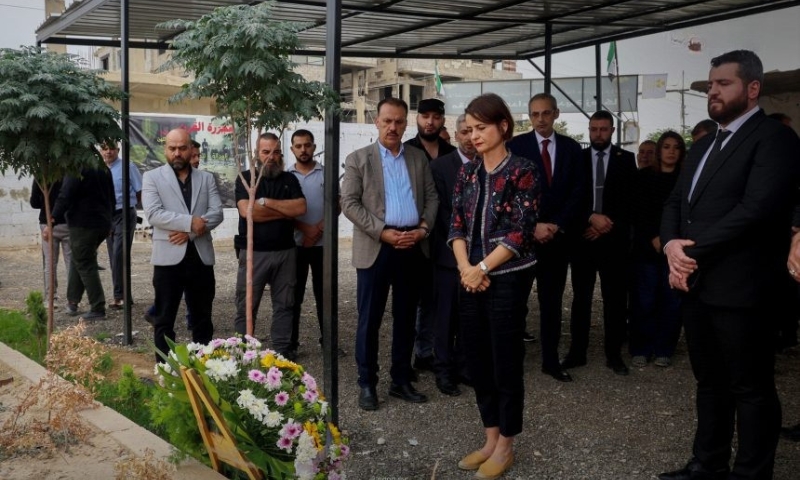
Holding those responsible for chemical weapons use in Syria under the former regime accountable was a central focus of the visit by Sabrina Dallafior, Director-General of the Organisation for the Prohibition of Chemical Weapons (OPCW), particularly its humanitarian and human rights dimensions.
At a joint press conference with Dallafior on October 13, Syrian Foreign Minister Asaad al-Shaibani said that closing the chemical weapons file must begin with redress for victims, ensuring these atrocities are never repeated, and securing justice for those affected. He noted that 18 suspects accused of using these weapons, including senior officers, had been detained and were still appearing before the competent courts.
Dallafior said the organisation was continuing to investigate past attacks and identify those responsible to prevent chemical weapons from being used again, with strong international support for addressing this legacy.
The Importance of Government Coordination With the OPCW
Fadel Abdulghany, executive director of the Syrian Network for Human Rights (SNHR), believes cooperation between the Syrian government and the OPCW represents an important development in efforts to secure accountability for chemical weapons use in Syria because it provides access to evidence and information that remained concealed for many years.
Speaking to Enab Baladi, Abdulghany said this cooperation provides access to new sources of evidence, including military and security archives; records of chemical weapons production, storage, and transport; operational orders; and correspondence concerning chains of command and decision-making. These sources, he said, could prove decisive in linking attacks to specific military units and then identifying individual roles within those units and institutions.
He stressed that eliminating chemical weapons does not end legal responsibility for their use. Closing the chemical weapons program file from a technical standpoint does not close the file on crimes committed using those weapons, which requires independent criminal investigations, fair trials, and redress for victims.
The OPCW’s Role in Accountability
Abdulghany said the OPCW plays an essential role in accountability efforts, while stressing the need to distinguish its technical and investigative mandate from the jurisdiction of criminal courts. The organisation’s Fact-Finding Mission verifies whether toxic chemicals were used as weapons, while its Investigation and Identification Team (IIT), established in June 2018, identifies those responsible for attacks falling within its mandate.
He added that the investigation team had issued five main reports covering seven incidents of chemical weapons use, in cooperation with SNHR. The network’s participation, he said, demonstrated the importance of combining national human rights documentation with specialised international investigations.
According to Abdulghany, human rights organisations have detailed knowledge of events and local conditions, longstanding relationships with victims and witnesses, and databases built up over time. The OPCW, meanwhile, has specialised technical, laboratory, and investigative capabilities that enable it to analyse and verify evidence, including chemical samples, munition remnants, satellite imagery, and data concerning how attacks were carried out.
100,000 Documents: What Does the Number Mean?
Syria’s foreign minister said Damascus had provided the OPCW with more than 100,000 official documents and granted it access to records and witnesses. In statements to Syria’s al-Ikhbariya television on October 13, Nidal Shikhani, director of the Chemical Violations Documentation Center of Syria, explained that the documents reveal how the chemical weapons program operated. This includes manufacturing, storage, and transport; the roles of personnel at studies and research centers and educational institutions; and the individuals who issued orders to use chemical weapons.
Abdulghany said the Syrian government’s announcement that it had handed over more than 100,000 official documents to the OPCW represented an important development because it could give investigators access to extensive records concerning the Assad regime’s chemical weapons program that had been unavailable in previous years.
He added that the documents could reveal the program’s organisational structure, the entities responsible for producing, storing, and transporting toxic substances, the military units that received them, and the relationships between the military, security, and scientific institutions involved in managing the program.
Despite their importance, Abdulghany said handling such a large volume of documents requires rigorous procedures. These include preserving originals, recording each document’s source and how it was obtained, examining its authenticity and integrity, and analysing its contents against other evidence. Documents that may be incomplete, misleading, or prepared to conceal the nature of certain activities must also be scrutinised.
Where Victims Fit In
During her visit, Dallafior met relatives of victims and survivors of the chemical weapons massacre in Zamalka (Damascus countryside, southwestern Syria). She listened to their accounts of the massacre committed by the Assad regime in the city in 2013.
Abdulghany believes Dallafior’s meeting with victims’ relatives and survivors affirms that Syria’s chemical weapons file is more than a technical matter involving facilities, munitions, and their disposal. It concerns crimes that left thousands of victims and continuing health, psychological, and social consequences.
He stressed that victims must be at the center of efforts to establish the truth and secure accountability. They should not be treated solely as witnesses or sources of information, but as rights holders entitled to the truth, access to justice, reparations, and appropriate medical and psychological care.
Abdulghany said SNHR’s experience had demonstrated that the participation of victims and eyewitnesses was essential to documenting chemical attacks since 2012. Testimony, however, must be verified and cross-checked against other sources, including medical, physical, and digital evidence, to form part of a coherent body of evidence.
222 Chemical Attacks
SNHR documented 222 chemical attacks between the first documented use of chemical weapons on December 23, 2012, and December 8, 2024. Forces of the former regime carried out 217 of these attacks, approximately 98% of the total.
According to SNHR, these attacks killed 1,514 people, including 1,413 civilians, among them 214 children and 262 women, and injured 11,080 people.
Between August 2025 and August 2026, developments in Syria gave the OPCW broader access to sites, documents, and information related to the former regime’s chemical weapons program.
In January 2026, the organisation’s Investigation and Identification Team concluded, applying the standard of “reasonable grounds to believe,” that the former regime’s air force carried out the chemical attack on Kafr Zeita (Hama governorate, central Syria) in October 2016. This finding forms part of the official international record.
The OPCW’s Technical Secretariat and the United Nations pointed to more than 100 sites potentially linked to chemical weapons program activities, along with additional sites that had not been included in previous official declarations.
SNHR called on the current Syrian government to continue full, verifiable cooperation with the OPCW and allow unrestricted access to all sites, archives, and individuals connected to the chemical weapons program. It also urged the government to secure relevant materials, sites, and documents and preserve them under a documented chain of custody before their destruction.
The network also called on the Security Council to consider referring the situation in Syria to the International Criminal Court and to renew support for the International, Impartial and Independent Mechanism and the Independent International Commission of Inquiry on the Syrian Arab Republic.
In an interview with the official al-Ikhbariya television channel on October 6, Shikhani said efforts to combat impunity encompass those involved in producing, transporting, storing, or using chemical weapons, as well as companies that helped support the chemical weapons program and individuals placed on US and European sanctions lists for financing it.
Responsibility also extends beyond those who carried out the attacks to the chain of command, including those who issued instructions; those involved in transport, storage, and manufacturing; and those who knew chemical weapons were being used but failed to report or work to prevent their use. It also encompasses companies and other entities that provided support or helped conceal their use.