
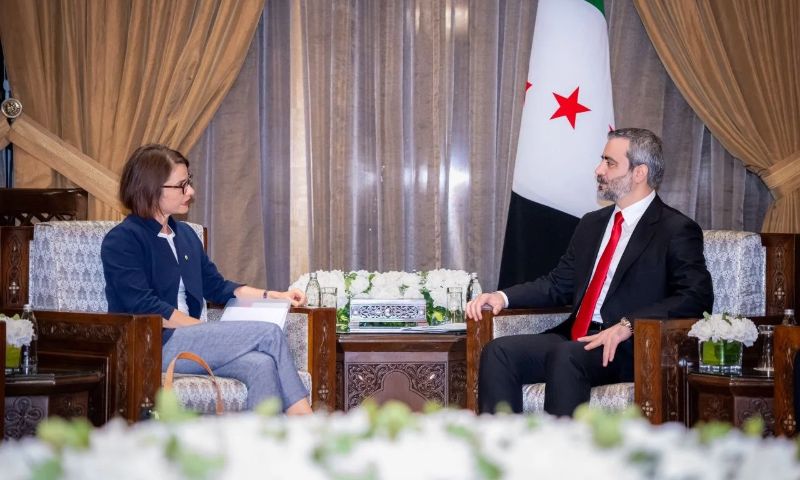

Syrian Foreign Minister Asaad al-Shaibani warned of challenges facing Damascus’s plans to eliminate chemical weapons, including mines, damaged sites, and records concealed or destroyed by the former regime.
He was speaking at a press conference in Damascus on Tuesday, October 13, alongside Sabrina Dallafior, Director-General of the Organisation for the Prohibition of Chemical Weapons (OPCW).
The Syrian foreign minister said the two sides discussed a roadmap to help move from the progress achieved on chemical weapons toward definitively closing the file. They also discussed a proposed joint plan with steps measured against concrete milestones.
He noted that these challenges require sustained efforts to fill gaps in the available information and uncover the full extent of the chemical weapons program.
Closing the File Begins With Justice for Victims
The Syrian foreign minister said closing the chemical weapons file begins with securing justice for victims, ensuring these atrocities are never repeated, and achieving accountability for Assad’s chemical massacres.
He said 18 people accused of using these weapons, including senior officers, had been detained and were still facing proceedings before the competent courts.
He added that Syria had joined the International Partnership against Impunity for the Use of Chemical Weapons, reflecting its belief that holding the perpetrators of these crimes accountable is a fundamental right that is not subject to a statute of limitations.
He noted that Syria had provided the OPCW with more than 100,000 official documents and granted it access to records and witnesses.
He explained that Damascus took the initiative in June to correct the declaration inherited from the former regime, adding a production facility, two storage facilities, and munitions that the Assad regime had concealed.
On September 3, UN High Representative for Disarmament Affairs Izumi Nakamitsu said the Syrian government had amended its initial declaration in June after discovering previously undeclared chemical weapons. It also declared an additional chemical weapons production facility and two storage facilities.
According to information presented by the United Nations, the discoveries also included a new chemical associated with the production of nerve agents and empty chemical munitions.
The Syrian foreign minister said these efforts led to the restoration of Syria’s full rights and privileges within the organization on July 9. He described the step as a “historic milestone” that received unprecedented unanimous support from member states.
He said Damascus’s efforts culminated in August with the destruction of 42 declared chemical aerial bombs under OPCW supervision, marking the first verified destruction on Syrian territory since 2014.
OPCW Investigates Previous Attacks
OPCW Director-General Sabrina Dallafior said the organization continues to investigate previous attacks and identify those responsible, aiming to prevent the renewed use of chemical weapons, with strong international support for addressing this legacy.
Dallafior added that visiting Syrian sites is a priority from a nonproliferation perspective, to secure any remnants of the Assad-era chemical weapons program and help protect the Syrian people and the region.
She explained that visiting Damascus had been a priority since she took office two months earlier, allowing her to assess conditions on the ground, hold discussions with her Syrian counterparts, meet victims, and visit Syrian sites.
Dallafior noted that the organization had destroyed a number of chemical weapons in cooperation with the Syrian government, describing the step as “a turning point and a result of the multilateral system working successfully.”
Syria Regains Its Rights Within the Organization
At its 112th session, the OPCW Executive Council adopted a draft decision to restore Syria’s rights and privileges within the organization, which had been suspended since 2021.
The decision was co-sponsored by 67 states parties from different regional groups and adopted by consensus, according to the organization’s statement issued on July 9.
The organization said the decision followed a fundamental change in circumstances since the Organization for Security and Co-operation in Europe suspended certain rights and privileges of the Syrian Arab Republic in 2021.
Syria welcomed the Executive Council’s adoption of the decision restoring its rights and privileges under the Chemical Weapons Convention.
It described the decision as “an important step reflecting the progress achieved in fulfilling obligations and constructive cooperation with the Technical Secretariat in addressing the legacy of the chemical weapons program from the former regime’s era.”