

Al-Hasakah, Mohammed Jaffal
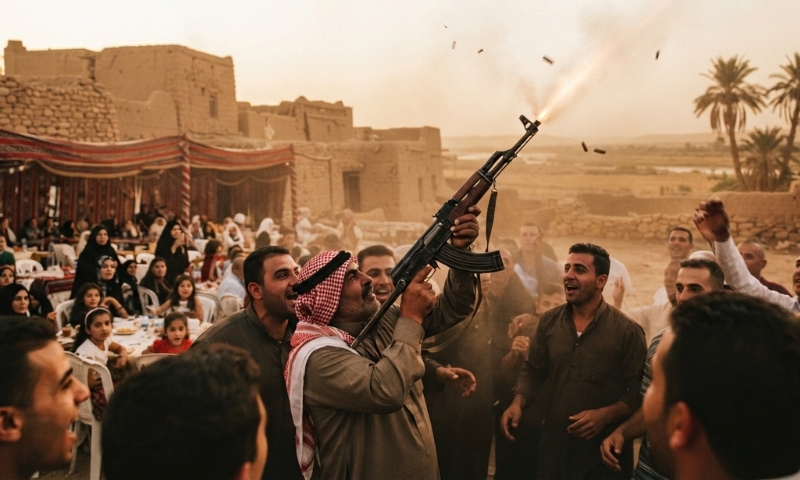
Residents of al-Hasakah (northeastern Syria) do not need a major occasion to hear gunfire in their neighborhoods. Shots fired into the air during celebrations, social gatherings, or personal disputes have become a recurring threat to civilians.
Over recent months and years, the city has recorded repeated incidents in which stray bullets have killed or wounded civilians, including children. Security measures and repeated warnings have failed to end the practice, which is linked both to celebratory gunfire and to the widespread possession of weapons among residents and the multiple security and military forces that have controlled the area.
The latest victims were two children in the city’s Mushayrifah and Tal Hajar neighborhoods. The two incidents brought indiscriminate gunfire back to the forefront of residents’ daily concerns.
These incidents come as al-Hasakah governorate undergoes a security and administrative transition. Arrangements are still being implemented to integrate the institutions and forces of the dissolved Syrian Democratic Forces (SDF) into Syrian state institutions, following years of SDF military and security control in the governorate.
Repeated Incidents
Civilians have repeatedly been struck by stray bullets in al-Hasakah this year. In March, two people, including a child, were killed and eight others sustained injuries of varying severity during Nowruz celebrations in al-Hasakah, Qamishli, and Amuda (northeastern Syria). Among those injured was al-Jihad Sports Club player Ali Issam Sheikhmous.
In April, five-year-old Abdul Razzaq al-Dabzi died from injuries caused by a stray bullet in al-Hasakah’s al-Omran neighborhood. The incident prompted calls for firmer measures to curb indiscriminate gunfire.
In May, another five-year-old child was killed in the city after being struck by a stray bullet during celebratory gunfire. Sources also reported other injuries caused by gunfire in al-Hasakah and Qamishli.
Earlier, in September 2025, a nine-month-old infant was struck by a stray bullet in al-Hasakah’s al-Mufti neighborhood. The bullet pierced his shoulder, passed through his lung, and lodged in his lower abdomen, according to a medical source at the time.
Despite their differing circumstances, these incidents reveal a problem that extends beyond gunfire during any particular occasion. It recurs at different times, exposing residents to bullets even in their homes, on the streets, and in public places.
The danger of stray bullets increases in densely populated cities. A person firing into the air cannot determine where the bullet will land when it falls back to the ground, while civilians in residential neighborhoods are the most exposed to the consequences.
“One Bullet Is Enough”
Saleh Obeid, a resident of al-Hasakah city, believes the continued killing and wounding of civilians by indiscriminate gunfire means the problem has moved beyond individual behavior and become a community safety issue.
Saleh told Enab Baladi that residents have been familiar with gunfire during celebrations for years. However, repeated injuries and deaths, particularly among children, require treating it as a dangerous offense rather than merely a social custom.
He added that curbing the practice requires clear, strict security measures, beginning with banning gunfire during celebrations and holding offenders accountable, alongside monitoring venues and gatherings where shots are commonly fired.
Saleh believes leaving weapons accessible to civilians without adequate controls increases the likelihood of misuse. He stressed the need to address the widespread possession of weapons while tightening penalties for using them in ways that endanger others.
Celebrations Become a Source of Fear
Gunfire is not limited to public celebrations. It can also occur at weddings, celebrations of academic success, gatherings marking detainees’ release, and other family and social occasions, as well as during personal disputes.
Indiscriminate gunfire during various occasions in al-Hasakah and Qamishli has killed and wounded civilians, including children, this year, prompting renewed public demands to ban the practice.
Shihab al-Ahmad, an al-Hasakah resident, told Enab Baladi that awareness campaigns alone cannot solve the problem because residents “already know how dangerous bullets fired into the air are.” He linked its persistence to weak deterrence and the large number of weapons held by residents.
Shihab believes security agencies should intervene directly at events where gunfire is expected. He called for venue owners to take preventive measures, including banning weapons from celebration venues, and for anyone firing a weapon inside the city to be held accountable.
He said efforts to address the practice must be accompanied by a broader plan to control weapons held by civilians. In his view, their continued widespread availability means any family or social dispute can turn into a shooting within minutes.
The latest incidents coincide with a security and military transition in al-Hasakah governorate. At the beginning of this year, the governorate underwent extensive changes on the ground, with government control extending to large parts of rural al-Hasakah while the SDF remained in the main cities, including al-Hasakah and Qamishli.
Multiple Authorities and Widespread Weapons
Speaking to Enab Baladi, activist Abdul Razzaq al-Abbas linked the persistence of indiscriminate gunfire to security and social factors that have accumulated over the preceding period.
Al-Abbas said the governorate’s security landscape involves multiple authorities with different areas of influence and responsibility. This has affected security agencies’ ability to enforce uniform rules governing weapons inside cities.
He added that the current phase, during which forces and institutions are being integrated, requires clear measures to establish a unified security authority and identify who is responsible for controlling weapons and addressing violations inside cities.
In his view, addressing the problem should go beyond pursuing those who fire weapons after injuries occur. It should begin with prevention, through monitoring parties, celebrations, and gatherings where gunfire might occur and requiring organizers to take measures that prohibit carrying or using weapons.
He also believes laws and deterrent penalties must be introduced against those who fire indiscriminately and enforced consistently, alongside mechanisms for addressing the widespread possession of weapons among civilians.
Al-Abbas considers the continued presence of weapons outside security and military institutions an additional risk, particularly in densely populated cities where residential neighborhoods overlap with areas of commercial and social activity.
Beyond Tougher Penalties
Although tougher penalties are one possible measure to curb gunfire, the views presented suggest that ending the practice requires addressing the factors that allow it to persist. These include the widespread availability of weapons, weak oversight of celebrations, and unclear security responsibilities during the transition.
The incidents recorded this year indicate that civilians, particularly children, are paying the price. Where a falling bullet strikes depends less on where it was fired than on where the person it hits happens to be.
In al-Hasakah city, which has experienced years of security tensions and control by multiple forces, establishing a unified security authority and controlling weapons appear to be essential parts of addressing indiscriminate gunfire.
As integration arrangements continue to be implemented, security agencies’ ability to enforce uniform rules inside cities is also being tested through everyday issues. These include protecting residents from uncontrolled weapons and preventing social occasions from becoming another source of casualties.