
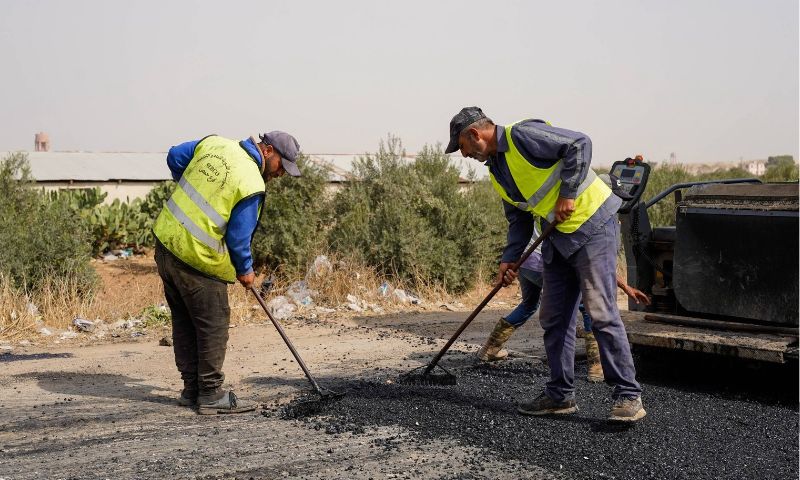

Homs Governorate (central Syria) is continuing to implement a package of projects under the “Athar” initiative, launched on October 15, aimed at improving public services and developing infrastructure in the city.
Abdul Basit Qaddour, coordinator of the “Athar” initiative, told Enab Baladi that the projects include street lighting, sewage and stormwater drainage systems, as well as the rehabilitation of parks, roads and sidewalks, the provision of waste containers and the installation of traffic signals, including the redesign of University Roundabout.
According to the announced project details, the work includes preventive measures to improve road readiness and reduce rainwater accumulation on streets by rehabilitating, cleaning, and clearing 14,000 stormwater drains and installing 1,500 new covers to replace missing or damaged ones.
The work also includes removing the University Roundabout, redesigning the intersection, repaving it, and installing new traffic signals to ease congestion and regulate traffic around the university. The sewage network will also be rehabilitated to reduce blockages and overflows, improving street cleanliness and public health.
To improve pedestrian safety, the project includes rehabilitating sidewalks and curbs, starting from the al-Khalidiyah neighborhood toward Cairo Street, to improve pedestrian routes and organize movement along both sides of the road.
The projects also include rehabilitating seven parks across the city to provide public spaces for children, families, and community activities, while expanding green spaces in residential neighborhoods. Existing traffic signals will also be replaced with new AI-powered systems at 29 intersections in Homs.
In the street lighting sector, the project aims to standardize lighting along the main road from the National Hospital toward Deek al-Jinn, improving nighttime visibility and road safety.
In the sanitation sector, the work includes replacing old and deteriorated waste containers with new ones and distributing them across the city’s neighborhoods to improve waste collection services.
Qaddour added that the program targets several damaged neighborhoods across the city, including northern and southern Deir Baalba, al-Sabil, Jubb al-Jandali, Karm Shamsham, Wadi al-Sayeh, al-Ashira, Karm al-Zeitoun, Baba Amr, al-Khalidiya, al-Taaminat, Jourat al-Shayyah, al-Qarabees, al-Bayada, the neighborhoods of Old Homs, Bab Houd, Bab Dreib, Bab Tadmur, Bab al-Sibaa, Bani al-Sibai, Jamal al-Din, al-Qusour and al-Hamidiyah.
According to Qaddour, the projects are expected to take between four and five months to complete, at a total cost of $4.5 million. He explained that the private sector is participating in their implementation under the supervision of the municipality and the water and sanitation authority.
Extent of Damage Across Homs’ Sectors
Several residential and public service sectors in Homs Governorate sustained damage during the years of war in Syria, including homes, schools, healthcare facilities, bakeries and places of worship. This has created challenges for restoring essential services and rehabilitating infrastructure.
Earlier, the Planning and Statistics Directorate at Syria’s Ministry of Local Administration and Environment, in cooperation with the United Nations Human Settlements Programme (UN-Habitat), issued reports assessing damage and needs across the governorate, based on data from the final quarter of 2025.
The assessment found that 5.2% of residential units had been destroyed, while 7% had sustained severe damage, 9% moderate damage, and 10.1% minor damage. Meanwhile, 68.8% of homes remained structurally sound.
In the education sector, the report documented varying degrees of damage to 527 schools. In the bakery sector, 35 bakeries had been destroyed, and 27 had sustained varying levels of damage, while 177 remained intact.
In the healthcare sector, the data showed that 32.4% of hospitals were no longer operational, while 43 of the governorate’s 410 health centers had sustained severe damage or been destroyed.
As for places of worship, 126 of the governorate’s 757 mosques had sustained severe damage or been destroyed, while five of its 146 churches had suffered varying degrees of damage.
According to the assessment, these findings provide a reference for identifying development priorities and directing rehabilitation and reconstruction efforts according to the extent of damage and the needs of different sectors.