
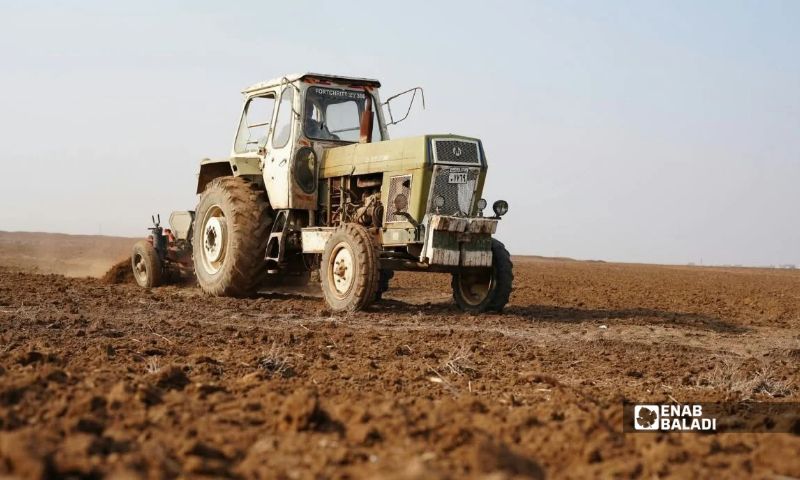

With the first autumn rains falling on parts of Syria’s Jazira region (northeastern Syria) several days ago, farmers began preparing for winter plowing ahead of planting crops, particularly wheat and barley, which form a central part of the region’s agricultural activity.
Plowing is one of the first stages of fieldwork. Preparing the land requires a series of operations that vary according to soil type, moisture levels, and the crop to be planted, as well as the availability of agricultural machinery and its operating costs.
While farmers today rely on tractors, plows, and machinery designed to break up and level the soil, traditional tools remain in the memories of older residents who lived through a time when animals and wooden and iron implements performed most plowing work.
Agricultural engineer Hassan Hamid told Enab Baladi that the timing of plowing depends on how much rain an area receives and the condition of its soil. Rainfall does not necessarily mean that all land becomes ready for plowing at the same time, he explained, because soil types and their ability to retain moisture differ from one field to another.
Hamid added that some farmers prefer to wait for the first rains before bringing machinery onto their land, as moisture helps prepare the soil for cultivation. Plowing very hard, dry soil can be more difficult and costly. Conversely, taking machinery onto waterlogged land can cause the soil to clump or become compacted, making it important to assess the right timing before work begins.
The agricultural engineer noted that some farmers wait after rainfall for weeds to emerge in the moist soil, then turn over or harrow the soil surface to remove them before planting. This practice is known in agriculture as a “false seedbed” when carried out as part of an appropriate land preparation plan. However, Hamid said it is not suitable for every field, as delaying plowing may be inappropriate when planting time is approaching or insufficient moisture is available.
From Plowing to Breaking Up the Soil
Preparing the land involves more than turning over the soil. It includes using different tools and machines, each serving a specific purpose according to the field’s condition and the work required. Among the main implements are the plow, which cuts into and turns over the soil; equipment known locally as the “disk”; and the “harrow,” which is used to rake the soil, break up clods, and level the surface to varying degrees.
Hamid explained that modern tractor-drawn plows vary in their design and operation. Moldboard plows turn over a slice of soil, while other types use tines or metal components that penetrate and loosen the ground without fully turning it over. The choice of implement depends on the nature of the land, how compact the soil is, and the purpose of plowing, rather than simply which machine is available.
He added that the local term “sikka” may refer either to the plow itself or to the iron component that cuts into the soil in some types of plow. In some colloquial usage, “faddan” refers to the plowing setup or the plow, though its meaning may differ from one area to another.
The “disk” uses metal discs that rotate as the implement is pulled across the ground, breaking up the soil, cutting plant residues, and mixing them into the surface layer. This equipment is used in land preparation, but its working depth and intensity depend on its design, settings, and soil conditions.
The “harrow,” meanwhile, rakes the soil and breaks up clods that may remain after plowing, helping prepare a suitable surface for sowing. Agricultural harrows come in different types, including those that use discs and those fitted with metal tines.
Hamid noted that some fields require several stages of work, beginning with plowing, followed by breaking up clods and leveling the surface, and finally sowing. Farmers may use a leveling implement when field conditions require it. However, these steps are not the same for every piece of land, the agricultural engineer said. They depend on soil type, the crop, and whether the farming system relies on rainfall or irrigation.
Once the land has been prepared, mechanical seed drills distribute seeds at specified intervals and depths according to the machine’s settings and the crop being grown. These machines help make sowing more orderly, but their success also depends on proper land preparation, correct adjustment of the seed drill, and attention to moisture conditions.
Old Tools Replaced by Machinery
Before tractors and modern equipment became widespread, farmers in Syria’s Jazira relied on simple implements drawn by animals, particularly oxen, to plow their fields. The process required physical effort and more time, as well as experience in guiding the animals and controlling the plow’s direction and working depth.
Rajab Saleh, an older resident of the region who used traditional implements, told Enab Baladi that plowing used to begin with preparing the plow and attaching it to the animals, then guiding them along successive paths through the field. Successful work depended on the farmer’s ability to control the animals’ movement and keep the furrows straight, alongside knowledge of the land and the right time to work it.
Saleh explained that the traditional plow consisted of wooden and iron components, with a metal part at the front known as the “sikka,” which cut into the soil as the plow moved. The plow needed a frame to support its components and transmit the pulling force, while a yoke was used to harness the animals for work, according to the design used in each area.
He added that some smaller tools served functions just as important as those of the plow itself. Farmers needed a long stick to guide the animals and urge them forward, and also used it to remove mud that clung to parts of the plow during work.
Among the names Saleh used for traditional plowing tools were “kabousa” and “massas.”
According to Saleh, the transition from traditional plowing to modern machinery involved more than replacing one tool with another. It changed how quickly work could be completed and how much land farmers could prepare. Animal-drawn plows required considerable time and effort, while tractors can cover larger areas in less time, although fuel, maintenance, and equipment rental costs have become factors in farmers’ calculations today.
Plowing as Part of Rural Memory
Beyond their agricultural function, old tools carry social meanings tied to rural life and the division of labor within families and communities. Preparing the land required cooperation and expertise passed down from one generation to the next, while knowing when to plow and interpreting changes in the weather and soil conditions formed part of farmers’ everyday knowledge.
Social expert Ahmed al-Hassan told Enab Baladi that the shift from traditional tools to modern machinery reflects a broader transformation in rural life, encompassing the nature of agricultural work, the time needed to complete it, and the relationship between farmers and the land. Whereas plowing once depended heavily on animal power and human effort, it is now tied to the availability of machinery and fuel and the ability to afford operating costs.
Al-Hassan added that traditional tools are more than old means of production. They form part of the social memory of farming communities because they are connected to farmers’ experiences, working methods, and knowledge acquired over many years. Documenting these tools, their names, and their functions could preserve an aspect of local agricultural heritage, he said, particularly as their use has declined with the spread of mechanization.
He noted that documenting the terminology requires listening to older residents and farmers in more than one area, photographing tools still in their possession, and recording their names in local dialects alongside explanations of how they were used. Some names may differ from one village to another, while a single name may have more than one meaning depending on the context.
As winter plowing begins after the first autumn rains, inherited expertise combines with modern tools in the fields of Syria’s Jazira, allowing the land to be prepared more quickly.
As farmers prepare to plant wheat and barley, the season’s success remains dependent on several factors, particularly regular rainfall, the timing of agricultural operations, soil conditions, and the costs of plowing and sowing. At the same time, this period offers an opportunity to recover part of the region’s agricultural history by documenting the tools farmers once used, the names they gave them, and the knowledge associated with their use.