
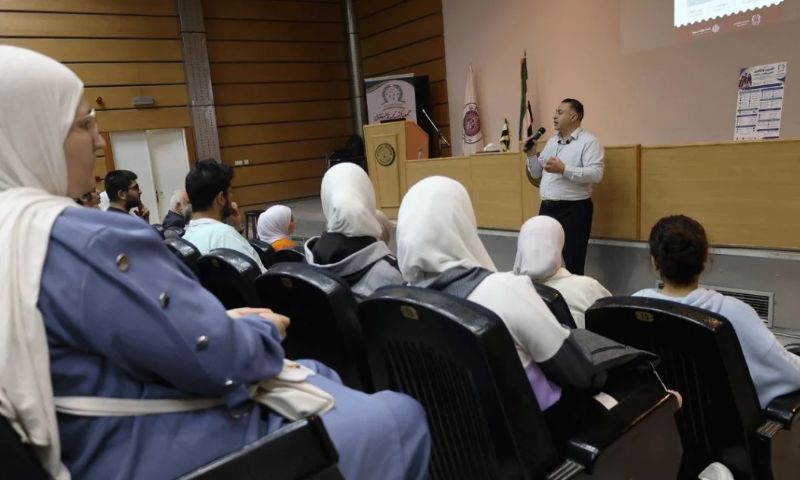

Damascus University announced on Wednesday, October 28, that it is finalizing codes of conduct aimed at regulating relations among members of the university community and defining the rights, responsibilities, and rules of interaction among students, faculty members, and administrative staff, both on and off campus.
Ahed Abu Younes, Damascus University’s Vice President for Scientific Affairs, told the Syrian news outlet al-Ikhbariya that the university had completed the code of conduct for faculty members, while those for students and administrative staff were nearing completion.
Regarding their publication date, she confirmed that the codes would be widely circulated once work on updating the university’s website was completed.
Rules of Conduct and University Ethics
Abu Younes said the codes of conduct provide a clear summary of the duties and responsibilities that every member of the university community must fulfill, whether faculty members, students at different stages of their studies, or administrative staff. They establish standards of conduct and university ethics both on and off campus, helping create a healthy educational environment.
According to Abu Younes, the codes include rules governing interactions among researchers, the protection of public facilities and infrastructure, and internet use. They also regulate the use of artificial intelligence in preparing research and conducting peer reviews, while prohibiting fabricated content and practices that undermine university values.
The codes also address aspects of daily university life, clarifying each individual’s rights and obligations to prevent violations of regulations or actions that could harm the university.
Regulating Relations Among Students, Faculty, and Staff
Abu Younes explained that the codes were developed following an in-depth examination of various aspects of daily university life and a review of regulations governing relations among students, faculty members, and administrative staff. The aim was to produce a concise, accessible document outlining rights and responsibilities and establishing clear rules for interaction.
According to Abu Younes, the drafting process takes the Universities Organization Law into account and provides a simplified reference that university members can consult easily. The codes are intended to serve as a unified reference for the entire university community, facilitating the handling of complaints, strengthening discipline, and fostering an educational environment based on mutual respect.
She added that the student code of conduct is being developed in cooperation with the university, the Student Union, and the Ministry of Administrative Development, as part of efforts to establish a unified framework covering all groups within the university.
Ban on Hate Speech at Universities
Syria’s Minister of Higher Education and Scientific Research, Marwan al-Halabi, had previously issued a decision prohibiting the publication, circulation, or promotion, by any means, whether verbal, written, or online, of content that incites hatred or sectarianism or undermines national unity or civil peace.
In its decision issued on May 10, 2025, the ministry specified that the ban applies to faculty members, students, and employees of the Ministry of Higher Education and Scientific Research, as well as all public and private universities, higher institutes, and entities affiliated with the ministry or directly linked to the minister.
Article 2 of the decision stipulates that violations may result in criminal, civil, and disciplinary accountability, with offenders referred to the relevant disciplinary boards for appropriate penalties.
According to the decision, penalties may include permanent dismissal or referral to the judiciary, in accordance with applicable laws and regulations.