
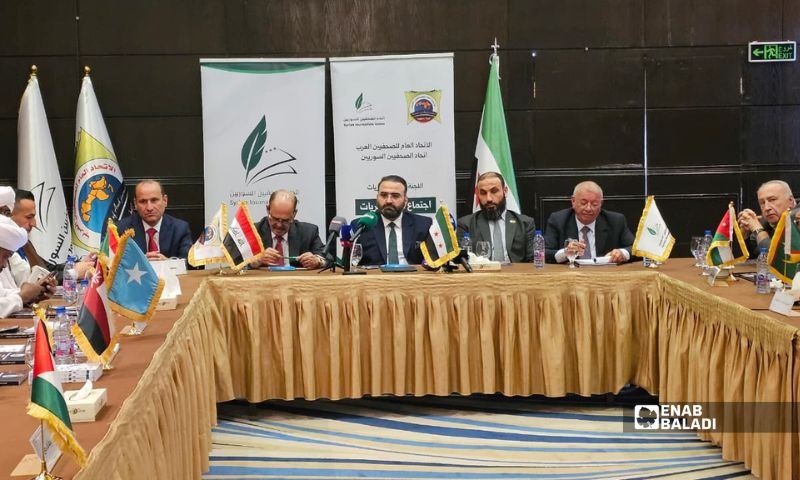

Protecting journalists, the lack of modern legislation, and difficulties accessing information were prominent issues raised by Arab journalists’ union officials speaking to Enab Baladi on the sidelines of a press freedom conference in Damascus.
The Federation of Arab Journalists’ Permanent Committee for Press Freedoms held its conference on Friday, October 16, with around 18 Arab delegations participating, to launch its annual report on press freedoms in the Arab world for 2025 and 2026.
Based on reports from the federation’s member journalists’ organizations, the report documents violations against journalists and these organizations’ efforts to support freedom of opinion and expression.
Protecting Journalists and Obstacles to Their Work
Mohammad al-Lahham, head of the Palestinian Journalists Syndicate’s Freedoms Committee, told Enab Baladi that Israeli attacks had killed around 263 journalists and media workers in Palestine.
Al-Lahham described the attacks on journalists as a war of “journalistic genocide,” noting that journalists were also being targeted in southern Lebanon and southern Syria.
Across the Arab world, al-Lahham identified the main obstacles to journalism as a lack of modern laws and regulations governing the profession and difficulties accessing official sources, leaving room for rumors and speculation.
“We share the same concerns across the Arab world, and the enemy is the same. But within our own countries, we must work to uncover the truth, because we want greater freedoms so that there can be real freedom of expression in the Arab world,” he said.
Ali Youssef, deputy chair of the Federation of Arab Journalists’ Press Freedoms Committee, said the difficulties journalists face combine local and global challenges, and that confronting violations requires adapting journalistic tools and working collectively.
“We face a major battle, and we need to adapt our role to restore the profession’s standing in shaping public opinion. Today, we need to go beyond simply addressing freedoms to examine the state of journalism and its role in the region,” Youssef said.
Information Minister Discusses Building Free Media
Syrian Information Minister Khaled Zaarour told the conference that Syria was moving toward establishing free media grounded in the fundamental principles of press freedom.
“We are working to build and overcome the administrative inefficiency and weaknesses across various sectors that we inherited from the ousted regime,” he added.
He said reporting facts and placing events in their proper context required addressing issues objectively, rather than merely highlighting problems.
Zaarour said that “more than 700 martyrs in the journalism sector paid with their lives for freedom during the Syrian revolution,” and that “the sacrifices Syrians have made are laying the foundations for a free media environment that reflects their aspirations.”
In a statement published on May 3, 2024, the Syrian Network for Human Rights documented the killing of 717 journalists and media workers by parties to the conflict and forces controlling territory in Syria between March 2011 and May 2024, including 53 who were killed under torture.
Discussing Support for Syrian Media
Baraa Othman, a member of the Syrian Journalists Union’s executive bureau, told Enab Baladi that Damascus had hosted the conference and the launch of the media freedoms report for the first time in 16 years.
He said holding the conference demonstrated that Syria was regaining its role in the Arab world.
He explained that the meeting discussed the state of freedoms in Syria and the Arab world, and ways Arab unions and countries could help advance media freedom and freedom of expression in Syria.
Syria Rises in Press Freedom Rankings
Syria climbed 36 places in the 2026 World Press Freedom Index published by Reporters Without Borders (RSF), reaching 141st place, compared with 177th in 2025.
The organization attributed this marked improvement to the fall of Bashar al-Assad’s regime in December 2024, noting that the country was undergoing a political transition that had moved it out of the “black zone,” denoting a “very serious” situation, after many years as one of the world’s worst environments for journalism.
Media outlets that previously operated in exile or in areas outside the Syrian regime’s control have also returned to the forefront, most notably Radio Rozana, Enab Baladi newspaper, and websites such as Al-Jumhuriya and Aks al-Seir.
Meanwhile, media outlets close to Qatar, such as Syria TV and Al Jazeera, have gained significant influence in Syria’s news landscape.
Most international news agencies resumed operations in Damascus just hours after the ousted regime fell, according to the report.