
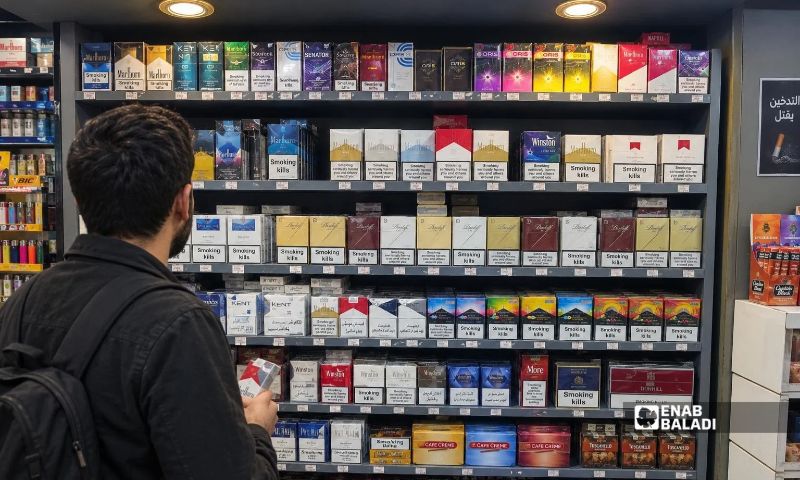

Choosing a pack of cigarettes or flavored shisha tobacco, commonly known as mu’assel, in Damascus markets is no longer simply a matter of personal preference or familiarity with a particular brand. Prices have become a decisive factor in what smokers can afford, amid difficult living conditions and rising costs of everyday necessities.
During visits to cigarette shops in Damascus, Enab Baladi observed significant price differences among well-known foreign brands. Smokers complained that prices were increasingly beyond their purchasing power, while vendors reported that some customers were switching to cheaper alternatives.
The impact of rising prices extends beyond consumers. Vendors also complain of occasional customs raids during which quantities of foreign cigarettes are confiscated, causing financial losses and raising questions about what happens to the seized goods, according to their accounts.
Price Differences Change Smokers’ Choices
Prices of foreign cigarette brands vary across Damascus markets depending on the brand and variety. Enab Baladi’s market survey found that a pack of Davidoff cigarettes costs between 250 and 750 Syrian pounds (approximately $1.79 to $5.36), while Marlboro ranges from 180 to 550 pounds (approximately $1.29 to $3.93). Winston costs approximately 250 pounds ($1.79), Kent 220 pounds ($1.57), and Oris 100 pounds ($0.71), while Kingdom and Gauloises range from 100 to 130 pounds ($0.71 to $0.93).
Prices of the locally produced al-Hamra brand range from 80 to 110 pounds (approximately $0.57 to $0.79), putting it close to some foreign brands.
As for flavored shisha tobacco, varieties of Mazaya cost between 180 and 200 pounds (approximately $1.29 to $1.43), while Al Fakher Black varieties sell for between 240 and 260 pounds ($1.71 to $1.86). Nakhla tobacco costs between 300 and 340 pounds ($2.14 to $2.43).
These prices illustrate the differences between available products, while smokers are finding it increasingly difficult to maintain their previous consumption habits. Some are forced to seek cheaper brands or reduce the quantities they consume.
Tahseen al-Dahhan, a Damascus resident, worker and head of a household, told Enab Baladi that rising cigarette prices have become an additional burden on his daily expenses, as his income is insufficient to cover his family’s basic needs.
He added that expensive cigarette brands place an additional strain on consumers amid deteriorating living conditions and continuously rising prices, particularly because the cheapest locally produced cigarettes are of poor quality and undesirable, in his view.
Another smoker, Alaa Darwish, said cigarette prices no longer match his purchasing power, explaining that rising prices of flavored shisha tobacco have led him to smoke shisha less frequently.
He considers Syria the most expensive country for these products compared with Gulf countries, Jordan and Lebanon, and called for price reductions. He noted that Al Fakher Black shisha tobacco now costs more than 250 Syrian pounds (approximately $1.79), slightly less than two dollars, while the same product sells abroad for between one dollar and $1.20.
Shift Toward Cheaper Brands as Dollar Sets Prices
Meanwhile, cigarette vendors in Damascus have noticed that some customers are turning to cheaper products instead of the brands they previously bought.
Marwan al-Sabaa, who owns a cigarette shop in Damascus, told Enab Baladi that customers now ask about prices before choosing a brand. Some are opting for locally produced cigarettes because they cost less than certain imported varieties.
He added that purchasing power has changed completely over the past year. Smokers who previously bought several packs of their preferred brand now purchase only one pack and smoke less frequently.
Another cigarette and shisha tobacco vendor, who requested anonymity, said the tobacco market suffers from irregularities affecting the availability and distribution of both locally produced and imported products.
He explained that pricing for imported products begins with major traders who import cigarettes and shisha tobacco and store them in warehouses. The price of each pack is calculated in US dollars based on the imported variety and its import cost.
Traders then convert that price into Syrian pounds using the daily dollar exchange rate. For example, if a pack costs two dollars and the exchange rate is 140 Syrian pounds to the dollar, its price becomes 280 pounds ($2) and changes as the exchange rate fluctuates.
Importers then distribute their products to wholesalers, who sell them to retail shops. Prices pass through these different stages of distribution, with import costs and the dollar exchange rate remaining key factors in determining the final retail price.
Customs Confiscations Increase Vendors’ Losses
Alongside rising prices and changing consumer preferences, shopkeepers and street-stall vendors in Damascus complain of intermittent customs patrols that confiscate quantities of foreign cigarettes.
According to the anonymous vendor, these campaigns can cause financial losses amounting to thousands of dollars. Vendors also do not know what happens to confiscated merchandise, reducing their businesses’ earnings and increasing their financial burdens.
He said the situation raises questions about how foreign cigarettes are traded in the market, the legal status of confiscated goods, the procedures followed in handling them, and why they are not returned.
He also questioned why foreign cigarettes and shisha tobacco are specifically targeted for confiscation when foreign goods are widespread across all sectors of the market, particularly food products.
Relevant Authority Declines to Respond
Enab Baladi contacted the Directorate of Internal Trade, affiliated with the Ministry of Industry, to inquire about regulations governing the sale of cigarettes and shisha tobacco in Syrian markets, the volume of domestic production and ways to support it.
The questions also covered the reasons customs patrols confiscate foreign products from stalls and shops, the role of the relevant authorities in seizing merchandise, and how the confiscated goods are handled.
However, the directorate declined to provide answers to these questions, according to a response received by Enab Baladi.
Smoking Costs Can Equal an Employee’s Salary
Complaints from smokers and vendors align with observations by economist and University of Hama professor Dr. Abdul Rahman Mohammed, who described changes in consumer behavior under pressure from rising prices.
He explained that some smokers are switching to cheaper domestic brands, while others are reducing consumption. Some may even consider quitting smoking for economic reasons.
According to Mohammed, the monthly cost of smoking for some employees can equal their entire monthly salary, depending on the type of cigarettes and their consumption rate. This makes smoking an additional burden on household budgets.
Mohammed linked this shift to factors beyond price differences. He argued that the quality of some domestically produced cigarettes influences consumers’ decisions and that their previous preference for foreign brands was partly driven by problems with local manufacturing quality, including poor production standards and cigarettes containing no tobacco.
He believes improving the quality of domestic products is essential to increasing consumer demand, rather than relying solely on lower prices to attract buyers.
Production and Distribution Problems: 500 Tons a Month
Mohammed does not attribute rising tobacco prices to a single factor. Instead, he links them to accumulated problems throughout the supply chain, from domestic tobacco production to cigarette imports and market distribution.
He pointed out that the General Tobacco Corporation’s limited production, relative to market demand, places additional pressure on domestic brands, particularly as consumers increasingly turn to them in search of cheaper alternatives to foreign cigarettes.
The General Tobacco Corporation is one of Syria’s oldest government institutions. Established in 1935, it operates under the Ministry of Industry and is headquartered in Latakia.
Mohammed estimates the corporation’s production at approximately 500 tons per month, which he believes is insufficient to meet growing demand. Meanwhile, reliance on informal imports makes the availability of foreign cigarettes dependent on supply and smuggling conditions, including security developments in neighboring countries.
He added that weak price-control and distribution mechanisms, along with the possibility of monopolistic practices involving certain brands, exacerbate market instability.
According to Mohammed, the General Tobacco Corporation denies responsibility for price increases and holds traders responsible for the higher prices.
He emphasized the need to distinguish between price increases caused by shortages in supply, those resulting from production and distribution costs, and those potentially arising from commercial practices or inadequate oversight.
In this context, the Syrian Center for Policy Research reported that annual inflation in the tobacco category reached 41% in 2026.
These figures come amid continuing structural inflationary pressures and high transportation and energy costs in Syrian markets.
Informal Supply Channels
Mohammed said some foreign cigarettes enter the Syrian market through informal channels, leaving them vulnerable to confiscation if they fail to meet legal and customs requirements.
In his assessment, the problem goes beyond confiscations to the absence of sufficient, well-regulated legal channels for supplying imported products.
He argued that tightening controls on unauthorized goods without addressing the reasons for their widespread availability would not necessarily lead to lower prices.
He also noted that the increased risks traders face when dealing in these products can be reflected in their selling prices, placing additional financial burdens on consumers.
Reforming Production and Regulating Imports
To address these problems, Mohammed proposed improving the quality of domestically produced cigarettes to strengthen consumer confidence.
He also recommended reviewing the prices paid to tobacco farmers to ensure they cover production costs and encourage farmers to continue cultivating the crop.
He warned that purchasing prices that do not reflect cultivation costs could push tobacco crops into informal trading channels, requiring a fairer pricing mechanism alongside improvements in production and manufacturing.
Mohammed also called for regulating foreign cigarette imports through clearly defined legal channels and requirements, rather than relying exclusively on confiscating products traded outside official channels.
In addition, he recommended developing distribution mechanisms that prevent monopolies and ensure domestically produced brands remain available in markets.
Mohammed concluded that rising tobacco prices in Syria are not an isolated pricing problem but reflect wider failures throughout the supply chain, from farming and production to imports, distribution and retail sales.
As smokers complain of declining purchasing power and vendors face losses from confiscations and shifting demand, resolving instability in the tobacco market will depend on the relevant authorities’ ability to improve domestic production, regulate imports and distribution, and strengthen market oversight.
These measures could help reduce the problems that ultimately affect the prices consumers pay.