
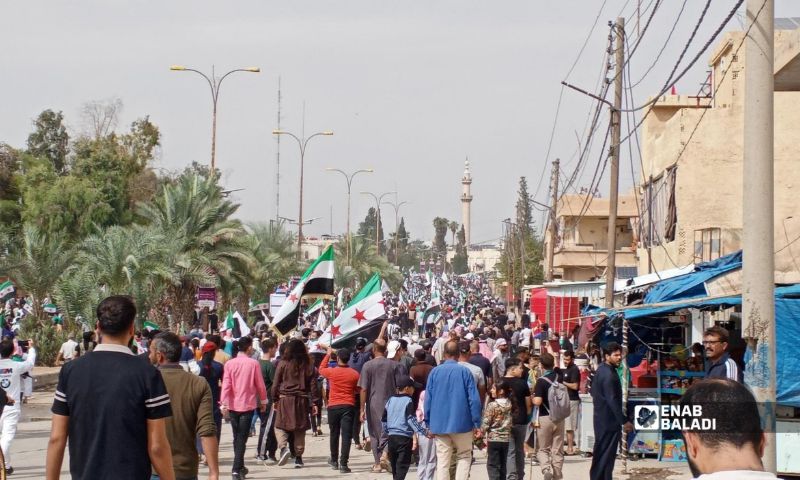

Security tensions are rising in al-Hasakah (northeastern Syria) amid allegations that members of the Revolutionary Youth Movement are targeting participants in demonstrations calling for the Syrian flag to be raised and state authority to be asserted, as well as assaulting civilians, searching their phones, and threatening them. These incidents are raising questions about the integration of military and security formations affiliated with the Syrian Democratic Forces (SDF) into state institutions.
The al-Hasakah Media Directorate reported that Mohammed Mahmoud Hassan, 27, was abducted on the morning of Sunday, October 11, from his workplace on al-Sittin Street in the city’s Ghweiran neighborhood. The directorate said members of the Revolutionary Youth abducted him because he had participated in demonstrations calling for the Syrian flag to be raised, security to be restored, and state sovereignty to be asserted.
According to the directorate, Hassan was detained and then handed over to an entity known as “Organized Crime,” which it said belonged to the Asayish forces integrated into the Internal Security Forces. He was later released through the efforts of the Internal Security Forces and the area administration.
The directorate quoted Hassan as saying that his abductors impersonated government security personnel and fired shots between his feet when he tried to resist detention, before beating and insulting him and threatening to kill him. It added that he was receiving treatment at home for the injuries and bruises he had sustained.
In the latest development, a number of residents of the al-Aziziyah neighborhood took up arms and set up checkpoints at the neighborhood’s entrances in al-Hasakah on the afternoon of Monday, October 12, to confront what they described as “provocations and actions by the Revolutionary Youth in the city.”
The development coincided with a statement from the al-Hasakah Internal Security Directorate affirming a ban on carrying weapons within the city. It added that “opening fire for any reason is strictly prohibited, and weapons shall be held exclusively by the state, represented by official security and military forces, only while performing their official duties.”
The directorate said the decision was intended to “preserve public order and citizens’ security and safety, and prevent chaos and the intimidation of residents.” It warned that “anyone who violates the decision will face strict measures, their weapon will be confiscated, and the necessary legal action will be taken against them without leniency.”
Targeting Protesters and Searching Phones
Complaints about the Revolutionary Youth’s conduct extend beyond Hassan’s abduction, according to local accounts given to Enab Baladi. Residents described armed groups operating in several neighborhoods and said they were targeting civilians because of their views or participation in recent demonstrations.
A resident of al-Hasakah’s Kababah neighborhood, identified by the initials A. S., who declined to have his full name published for security reasons, said Revolutionary Youth members had torn down a sign displaying Syria’s official visual branding and a welcome message at the city’s western entrance.
He added that the Revolutionary Youth had formed armed groups in several neighborhoods under the name “Commune Guards.” He said these groups stopped passersby, searched their phones, and treated them in a humiliating manner.
He also reported that a man and his companion had been assaulted while riding a motorcycle at the junction by the Joudi roundabout in al-Hasakah. He said such practices were increasing residents’ fears about their ability to move safely around the city.
According to the same source, raids and phone searches took place in Tal Hajar and al-Nasra, and along Ugarit Street, alongside what he described as a major tightening of security.
Abdulrahman al-Hassan, a resident of Ghweiran, said the city was experiencing severe tensions because of the Revolutionary Youth’s conduct, adding that tensions had escalated following the previous Friday’s demonstrations.
Al-Hassan added that, in his assessment, residents were not seeing sufficient intervention by government security forces to stop these practices or establish control throughout the city.
He said he had personally witnessed Revolutionary Youth members beating and insulting a young man in a northern al-Hasakah neighborhood simply because his mobile phone wallpaper showed the Syrian flag.
These accounts coincided with the circulation of a video that, according to the information accompanying it, showed Revolutionary Youth members assaulting people returning from Friday’s demonstrations in the al-Mufti neighborhood. There was insufficient independent information to verify all the details of the incident or identify the people shown in the footage.
Security Activities Outside State Institutions
Samer al-Ahmad, a journalist and activist from al-Hasakah, told Enab Baladi that events in the city reflected continuing complications in the integration process, despite the progress achieved in recent months. He noted that some groups had yet to adapt to the new changes and that some parties might be seeking to retain their previous influence.
Al-Ahmad added that the core problem was not the names of the formations, but the continuation of any security or armed activity outside state institutions, along with the abuses or attempts to impose control on the ground that might accompany it.
Al-Ahmad said Mazloum Abdi’s announcement dissolving the SDF was an important step, but that the real test remained its implementation on the ground. In his view, the continued activity of security formations outside official institutions points to gaps in the integration process and raises questions about the ability of former leaders to keep these groups under control.
He stressed that what was needed was more than changing names and military uniforms. Overlapping security structures must actually be ended, with a single security authority subject to the law and accountability.
Regarding security in the governorate, al-Ahmad said conditions were improving somewhat as the presence of state institutions expanded, but had not yet reached the required level of stability.
He added that, based on his monitoring of the recent popular mobilization, residents’ demands centered on establishing state authority, ending unauthorized armed activity, stopping unlawful arrests and abuses, ensuring the judiciary functions effectively, and guaranteeing the return of displaced people.
He said residents were no longer waiting for more statements and agreements. They wanted tangible results that improved their security and daily lives, while guaranteeing the rights of all communities in the governorate without discrimination.
Security Integration Leaves Overlapping Authorities
The developments in al-Hasakah come amid military and administrative changes in the governorate since early 2026, when the Syrian army took control of the southern and eastern countryside and parts of the western countryside, while the SDF withdrew to the main cities, particularly al-Hasakah and Qamishli.
This shift created overlapping control and administration across parts of the governorate. On January 29, 2026, the Syrian government and the SDF reached an agreement to begin integrating military, security, and service institutions into government structures and the relevant ministries.
The integration process began gradually in February, including steps to reorganize existing institutions and integrate SDF-affiliated formations into state institutions. However, the continued appearance of former groups’ names and complaints about armed activity outside official security structures raise questions about how fully the process has been implemented on the ground.
On August 25, Mazloum Abdi announced the dissolution of the SDF and its affiliated formations. On August 27, Syrian President Ahmed al-Sharaa issued a decree appointing Abdi as an adviser to the presidency.
Despite these developments, the accounts gathered by Enab Baladi indicate that some al-Hasakah residents still perceive multiple entities conducting security activities within the city, particularly in neighborhoods that have witnessed protests in recent days.