
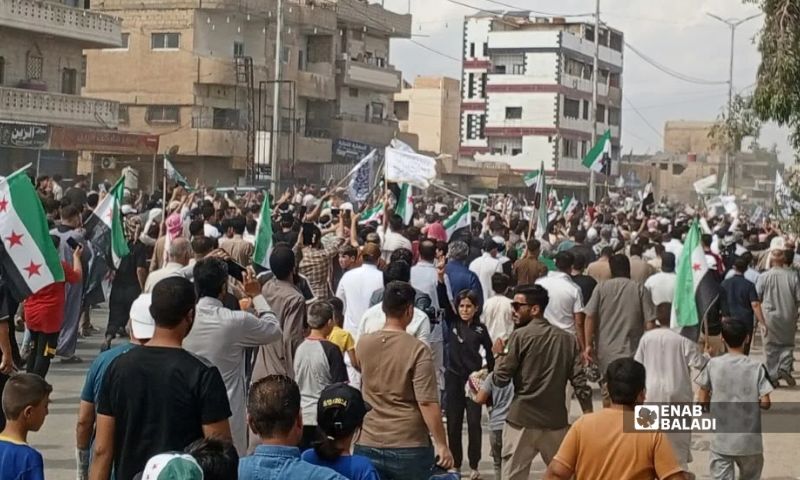

A demonstration set out after Friday prayers today, October 2, from Abu Bakr al-Siddiq Mosque in the Ghweiran neighborhood of al-Hasakah city, northeastern Syria. Protesters marched through several streets before reaching Governorate Square in the city center, calling for the extension of state authority, a stronger presence of government institutions, and an end to what they described as overlapping security and administrative authorities in the governorate.
The demonstration was held under the slogan “Friday for the Restoration of Sovereignty,” activist Ibrahim al-Halabi told Enab Baladi. He said preparations for the protest began on Thursday and that the main gathering point for participants was the large mosque in the Ghweiran neighborhood before they headed toward the city center.
The demonstration coincided with the deployment of Internal Security Forces across the streets of al-Hasakah. The forces had reinforced their presence since the morning, conducting mobile patrols and setting up checkpoints at several locations. Security patrols also accompanied the demonstrators along the protest route.
Al-Halabi said the demonstration was called to demand that “the government establish full control over the governorate,” arguing that al-Hasakah continues to suffer from “overlapping control,” which, according to him, has affected security, public services, and residents’ daily lives.
He added that participants want to reach a stage in which state institutions are the sole authority in the governorate, ensuring the regular operation of administrative and service departments and the restoration of services that were suspended or remained inactive over the past years.
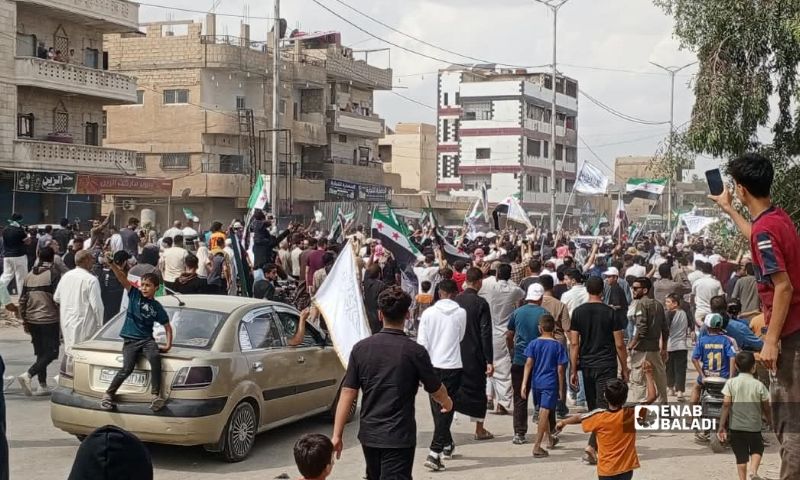
Large demonstration in al-Hasakah calling for the government to establish full control over the governorate, October 2, 2026 (Enab Baladi)
Calls to End Overlapping Authority
Participants focused their demands on strengthening Syrian government control across the various areas of al-Hasakah governorate and ending what they consider overlapping security and administrative decision-making.
Participants told Enab Baladi that the presence of more than one authority exercising security or administrative influence in the governorate had complicated residents’ movement over the past several months.
Mohammad al-Ajaj, one of the demonstrators, told Enab Baladi that his main demand was “for there to be one authority responsible for security, administration, and services in the governorate,” adding that the continued existence of multiple authorities “does not serve residents and increases anxiety and instability.”
According to al-Ajaj, al-Hasakah residents want closed government institutions and service departments to reopen so they can complete their administrative procedures within the governorate instead of bearing additional costs and complications to travel to other areas.
Mahmoud al-Saleh, another participant, said residents had taken to the streets to demand “the return of the state and its institutions to all areas of the governorate,” noting that daily services should not depend on the presence of multiple controlling authorities or disputes over administration.
Al-Saleh called for government departments to be reactivated quickly, saying citizens “need an institution operating in front of them and providing services in accordance with the law, not several authorities issuing different decisions.”
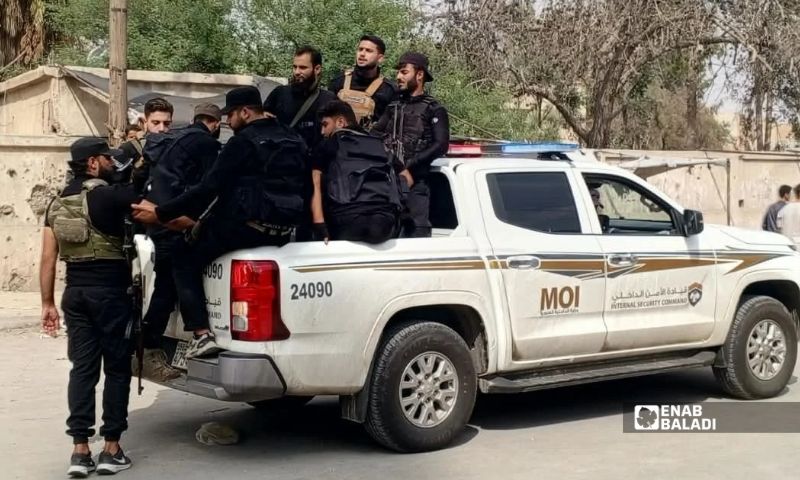
Internal Security Forces patrols accompanying a demonstration in al-Hasakah, October 2, 2026 (Enab Baladi)
Criticism of Appointments
Participants also addressed administrative appointments in al-Hasakah governorate, calling for government positions to be based on competence and experience rather than political considerations or agreements among local forces.
Khaled al-Ali, who participated in the demonstration, told Enab Baladi that, in his view, several appointments made in the governorate had not been based solely on competence but had instead been influenced by what he described as “quota-sharing.”
He added that the coming phase requires officials to be selected based on their ability to manage institutions and serve residents, calling for appointment mechanisms to be reviewed and equal opportunities to be guaranteed for the governorate’s residents.
Agreements announced earlier this year between the Syrian government and the Syrian Democratic Forces (SDF) stipulate the integration of civilian institutions in al-Hasakah governorate into state institutions, along with the integration of military and security personnel into the Ministries of Defense and Interior. The process continues to be implemented in stages.
In June, government bodies announced the beginning of steps to integrate institutions in several sectors in al-Hasakah, including agriculture and electricity. The government also said it planned to reactivate a number of state institutions.
In July, the General Establishment for Insurance and Pensions discussed reactivating its al-Hasakah branch as part of a plan to restore government institutions and prepare their premises to resume providing services to citizens.
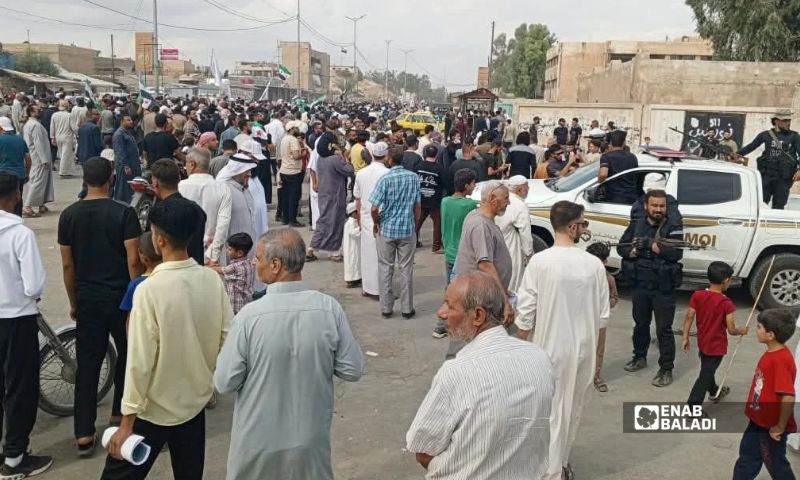
Large demonstration in al-Hasakah calling for the government to establish full control over the governorate, October 2, 2026 (Enab Baladi)
Calls to Regulate Security Movements
Participants in the demonstration also called for an end to movements by what they described as members of the “Revolutionary Youth” and SDF personnel who had not yet been integrated into state institutions. They argued that continued activity by armed or paramilitary groups outside official structures had affected the security situation in the governorate.
Abdulrahman al-Hassan, one of the participants, told Enab Baladi that “the priority today is security and stability and preventing any party from acting outside state institutions,” calling for an end to the visible presence of weapons not subject to government authority.
Al-Hassan added that residents of the governorate “do not want a return to chaos or confrontation,” but instead want a single security institution responsible for protecting civilians and maintaining security. He called for the announced integration measures to be implemented more quickly.
These demands come as the Syrian government maintains that the process of integrating the SDF and institutions of the former administration is moving toward establishing a unified authority. Al-Hasakah Deputy Governor Ahmed al-Hilali said in August that the integration process had entered the stage of actual implementation and that the goal was for state institutions to become the sole authority, while administrative, security, and military arrangements continued to be completed.
On August 25, Mazloum Abdi announced the end of the SDF’s role and its dissolution as an independent military force, saying its forces had been integrated into Syrian army brigades. Two days later, President Ahmed al-Sharaa issued a decree appointing Abdi as an adviser to the Presidency.
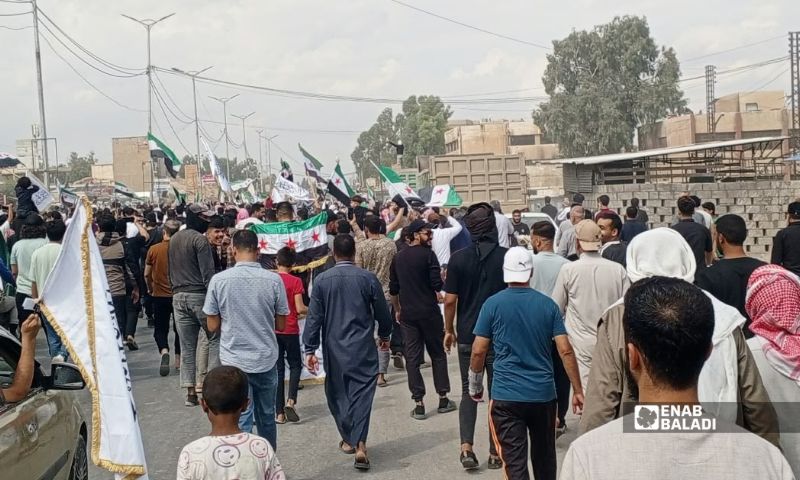
Large demonstration in al-Hasakah calling for the government to establish full control over the governorate, October 2, 2026 (Enab Baladi)
Integration Process Has Not Resolved All Issues
The current integration process began with agreements announced in January that included a ceasefire and the launch of a phased process to integrate military and administrative structures. The agreements also provided for Interior Ministry security forces to enter the centers of al-Hasakah and Qamishli, while the state would assume control of civilian and government institutions, border crossings, and entry points under the announced provisions.
In February, implementation steps began on the ground, including the deployment of some Internal Security Forces in al-Hasakah city and continued procedures to integrate personnel and institutions. Government bodies also discussed with the SDF mechanisms for integrating military and security institutions, reopening roads, and reactivating government services.
Despite these steps, participants in today’s demonstration said completing the integration process requires more than announcing agreements or incorporating some institutions. They called for an end to overlapping authorities on the ground, the reopening of all government institutions and service departments, and unified security and administrative decision-making.
Mohammad al-Ajaj said the next phase should “translate the agreements into a reality that citizens can feel in their daily lives,” while al-Saleh called for services to be available to all residents without discrimination.
Khaled al-Ali, who also participated in the demonstration, said that “selecting qualified people and moving away from quota-sharing” should be part of rebuilding the governorate’s institutions. Participant Abdulrahman al-Hassan, meanwhile, stressed the need to regulate any security movements outside state institutions and accelerate efforts to consolidate stability.
The protesters’ demands reflect some of the issues that remain before authorities in al-Hasakah as the process of integrating institutions and forces affiliated with the Autonomous Administration into state institutions continues. The government says the process is intended to establish unified administrative, security, and military authority in the governorate.