
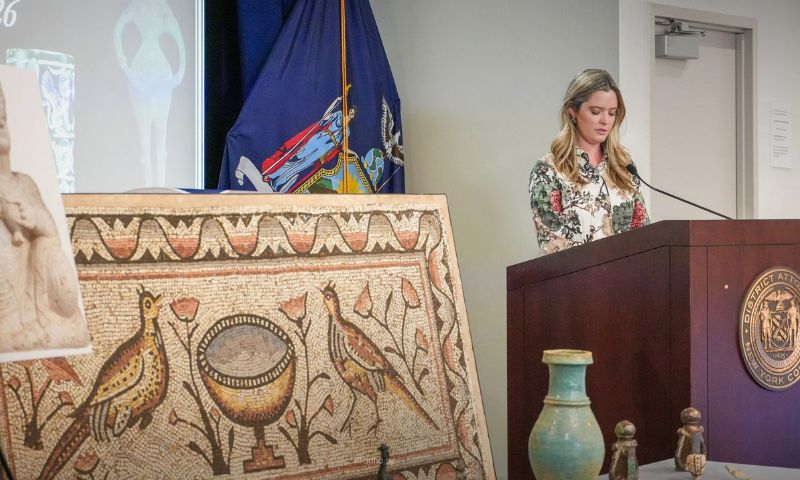

The United States returned 36 artifacts to Syria, with a total estimated value of more than $5 million, during a ceremony held in New York City.
Manhattan District Attorney Alvin Bragg announced in a statement published Wednesday, September 23, that the artifacts had been returned to Syria. He said some were seized from the Metropolitan Museum of Art in New York and from private collections following investigations spanning several years and multiple countries.
The handover ceremony was attended by Bragg, US Deputy Secretary of State Christopher Landau, US Special Presidential Envoy to Syria and Iraq Thomas Barrack, Chargé d’Affaires of the Syrian Embassy in Washington Mohammad Nasser Qanatri, and Syria’s Permanent Representative to the United Nations Ibrahim Olabi, along with other officials and diplomats, according to the Syrian Arab News Agency, SANA.
Bragg said the return of the antiquities serves as a reminder that protecting cultural heritage “transcends borders and nationalities,” adding that the process resulted from what he described as a complex, multifaceted investigation based on international cooperation.
Artifacts from Palmyra and Syrian Mosaics
Among the artifacts returned to Syria are a large stone relief from Palmyra, as well as 14 mosaic panels that the Manhattan District Attorney’s Office said were looted from a Roman villa in Syria.
The office said the Palmyrene relief is a limestone sculpture dating to the late second century AD. It depicts a reclining man surrounded by a woman and three children. The sculpture was once part of the wall of a burial chamber in a Palmyrene tomb and weighs more than 1,000 pounds, or about 450 kilograms.
According to the District Attorney’s Office, the sculpture was removed from Palmyra and smuggled to Dubai before the Islamic State group destroyed large sections of the archaeological site between 2015 and 2017. The piece is among Palmyra’s antiquities that were looted and trafficked during the years of war in Syria.
The returned objects also include a large section of a mosaic floor known as “Telete and Eros,” dating to the third century BC. The mosaic depicts the mythological wedding of the deities Telete and Eros in the presence of Aphrodite and the “three goddesses,” and is made from hundreds of small colored stone cubes.
The District Attorney’s Office said the mosaic was seized in July 2021 along with 22 other mosaic pieces stolen from Syria and Lebanon after they were found in a storage unit linked to antiquities trafficker George Lotfi. Lotfi is wanted in the United States under an arrest warrant issued in 2022, while the International Criminal Police Organization, Interpol, issued a Red Notice for him in 2023, according to the US statement.
Syrian Statues Dating to the Second Millennium BC
The returned artifacts include three Syrian Hittite female statues dating to the second millennium BC that were made in northwestern Syria.
According to the District Attorney’s Office, the three statues first appeared on the art market in the late 1980s and early 1990s. They were in the possession of New York art dealer Edward Merrin, who was later convicted in a US federal court of crimes related to antiquities trafficking.
The statues were later sold to the collection of Michael Steinhardt, a prominent collector of ancient art. US authorities seized 180 antiquities from his collection, valued at about $70 million, as part of a criminal investigation spanning several years and countries.
The District Attorney’s Office said four of the artifacts returned to Syria had been part of the Steinhardt collection, while other pieces came from different sources, including the Metropolitan Museum of Art.
According to the statement, the Manhattan District Attorney’s Antiquities Trafficking Unit has seized about 402 antiquities from the museum since 2017, with a total value of $98.7 million. It has also recovered more than 6,400 antiquities and cultural objects valued at up to $495 million, returning more than 6,200 of them to 40 countries.
Returning Antiquities to Syria
Mohammad Nasser Qanatri, Chargé d’Affaires of the Syrian Embassy in Washington, said Syrian American cooperation and the efforts of the Manhattan District Attorney’s Office helped return part of Syria’s history to the country.
Qanatri added that the restitution process demonstrates, in his words, the possibility of building long term cooperation between the two countries in the field of cultural heritage protection.
The return comes as Syria is pursuing efforts to recover cultural property that left the country over past decades, particularly during the years of war, when archaeological sites, museums, and antiquities were subjected to looting and trafficking.
Earlier Return of Artifacts from France
In July, French President Emmanuel Macron brought 23 Syrian artifacts that had been in France since 2010 during a visit to Damascus.
The artifacts had been loaned to the Arab World Institute in Paris in preparation for an exhibition scheduled for 2011, but the outbreak of the Syrian revolution prevented their return to Syria at the time. The objects represented different historical periods, beginning with the 10th millennium BC, through the Bronze Age and classical periods, and extending to Arab Islamic civilization.
The French artifacts were returned during Macron’s visit to Damascus on July 6 and 7, the first visit by a French president to Syria since former President Nicolas Sarkozy traveled there in 2009.
The two cases differ in the artifacts and how they left Syria. The pieces returned by France had been loaned to the Arab World Institute, while those returned by the United States concern antiquities that US authorities said were looted or trafficked and later seized during investigations into the illicit antiquities trade.
The two restitution efforts highlight the issue of Syrian antiquities that were taken abroad, either through official loans or as a result of looting and trafficking, as well as continuing international efforts to return them to Syria.