
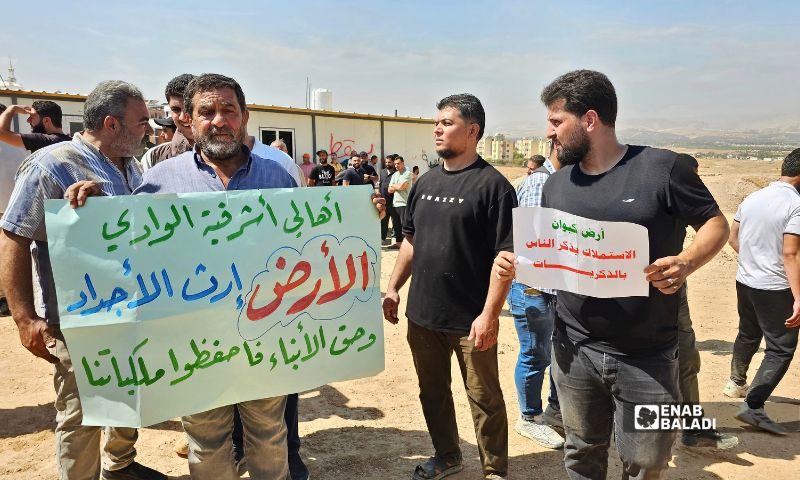

Syria’s Ministry of Public Works and Housing said that “expropriation is a legal and legitimate tool used by all countries to build roads, schools, hospitals, infrastructure, cities and housing projects,” responding to protests demanding the return of expropriated land.
In a statement on Monday, September 28, the ministry added that expropriation is only undertaken for a public-benefit project, in accordance with the law and in exchange for the stipulated compensation, while guaranteeing affected people the right to object and seek review.
It said that an objection to a specific case does not invalidate expropriation as a legal mechanism, nor does it nullify all decisions and procedures taken under it, noting that establishing rights requires official documents and records.
The ministry’s statement came in response to what it described as information circulating on some platforms and social media regarding expropriated land and new urban development projects.
The ministry described the published information as “selective,” saying it portrayed the situation as the sale of citizens’ land or the surrender of their rights.
Land Transferred to Public Entities
The Ministry of Public Works said decisions concerning the expropriated land were issued decades ago, after which the land was transferred to public entities and expropriation compensation was deposited in accordance with the procedures in effect. It added that payments documented in official records and documents had been disbursed.
The ministry said some owners of the land benefited from allocations and priority rights to purchase plots or shares in individual floors, while cautioning against assuming that all cases were identical.
It added that any claim involving an error or a right to a particular property must be settled through documents, land registry records, proof of deposits and payments, and records of the transfer of ownership.
According to the ministry, delays in implementing some projects because of corruption under the former regime, followed by the years of the revolution and instability, do not by themselves terminate the expropriation or automatically restore ownership as long as the public benefit remains.
The ministry added that it is inappropriate to compare the value of land at the time of expropriation with its value decades later, after zoning, planning, road construction, the provision of utilities and services, and public spending. It attributed a significant part of the increase in value to planning and urban expansion.
Public-Benefit Projects
The Ministry of Public Works said the new projects should not be regarded merely as the sale of state land, purely profit-driven investments, or housing intended for a single group.
It said the new urban developments are public-benefit projects that, by their nature, are not limited to a single type of housing, but include multiple forms of housing, projects, services and facilities.
These models include the investment, commercial and service components needed to achieve urban integration and the project’s economic sustainability.
According to the ministry, the General Housing Establishment has the authority to carry out its projects directly or through partnerships with third parties, in accordance with applicable laws and regulations.
Under this model, the ministry said, the land is incorporated into a partnership in which the public entity retains its rights and returns, in exchange for the construction of housing, services and infrastructure and the creation of jobs.
The ministry said state revenues contribute to strengthening its ability to complete housing projects, provide affordable and social housing support, and fund programs for low-income groups and those most in need.
Complaints Office
The Ministry of Public Works said it coordinated with the Rural Damascus Governorate to establish a joint office to receive complaints, documents and objections and examine them in accordance with legal procedures.
It expressed respect for citizens’ right to peaceful expression and to demand their rights, while saying that stopping machinery or blocking roads does not constitute legal proof of property ownership.
Protest Against Expropriation Decisions
The Ministry of Public Works and Housing issued its statement two days after dozens of residents from Dummar Suburb, Qudsaya, al-Bajaa, Moadamiyeh and other areas of Rural Damascus (southwestern Syria) held a protest on September 26.
At the protest, which Enab Baladi covered, demonstrators demanded a halt to the construction of the “Abyat Hills” and “Sham View” projects on their expropriated land.
The demonstrators gathered in Qudsaya Suburb Square before heading to the offices of the “Sham View” project and then to the “Abyat Hills” offices. They denounced the Syrian Ministry of Public Works and Housing’s transfer of their expropriated land to private companies and investors to build the “Abyat Hills” and “Sham View” residential investment projects.
Several areas in the Damascus countryside, particularly Moadamiyeh al-Sham, have also seen repeated protests against the launch of investment projects on land expropriated during the rule of the Assad regime.
Rights-Based Demands
Human Rights Watch, for its part, said the Syrian government is signing billions of dollars in reconstruction deals while the legal frameworks governing the process still lack safeguards to ensure the participation of affected communities and protect their housing, land and property rights.
In a report published on September 27, the organization said the government, donors and investors should ensure that reconstruction projects serve local communities and that the process includes clear mechanisms for consultation, compensation and challenges to decisions involving homes and land.
The Syrian government unveiled a national recovery plan in March 2026, followed by international pledges of billions of dollars in aid, financing and investment. According to Human Rights Watch, however, reconstruction laws do not require the government or developers to consult affected communities, including those who remain displaced, before approving projects.
Human Rights Watch said the reconstruction process should include negotiations over the terms of compensation rather than imposing them, along with an independent mechanism allowing residents to challenge decisions concerning their homes and land.