
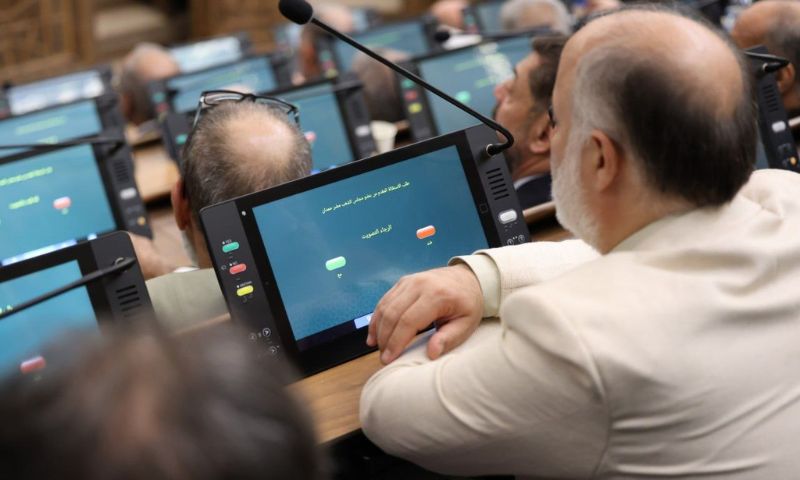

The Syrian People’s Assembly approved its internal budget and discussed a resignation request submitted by assembly member Mudar Hamdan.
The steps came during the assembly’s third session of its first extraordinary term, held on Sunday, September 13.
What Is Hamdan’s Case?
The assembly said through its official accounts that it discussed the resignation request submitted by member Mudar Hamdan.
Controversy surrounding Hamdan emerged with the start of the assembly’s first session, after past positions of his supporting the Assad regime resurfaced.
The assembly added that it discussed the request after reviewing a report by a special committee tasked with examining the allegations and issues raised around Hamdan, hearing his statements before the committee, and studying the resignation request he submitted.
Following the discussion in the assembly, and in accordance with the rules and procedures governing its work, the assembly approved the resignation request while removing some phrases included in the resignation letter.
The assembly stressed that matters affecting the work of the legislative institution are addressed through legal and institutional frameworks in a manner that preserves the assembly’s standing and citizens’ trust in it, while placing the public interest and the interests of the state above all other considerations.
Hamdan’s Resignation Formally Accepted, Reservations Over Content
Syrian People’s Assembly member Nawar Najma, deputy chair of the Diplomatic Affairs Committee, said the assembly devoted Sunday’s session primarily to discussing the resignation of assembly member Mudar Hamdan and approving the assembly’s financial budget.
Najma told Enab Baladi that the assembly formally accepted Hamdan’s resignation while expressing reservations over some of the language used in it.
He said assembly members considered some of the phrases and wording inappropriate, including Hamdan’s reference to being subjected to “campaigns against him” and his statement that he was leaving the assembly “with his head held high.”
Hamdan, who was appointed to the People’s Assembly as part of the president’s one-third allocation, denied in a press statement last June rumors concerning his father’s alleged military rank as a major general.
At the time, he said his father had previously worked as a military lecturer and had been summoned by security services under the former regime, arbitrarily imprisoned in Sednaya Prison, deprived of his rights because of his positions, and later discharged. He added that his father is currently consulted only because of his teaching expertise. Hamdan attributed the confusion over the name to the existence of a major general named Wafiq Abu Hamdan.
Meetings Were Scheduled to Continue on September 14
The agenda for the September 14 session included:
– Hearing from the education minister.
– Presenting draft laws concerning the “repeal of the Terrorism Court Law” and the “exemption from taxes of confiscated properties returned to their owners,” in preparation for referring the bills to the relevant committees for discussion.
Earlier on Sunday morning, the People’s Assembly Bureau held its first meeting with the chairs of the assembly’s standing committees, attended by the heads of all 26 committees, to discuss parliamentary working mechanisms and organize the committees’ tasks for the coming period.
The meeting addressed how the committees operate, the process of reviewing, discussing, and drafting legislation, and the need to comply with the assembly’s internal rules and applicable laws throughout all stages of legislative work.
The Assembly Bureau also heard comments, observations, and proposals from committee chairs according to their respective areas of responsibility, with the aim of organizing the work and standardizing its procedures.