
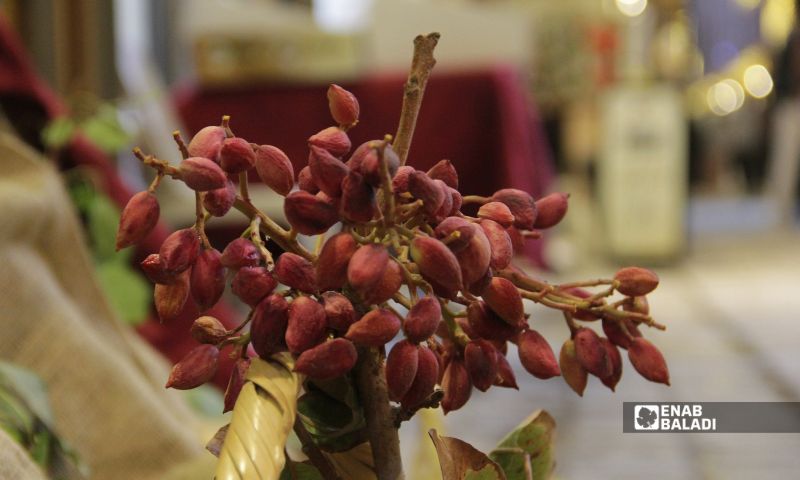

Aleppo pistachio prices have risen this year, but the increase has not delivered the profits farmers had hoped for, as production has declined, costs have climbed, and foreign varieties entering the Syrian market have competed with the local crop and pushed down its price.
Farmer Ghassan Douba, who owns about eight hectares in the Azaz area (northwestern Syria), said prices should be higher than those currently offered because the crop cannot be marketed abroad, sales are restricted to the domestic market, and production costs have risen this year.
Ready-to-eat Aleppo pistachios sell for between $6.50 and $7 per kilogram, while pistachios sold in clusters range from $4 to $4.50 per kilogram.
Although pistachios in clusters sold for between $2.75 and $3 per kilogram last year, the profit margin was higher.
Douba believes ready-to-eat Aleppo pistachios should sell for around $9 per kilogram this year, while pistachios in clusters should exceed $5 per kilogram.
Prices for agricultural chemicals, fuel, fertilizers, and labor have increased, according to Douba. He told Enab Baladi that the price increases were not gradual, describing them as “exorbitant,” with some inputs rising by more than 40%.
Iranian Pistachios
Douba complained about imports of Iranian pistachios, which he said affect both the national economy and farmers. He said imports drive down domestic prices and bring the two varieties to similar price levels, even though Aleppo pistachios are higher quality than their Iranian counterparts.
Confectionery makers prefer using Iranian pistachios because of their dry texture, which allows them to absorb sugar syrup, while Aleppo pistachios retain their oil, according to Douba.
For his part, Adel Hawash, director of the Pistachio Office at the Ministry of Agriculture, said the office had contacted the General Authority for Land and Sea Ports and Customs to regulate the export process.
Hawash told Enab Baladi that import and export matters are handled by a committee comprising several ministries and authorities, which issues decisions based on market needs.
He said the ministry maintains an annual agricultural calendar prepared according to available supply and production levels, through which periods for allowing or suspending imports are determined.
The Pistachio Office also issues certificates of origin exclusively for Syrian pistachios following what Hawash described as a “thorough” inspection to prevent foreign pistachios from being exported as Syrian products. He said the measure is intended to regulate the market and preserve the reputation of the domestic product.
Support Awaits a “National Program”
Douba is calling on the Ministry of Agriculture to support pistachio farmers by providing fertilizers and pesticides, as well as agricultural equipment and machinery, including tractors, at reduced prices and through affordable installment plans, along with accessible agricultural loans.
He said he has received no support from the Ministry of Agriculture, adding that assistance previously provided by organizations in the northern Aleppo countryside stopped this year.
As part of its support for farmers, Hawash said the Pistachio Office organizes agricultural extension programs and provides farmers with certified seedlings and grafting material at nominal prices.
The office is also preparing a comprehensive plan titled the “National Program for the Development of the Aleppo Pistachio Sector.” Hawash said the program will examine all farmers’ needs to develop the sector.
Pistachio Production Declines in Aleppo
The total area planted with Aleppo pistachios across Syria is about 67,864 hectares, with 10.478 million trees, including 8.033 million fruit-bearing trees, according to statistics obtained by Enab Baladi from the Ministry of Agriculture’s Pistachio Office.
In Hama (central Syria), the area planted with Aleppo pistachio trees totals 27,374 hectares, with production expected to reach about 14,740 tons.
In Aleppo, pistachio plantations cover 23,516 hectares, while production this season is expected to reach 12,690 tons.
In Idlib (northwestern Syria), about 11,126 hectares are planted with pistachios, while expected production stands at 5,015 tons.
These figures are estimates, and precise figures will be released in about two months, after the end of the season, according to Hawash.
In 2025, Aleppo governorate recorded about 23,516 hectares of pistachio cultivation and production of 25,360 tons. Hama recorded 21,364 hectares and production of 10,343 tons, while Idlib had 10,475 hectares planted and produced 4,695 tons.
According to these figures, pistachio production in Aleppo governorate has declined this year after the governorate led production last year.
Hawash attributed the decline to the drought Syria experienced in previous years. He said rainfall was low in 2025, causing fruit buds to fall.
Pistachio trees are characterized by “alternate bearing,” producing a heavy crop one year followed by little or no production the next.
A year in which the tree produces a large crop is known as an “On Year,” while the following year is called an “Off Year.” In some cases, this pattern can occur across a sequence of years, with production declining for two consecutive years followed by a high-yield year, or the reverse.
Douba expects a plentiful crop next year after the current season brought heavy rainfall during winter and spring.