
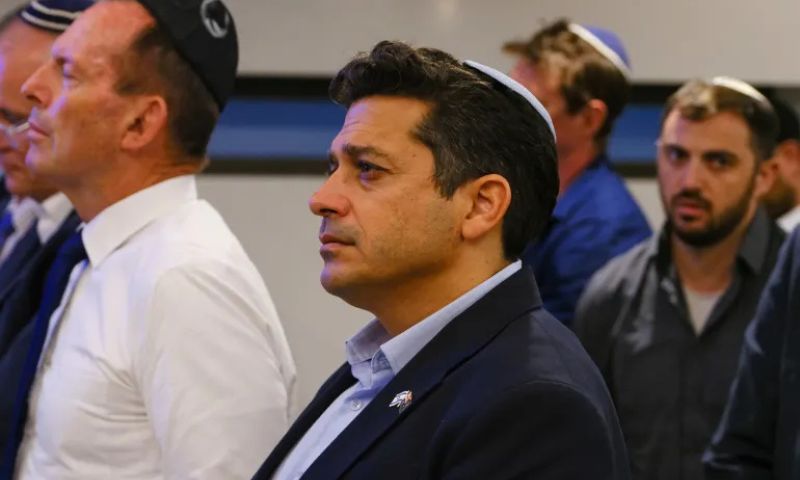

Israeli Diaspora Affairs Minister Amichai Chikli described Syrian President Ahmed al-Sharaa as “Israel’s next enemy,” called Syria “the next Gaza,” and spoke of the possibility of a war breaking out between the two countries.
In an interview, excerpts of which were published by Al Jazeera on Thursday, August 13, Chikli said he does not see “al-Jolani,” referring to Syrian President Ahmed al-Sharaa, as an “opportunity” for Israel. At the same time, he criticized former Israeli Chief of Staff Gadi Eisenkot, who viewed the political change in Syria as an opportunity for Israel to engage with.
The remarks come as Israeli forces continue their military movements inside Syrian territory, particularly in the southern governorates of Quneitra and Daraa.
Chikli criticized statements Eisenkot made at a conference held by the Institute for National Security Studies (INSS), in which he said he “sees the new regime in Syria as an opportunity” and that Israel would be prepared to reach agreements with “al-Jolani.”
“Anyone who has taken three university courses on the Middle East, on the Muslim Brotherhood, global jihad movements and the Salafi movement, and understands who they are dealing with, does not see any opportunity in al-Jolani. Rather, they see him as the next enemy of the State of Israel,” Chikli added.
The Israeli minister compared al-Sharaa to Yahya Sinwar, the former head of Hamas’ political bureau in Gaza, but said al-Sharaa has the advantage of two seaports and the backing of a major state, referring to Turkey. He added that Syria is Gaza, but many times more powerful, and that this is the next war.
Israel Insists on Remaining in Syria
Israel no longer describes its deployment in southern Syria as a short-term security measure. On August 1, Israeli Defense Minister Israel Katz said the Israeli military would continue to remain in areas it describes as “security zones” inside Syrian territory, as well as in areas of Lebanon and the Gaza Strip, “until further notice.”
The minister’s position reflects the Israeli government’s insistence on maintaining the deployment of its forces in southern Syria, despite growing Arab condemnation of recent military incursions in Daraa and Quneitra governorates.
Speaking during a memorial ceremony for Israeli soldiers killed in the 2006 Lebanon War, Katz said, “The Israeli army will remain in the security zones in Lebanon, Syria and Gaza until further notice, in order to protect our residents and communities from jihadist elements.” He added, “We will not withdraw from the security zones.”
The Israeli defense minister’s remarks, reported by Agence France-Presse, came as Israel continued to reinforce its military presence in southern Syria following repeated incursions into the countryside of Daraa and Quneitra. The moves have drawn official Syrian rejection and Arab condemnation, with critics describing them as a violation of Syrian sovereignty and an escalation that threatens regional stability.
Katz did not specify a timetable for any potential withdrawal from the territories where Israeli forces are deployed. He also repeated a warning to Iran, saying it would face “strikes with full force” if it targeted Israeli forces deployed in Lebanon.
Israeli Prime Minister Benjamin Netanyahu had said that his country’s forces would remain in Lebanon as long as Hezbollah continued to pose a threat to residents of northern Israel, while Israeli officials have linked any withdrawal from southern Lebanon to the group’s disarmament.
Chikli: Turkish Influence in Syria Is a Front Against Israel
Israeli Diaspora Affairs Minister Amichai Chikli had accused Turkey in November 2025 of posing, in his view, “the greatest threat” to Israel, saying Turkish military influence in northern Syria could develop into a front against Israel.
This position also places Turkey at the center of Israeli calculations over Syria’s future, as Chikli cited Turkish support for the Syrian authorities in his latest remarks as one of the elements of the threat behind his comparison of Syria with Gaza.
In recent days, southern Syria has seen new Israeli incursions into areas of Quneitra and Daraa, accompanied by searches, detentions and land-clearing operations.