
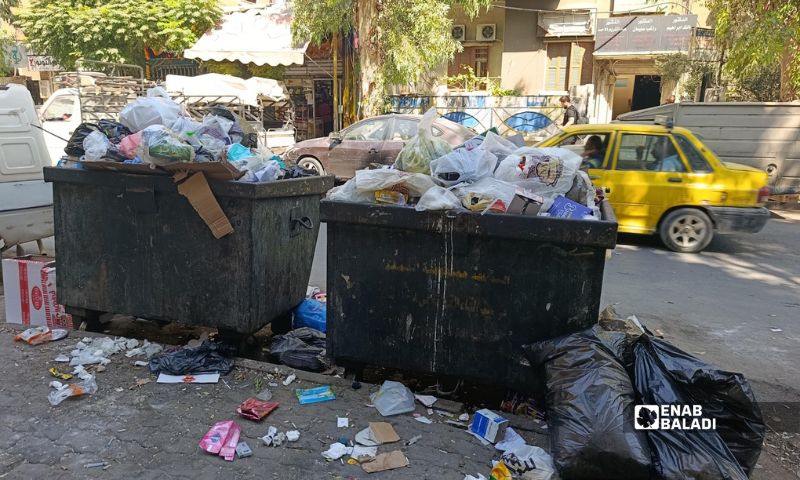

Several neighborhoods in the Syrian capital, Damascus, are experiencing declining sanitation levels, with garbage piling up in streets and residential areas for days. High summer temperatures are worsening foul odors and the spread of insects, prompting frustration among residents.
Residents say the problem has become part of the daily scene in several areas, with garbage bags remaining piled around containers and sometimes spilling onto sidewalks and roads. Rising temperatures are making the odors worse and accelerating the spread of insects.
Residents who spoke to Enab Baladi said their concerns go beyond the sight of the waste, as the continued accumulation of garbage affects daily life, particularly in densely populated neighborhoods and areas with markets and shops. They called for regular garbage collection and removal and greater field monitoring.
Garbage Piles Up for Days
In Dweila (Damascus), resident Rawan Maalouli said the sanitation problem begins with delays in garbage collection, which leaves waste outside homes and around containers for several days, particularly during periods of high temperatures. She said this leads to the spread of insects and dogs gathering around garbage containers.
Maalouli added that the failure to remove garbage has contributed significantly to the spread of insects in the neighborhood, including gnats, flies, and cockroaches, in addition to widespread odors that prevent residents from opening their windows.
She said sanitation conditions in the area require greater oversight because of the accumulation of garbage and delays in its removal. Maalouli called for improving the waste collection system, increasing the number of garbage containers in the streets, and ensuring daily collection, particularly during the summer.
Ghaith al-Homsi, a resident of Baghdad Street in Damascus, agreed, saying sanitation conditions across the capital’s streets had become unacceptable, particularly because Damascus is Syria’s capital and its public face.
He said piles of garbage sometimes remain for several days before collection vehicles remove them, adding that even the streets are filled with dirt and waste. He said this raises questions about why the problem has worsened and remained unresolved for months while the Damascus Governorate has moved to beautify roundabouts, sidewalks, and streets.
Al-Homsi called for a lasting solution instead of merely removing waste after it has accumulated. He also called on the governorate to explain what he described as its shortcomings rather than remaining silent and neglecting the problem.
In the al-Sinaa area (Damascus), resident Fuad Barakat highlighted the impact of declining sanitation on shop owners, workers, and pedestrians. The area sees heavy daily activity, particularly al-Sit Garage, making accumulated garbage more visible and increasing its effect on daily activity.
Barakat criticized the governorate’s handling of sanitation conditions, questioning why garbage has been allowed to accumulate for several days in the capital’s streets and neighborhoods. He said the current situation was unusual for Damascus.
He said the city had not previously experienced garbage accumulation on this scale and called on the governorate to explain the reasons for the decline in sanitation and address the problem instead of allowing it to worsen, particularly during the summer and periods of high temperatures.
Uneven Sanitation Across Neighborhoods
Sanitation conditions do not appear to be the same across Damascus. Enab Baladi observed that garbage collection and removal are more regular in some neighborhoods and streets than in others, where waste remains for several days, including al-Malki, Abu Rummaneh, and al-Tijara (Damascus).
Residents said sanitation levels vary from one area to another, raising questions about how cleaning services are distributed and why such disparities exist. They called for garbage collection and removal to cover all neighborhoods at the same frequency and for some areas not to be left without service for extended periods.
Following residents’ complaints, Enab Baladi sent questions to the Damascus Governorate two weeks ago about the reasons behind worsening sanitation conditions, whether emergency measures were planned, and the disparities in cleanliness between neighborhoods. The governorate had not responded by the time of publication.

Garbage accumulation in the streets of Old Damascus, August 23, 2026 (Enab Baladi)
Waste Problem
The spread and accumulation of waste is not a new problem in Syria, but it worsened as the country’s situation became increasingly difficult and complex after 2011. Solid waste management had already been recognized as an environmental problem in Syria before that year, as Enab Baladi addressed in a previous investigation.
Waste management practices were inadequate and lacked regulatory oversight of emissions into the environment, while the environmental governance system was weak, according to a 2015 report by the Dutch organization PAX.
Before 2011, household waste was collected, but all landfills were open. Waste was also frequently burned in open pits, while hazardous waste was not disposed of separately. As violence and conflict escalated over the years, the situation deteriorated further, according to the PAX report.
Because waste management services have nearly collapsed, large quantities of waste continue to be dumped in streets across the country. Many municipalities have resorted to measures such as burning waste or uncontrolled dumping, increasing the threat of diseases and parasites.