
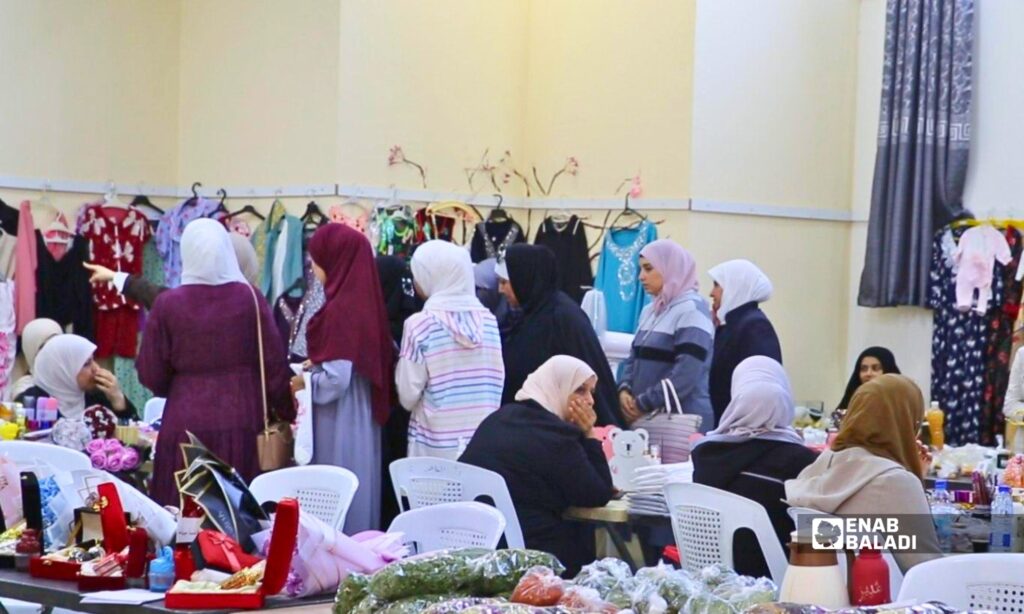

Women from families of people killed in Darayya and owners of home-based businesses continued displaying their products during the seventh edition of a monthly bazaar. The event opened on Sunday, Aug. 2, at the cultural center in Darayya (Rif Dimashq, southwestern Syria) and ran for two days, seeking to connect participants with new customers and provide them with income, as many cannot afford to open their own shops.
The bazaar brings together dozens of participants whose businesses mostly focus on handicrafts and handmade products. Results vary: some report strong sales, while others say many visitors look at the products without making purchases.
The bazaar has continued for several months since becoming an almost monthly event in the city. It began in May with women from families that lost their breadwinners during the war, before gradually expanding to include various home-based businesses and becoming a space to promote and sell products directly.
From Training to Sales
Zubaida Janah participates with products made from resin, a craft she learned while living in Lebanon. After returning to Darayya, she began training girls in the craft to help them establish sources of income.
Janah told Enab Baladi that the bazaar brings together women from families of people killed during the war and owners of handicraft businesses, allowing them to display their products, particularly because many cannot afford to open private shops.
She said she had noticed an increase in visitor numbers compared with previous editions and hoped that continued participation would introduce more people to her products and increase her sales.
Qatr al-Nada Abdullah is participating for the first time with her business making bouquets from satin flowers. She buys the fabric, rolls and arranges the flowers, and packages them by hand before offering them for sale.
Abdullah believes the bazaar gives women from affected families an opportunity to start small businesses that can develop over time. She described demand for her products during her first participation as “good.”
Celine Mdawwar, 17, participates with products including satin flowers, perfumes, and cosmetics after learning about the bazaar through an advertisement on Facebook.
She told Enab Baladi that attendance was good and that she found the displays varied and well organized, encouraging her to try the experience.


More Visitors, Fewer Purchases
Sales activity, however, differs from one participant to another.
Tasnim Ziyada displays artwork and writing applied to cups, glass, wood, and pottery, but she believes the bazaar has not yet become sufficiently well known.
She told Enab Baladi that some visitors come to view the products and then leave without purchasing anything, although attendance at the bazaar is good.
Ziyada started her business six months ago after turning her interest in drawing into products she could sell. She hopes the bazaar’s continuation will help expand her customer base.
Despite differences in sales volumes, participants agree that the bazaar has helped them reach people who previously would have been difficult to introduce to their products. It has also provided an opportunity for business owners to exchange experience.
Participants in previous editions told Enab Baladi that the bazaar’s impact was not limited to direct sales. Some also received later orders through social media after visitors became familiar with their products.
Venue Challenges
Bazaar organizer Amani al-Hourani told Enab Baladi that the event is held at the beginning of every month. She said the organizing team had used lessons from previous editions to improve arrangements as awareness of the bazaar increased among city residents.
She said the main challenges were high temperatures inside the hall and the absence of air conditioning, as well as the need for participants and visitors to climb stairs to reach the second floor.
Al-Hourani called for the allocation of an air-conditioned hall on the ground floor that would be easier for participants and visitors to access, helping expand participation and improve display conditions.
She added that the organizing team had coordinated with the Ministry of Social Affairs and Labor to participate in the Damascus International Fair and other exhibitions in Damascus, and was working to display participants’ products at Damascus International Airport.
Opportunities Beyond Darayya
Darayya Mayor Raed Obeid told Enab Baladi that women from families affected by the war deserved support from the local community as they relied on their own businesses. He expressed hope that similar initiatives would be organized in other areas.
Obeid said Social Affairs and Labor Minister Hind Kabawat had promised during her visit to the bazaar to allocate space for participants’ products at the Damascus International Fair and to display them at Damascus International Airport.
He noted that some non-handicraft products were included among the displays, although the bazaar’s primary objective was to encourage handicrafts and home-based businesses.
An Enab Baladi’s correspondent attempted to obtain a comment from Minister of Social Affairs and Labor Hind Kabawat while she was at the bazaar, asking for her assessment of the event and the ministry’s plans to support such initiatives. However, she declined to respond, saying she does not give interviews to media outlets “that criticize the government’s work.”
Bazaar organizers hope that participation in exhibitions outside Darayya, together with the event’s continued monthly schedule, will expand marketing opportunities for participants. Providing an air-conditioned, ground-floor hall remains their main request for improving display conditions and receiving visitors during future editions.

