
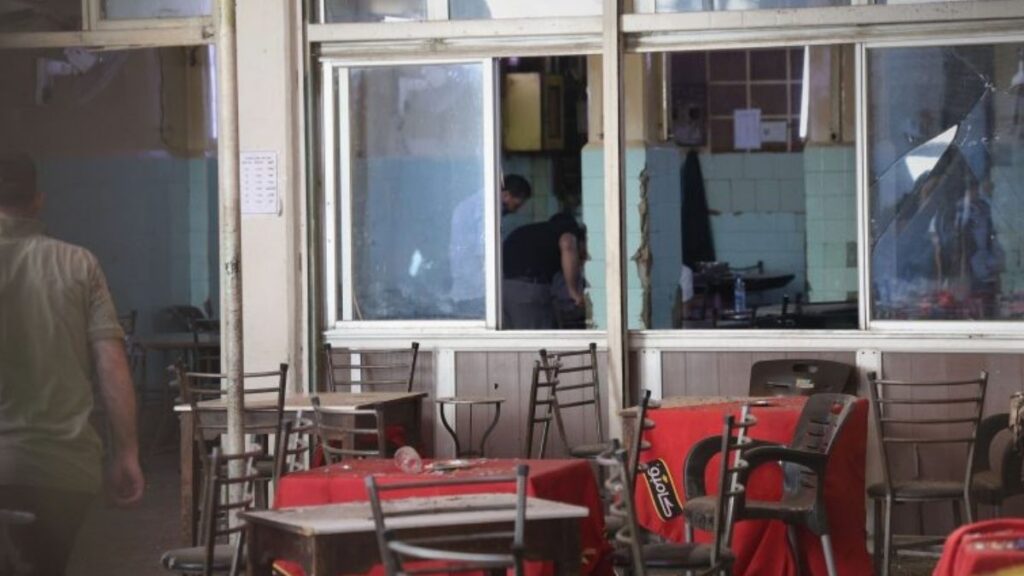

The July 2 bombing in central Damascus has raised questions over its timing, its political and security messages, and the parties that could benefit from destabilizing Syria at a sensitive transitional moment.
Investigations are continuing to identify those behind the attack, while analysts are focusing on the implications of the bombing, which targeted a cafe near the Justice Palace as Syria proceeds with trials linked to figures from the former regime.
According to the official account, the bombing was caused by an explosive device at al-Mushiriyah cafe on al-Nasr Street in Damascus, near the Justice Palace, killing and injuring dozens of cafe patrons.
Obstructing Transitional Justice
The latest bombing in Damascus renewed debate over the scale of the security challenges facing Syria, after the capital and several governorates had witnessed a period of relative stability.
Assessments of the incident vary between those linking the operation to regional shifts and those reading it as a security breach targeting the transitional justice process.
Political writer Darwish Khalifa said Syria had seen a good level of security stability during the past period, but rapid regional developments, including the Iranian-Israeli war, Hezbollah’s involvement in it, and US statements calling on Syrian authorities to intervene in Lebanon, could affect the security and stability of any country in the region.
He noted that the attack did not target political figures, but a location connected to the justice and judicial system, at a time when Syria is witnessing trials of figures from the former regime. He considered that regional actors and influential forces, including Hezbollah and Iraqi loyalist militias, were harmed by the fall of the Assad regime, making the possibility of similar operations recurring a real one.
Khalifa added that the operation had a clear intelligence character, as it suggested the involvement of parties with security and intelligence experience in planning and execution. He said the aim was to send a message that they can penetrate facilities linked to the trials, destabilize security, and obstruct progress on transitional justice. He concluded that the issue is, at its core, a security and intelligence matter more than a political one.
A Message Beyond Security
Dr. Samir al-Abdullah, a senior researcher at the Arab Center for Syrian Contemporary Studies, said the bombing carried a message beyond the immediate security dimension.
He considered that the region is witnessing a reshaping of alliances and political contexts, and that parties are seeking to disrupt new tracks related to Syria, whether in its Arab and international relations, efforts to attract investment, or state building and transitional justice.
Al-Abdullah added that the messages of the bombing were not limited to causing casualties. They also included spreading chaos, undermining confidence in security, frightening investors, and slowing economic recovery. Continued poverty, unemployment, and despair, he said, provide a suitable environment for recruiting new members. He stressed that confronting terrorism is no longer only a security battle, but also a battle for economic stability, institution building, and strengthening Syrians’ confidence in the state.
What Does the Timing Say?
The bombing came at a notable political moment. It coincided with Foreign Minister Asaad al-Shaibani’s visit to Lebanon, anticipation of the first session of the People’s Assembly on Monday, July 6, and talk of an expected visit by French President Emmanuel Macron. This opened the door to questions about the messages carried by the timing.
Khalifa ruled out a direct link between the operation and the foreign minister’s visit to Lebanon, considering that there is no logical connection between the visit and the targeting of a cafe located near the Justice Palace, which lawyers and legal transaction agents usually frequent.
He suggested that the operation was linked to internal factors or parties harmed by the return of security stability, even if relative, to governorates such as Damascus, Aleppo, Homs, Hama, and Idlib. He considered that the aim was to confuse the security scene and send a message that stability remains fragile and vulnerable to breaches.
Who Benefits?
The bombing raises questions about the parties that benefit from destabilization, especially since no party had claimed responsibility for the incident by the time this report was prepared.
At the same time, the Syrian government received a broad wave of Arab and international condemnation and solidarity, opening discussion over what that could mean for the coming phase.
Khalifa said the beneficiaries of this security breach are numerous, including detained figures on trial over links to the former regime, countries that supported Bashar al-Assad’s regime, and currents still operating in secret and seeking to disrupt the security scene.
He added that the Islamic State also benefits from any state of chaos or security decline, even if there are so far no indicators confirming that it was behind the operation.
Khalifa pointed to information circulating from inside the Justice Palace in Damascus indicating that the plan consisted of three stages, beginning with targeting the cafe, then infiltrating through the left side, and reaching the stage of carrying out terrorist acts and bombings inside the Justice Palace. He considered that the perpetrators succeeded in achieving part of their goals by instilling confidence in the security situation, while failing to carry out the full plan.
Al-Abdullah, meanwhile, said several parties could benefit from destabilizing Syria, including the Islamic State, remnants of the former regime, regional actors, and networks linked to them.
He considered that the available indicators strongly suggest that the Islamic State was behind the attack, in light of its activity during the past period in Raqqa and rural Aleppo. He explained that the group seeks to confirm that it remains capable of carrying out attacks deep inside Syria.
The group is also trying to exploit resentment among some groups opposed to the Syrian government’s openness to the West and its new regional alliances, to rebuild recruitment and mobilization networks, according to Al-Abdullah.
He noted that the broad Arab and international solidarity with the Syrian government after the bombing reflects a regional and international interest in Syria’s stability and in preventing its return to chaos.
He said this position strengthens the government’s political standing and gives it greater support in facing security challenges, but at the same time increases its responsibility to protect stability and accelerate the building of state institutions.
Security Incident After the Bombing
In parallel with the Damascus bombing, three members of the security forces were injured on the morning of Friday, July 3, in an attack targeting a security checkpoint at the entrance to Jaramana (Rural Damascus), before the attacker was killed by the explosion of a hand grenade he was trying to throw.
The Syrian Arab News Agency (SANA) quoted a security source as saying that checkpoint personnel stopped two people riding a motorcycle to verify their identities, before one of them pulled out a pistol and opened fire, then threw two hand grenades toward the checkpoint, injuring three personnel.
The source added that the attacker tried to throw a third hand grenade, but it exploded on him, killing him instantly.
According to the Syrian al-Ikhbariya channel, after his identity was established, he was found to be Daniel Riad Dawoud, wanted in cases of murder and drug trafficking. Security forces arrested the person accompanying him, and investigations are ongoing to uncover the circumstances of the incident and take the necessary legal measures.