
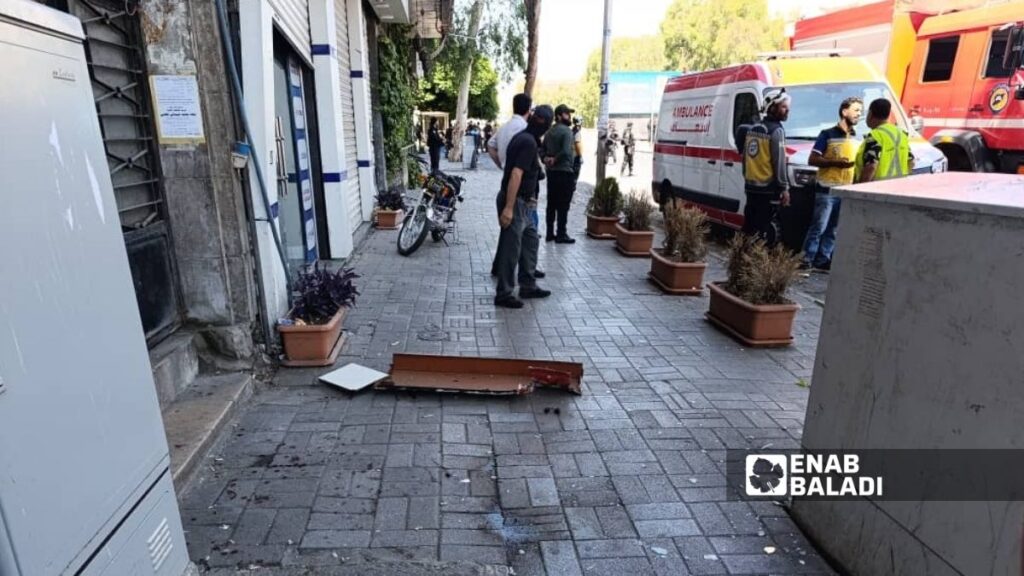

The Syrian Ministry of Interior said 18 people, including four police officers, were injured after two explosions occurred in central Damascus today, Tuesday, July 7.
Enab Baladi’s correspondent in Damascus reported that the two explosions occurred near the site where French President Emmanuel Macron is staying in Damascus. The first took place near al-Naanaa Garage in the al-Halbouni area, close to the Ministry of Tourism, and the second near the Four Seasons Hotel. Several people were injured, including members of the Road Security Police.
The Ministry of Interior told SANA that Internal Security forces detected two explosive devices during field operations. Specialized units began taking the necessary measures to dismantle them, but the devices exploded while preparations for the dismantling operation were underway.
Internal Security forces imposed a security cordon around the site to protect civilians, while specialized units began sweeping and securing the area.
The ministry said an initial inspection showed that the two devices had been made in a primitive manner. The first was placed inside a car parked on the side of the road, while the second was placed inside a garbage container. Investigations are still underway to uncover the circumstances of the attack and identify those involved.
The ministry confirmed that the site of the explosion was outside the security perimeter allocated for the French president’s residence and did not pose any direct threat to the residence or to the official visit program, which is continuing according to schedule.
Eyewitnesses told Enab Baladi that columns of smoke rose from the site after the explosion and that roads near the two blast sites were closed.
Agence France-Presse reported that the explosion was followed by smoke rising from a location near a luxury hotel where French President Emmanuel Macron had spent the night.
Reuters quoted a security source as saying that explosive devices detonated today, Tuesday, near the site.
The Élysée Palace said Macron did not hear the blasts that occurred in the Syrian capital, Damascus, and that the visit is continuing.
Macron arrived in Damascus on Monday, becoming the first Western head of state to visit the city since the fall of the Assad regime.
Previous Explosion in Damascus
An explosion caused by an explosive device, according to the official account, occurred at al-Mushiriya Café on al-Nasr Street in the capital, Damascus, near the Palace of Justice, killing and injuring dozens of café patrons on July 2.
The Syrian Ministry of Interior announced at the time that its units began field procedures immediately after the explosion.
The statement came after preliminary information circulated on social media and local media outlets suggested that the blast may have been caused by a lithium battery or a gas cylinder inside the café.
The ministry added that Internal Security patrols and ambulance teams headed directly to the scene after receiving the report. They evacuated the wounded and provided necessary first aid, while also establishing a security cordon around the site to ensure civilian safety and secure the surrounding area.
No party had claimed responsibility for the previous incident by the time this report was prepared.
Who Benefits?
The previous bombing raises questions about which parties benefit from destabilizing security, especially since no party claimed responsibility for the incident. The Syrian government received a broad wave of Arab and international condemnations and expressions of solidarity, opening discussion over the implications for the next phase.
Political writer Darwish Khalifa believes several parties benefit from this security breach, including detained figures on trial over their links to the former regime, countries that supported Bashar al-Assad’s regime, and currents that are still operating covertly and seeking to disrupt the security scene.
He added that the Islamic State group is also among those that benefit from any state of chaos or security decline, even if there are so far no indicators confirming that it stood behind the operation.
Khalifa said information circulating from inside the Palace of Justice in Damascus indicates that the plan had three stages, starting with targeting the café, then infiltrating from the left side, and finally carrying out terrorist acts and explosions inside the Palace of Justice. He considered that the perpetrators succeeded in achieving part of their objectives by striking confidence in the security situation, while failing to complete the full plan.
Dr. Samir Alabdullah, a senior researcher at the Arab Center for Contemporary Syria Studies, considered that several parties may benefit from destabilizing Syria, including the Islamic State group, remnants of the former regime, regional parties, and networks linked to them.
He believes the available indicators strongly suggest that the Islamic State group stood behind the attack, given its activity in the past period in Raqqa and rural Aleppo. He explained that the group seeks to prove that it is still capable of carrying out attacks deep inside Syria.
The group is also trying to exploit discontent among some groups opposed to the Syrian government’s openness to the West and its new regional alliances, with the aim of rebuilding recruitment and mobilization networks, according to Alabdullah.
He said the broad Arab and international solidarity with the Syrian government after the bombing reflects a regional and international interest in Syria’s stability and in preventing its return to chaos.
He believes this position strengthens the government politically and gives it greater support in confronting security challenges, but at the same time doubles its responsibility to protect stability and accelerate the building of state institutions.
Security Incident After the Bombing
In parallel with the Damascus bombing, three security personnel were injured on July 3 in an attack targeting a checkpoint at the entrance to the city of Jaramana (Rural Damascus), before the attacker was killed by the explosion of a hand grenade he was trying to throw.
SANA quoted a security source as saying that checkpoint personnel stopped two people riding a motorcycle to verify their identities, before one of them pulled out a pistol and opened fire, then threw two hand grenades toward the checkpoint, injuring three personnel.
The source added that the attacker tried to throw a third hand grenade, but it exploded in his hand, killing him instantly.
According to Syrian al-Ikhbariya, after his identity was established, it became clear that his name was Daniel Riyad Dawoud and that he was wanted in cases involving murder and drug trafficking. Security forces arrested the person who had been accompanying him, while investigations are still underway to uncover the circumstances of the incident and take the necessary legal measures.