
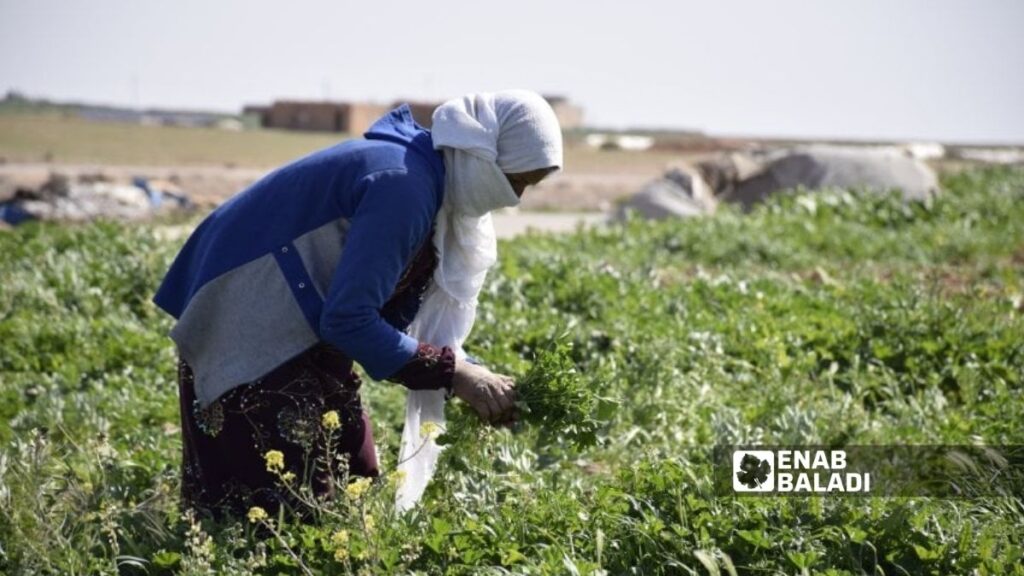

As Hasakah governorate (northeastern Syria) enters the peak agricultural season, hundreds of women spread daily across wheat and barley fields, as well as cotton, vegetable, and aromatic crop farms. The scene reflects the role rural women play in supporting the household economy, while also revealing the scale of the challenges facing women agricultural workers, who receive low wages for exhausting work that lasts long hours under the sun.
While farmers are busy harvesting wheat and barley, other fieldwork of equal importance is taking place, including collecting straw, clearing cotton of weeds, harvesting cumin and coriander, and picking summer vegetables. These jobs rely heavily on women workers, who have become an essential part of the agricultural cycle in the governorate’s countryside.
Women now make up the largest share of seasonal labor in many villages, especially as many rural men have migrated abroad in search of better job opportunities or commute daily to the city for work no less difficult than women’s labor. This has pushed women to shoulder additional burdens in the fields alongside their household responsibilities.
Packing Straw, Wages That Do Not Match the Effort
After harvesters finish gathering wheat and barley crops, another phase of hard work begins, collecting and packing straw for use as livestock feed throughout the year.
Noura al-Ali, from Tell Brak subdistrict northeast of Hasakah, said a large number of women move directly to this stage after the harvest ends.
She told Enab Baladi that wages for packing “shloul,” the local term for bundles of straw, remain low despite the effort involved, as each worker receives about 2,000 Syrian pounds for every bundle prepared and tied.
She explained that a worker can complete between 15 and 20 bundles a day at best, depending on the density of the straw, temperatures, and the number of women present in the field. This makes daily income limited compared with current living costs.
She said work begins in the early morning hours to avoid intense heat, but it requires major physical effort because it involves lifting, compressing, tying, and gathering straw in one place.
She added that many women who work in this field are widows or wives of low-income laborers and farmers, forcing them to accept whatever wages are available, however low they may be.
Cleaning Cotton, Long Hours of Bending
Alongside the grain harvest, wide areas of Hasakah continue to see work on cotton crops, chiefly the removal of weeds locally known as “al-Afish.”
This process is among the agricultural jobs most dependent on women, as it requires moving between cotton rows and pulling weeds by hand to preserve plant growth and improve productivity.
Salma al-Hamad, from northern rural Hasakah, said clearing cotton fields of weeds requires long hours of continuous work. She added that women remain in the fields from morning until noon or afternoon for daily wages that usually range between 40,000 and 60,000 Syrian pounds.
She added that this task is among the most exhausting agricultural jobs because of constant bending and repeated movement between crop rows, especially during the summer months, when temperatures are high in the area.
She said some women also work in planting cotton at the beginning of the season, then return to clean it during its different growth stages, keeping them tied to the crop for long months of the year.
Cumin and Coriander by Women’s Labor
Women’s work is not limited to wheat and cotton. Areas where cumin and coriander are grown in Hasakah also see high demand for women workers during the harvest period.
Farmers rely on women to collect, sort, clean, and prepare the crops for transport and storage, given the precision and care these crops require during collection.
Daily wages for these jobs range between 60,000 and 100,000 Syrian pounds, depending on the nature of the work and the distance workers travel to reach the fields. Wages rise slightly in some areas that suffer from labor shortages.
Farmers say women have become a main element in cumin and coriander seasons in recent years, especially in villages that rely on these crops as an important source of agricultural income.
Families Depend on Picking Vegetables
In northwestern Hasakah, Barda al-Abdullah, a woman in her fifties, works alongside two of her daughters picking vegetables during different agricultural seasons.
She told Enab Baladi that fieldwork has become the family’s main source of income, explaining that they move between cucumber, tomato, zucchini, and bell pepper farms depending on the season.
She added that the workday often begins before sunrise to avoid high temperatures and continues until noon or later, depending on the amount of produce that needs to be picked.
She said daily wages usually range between 60,000 and 100,000 Syrian pounds, but she believes these amounts are no longer enough amid the continued rise in food, fuel, and transportation prices.
She added that a large number of women workers are breadwinners for their families or contribute significantly to household income, making them more tied to seasonal work despite its difficult conditions.
Low Wages Compared With Living Costs
Despite the important role women play in the agricultural sector, women workers complain that wages do not match the scale of effort required.
Most women workers can secure only a small portion of their needs amid rising living costs. They also lack any form of social or health protection, as they are often hired on a daily or seasonal basis without work contracts, guarantees, or compensation in case of injury during work.
Women workers say daily wages may appear high when viewed separately, but they become very limited once the actual number of working days during the season is calculated, along with expenses for food and family needs.
Economist, Women Are a Pillar of Agricultural Production
Economist AbdulHamid Saleh believes the expansion of women’s participation in the agricultural sector in recent years is directly linked to deteriorating economic conditions and rising poverty rates in rural Syria.
Saleh told Enab Baladi that rural women are no longer merely a supporting element in the agricultural process, but have become one of the main pillars of agricultural production in many areas.
He added that low wages are due to several factors, most notably the abundance of labor seeking any work opportunity, the absence of legal regulation in the agricultural labor market, and the lack of bodies that defend women workers’ rights or set fair wages for them.
He explained that women are paid less than men in many cases despite carrying out similar or more precise work, reflecting chronic imbalances in the agricultural labor market.
He said the economic value of women’s work goes beyond the direct wages they receive, because women also take part in raising poultry and livestock, housework, and childcare, doubling their contribution to the rural household economy.
International Reports Discuss Women’s Role in Agriculture
Reports issued by the Food and Agriculture Organization of the United Nations (FAO) confirm that women make up a large share of the agricultural labor force in Middle Eastern countries and participate in various stages of agricultural production, from planting and crop care to harvesting, storage, and marketing.
Academic studies addressing the situation of women working in Syrian agriculture have also indicated that women are often concentrated in seasonal and lower-paid jobs and work in conditions that lack legal and social protection.
Previous Enab Baladi reports have shown the continued suffering of women agricultural workers in several Syrian governorates due to low wages and the absence of labor rights, despite the agricultural sector’s growing reliance on women’s work during different seasons.
Between harvesting wheat and barley, cleaning cotton, collecting cumin and coriander, and picking vegetables, Hasakah’s women continue working through an uninterrupted agricultural cycle that stretches over long months of the year.
While their modest wages provide a basic resource for many families, the reality of women agricultural workers remains one of the clearest signs of the economic challenges facing women in rural Syria, where burdens and responsibilities are increasing at a far faster pace than wages.