
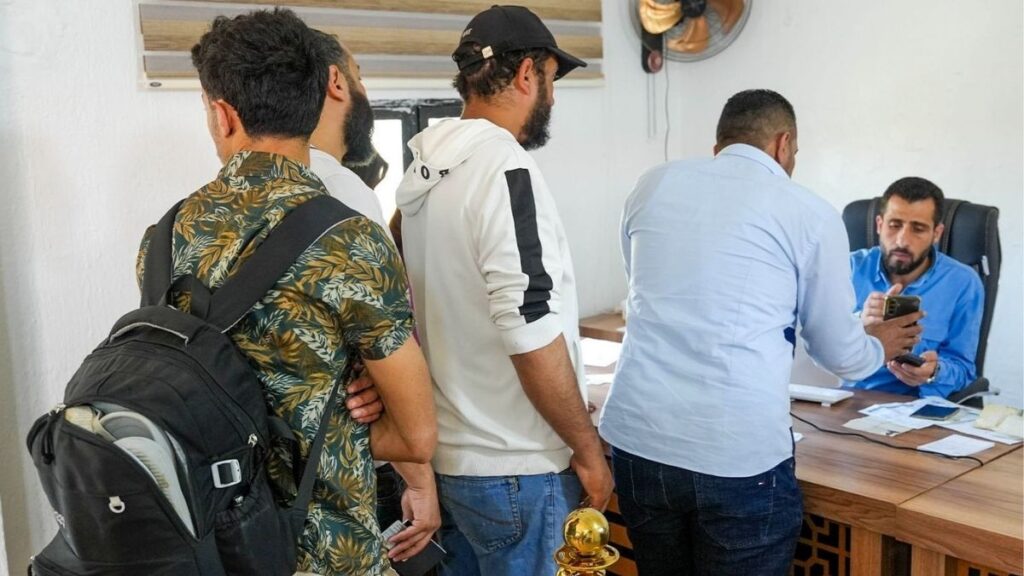

The Norwegian Refugee Council (NRC) revealed in a press statement that millions of Syrians still suffer from legal insecurity because of a lack of civil documents and proof of property ownership.
The report, published on June 16, was based on an assessment of 1,200 households in nine Syrian governorates: Aleppo, Idlib, Hasakah, Raqqa, Daraa, Damascus, Rural Damascus, Hama, and Homs.
Its findings showed that most war-affected households live without the basic legal documents needed to access services, secure housing, or claim rights.
The report found that 62% of households have at least one member who lacks basic civil documentation.
This figure rises significantly among people who have returned to their areas since 2024, with 80% of them lacking official documents.
The report noted that women and displaced people are among the groups most affected, as 70% of women lack property documents, compared with just over 50% of men.
Regarding women who lost their husbands, the report showed that 87% of them cannot access the property or legal rights of the missing person, as inheritance procedures remain legally frozen in the absence of a death certificate.
It also noted that only 24% of women who sought a legal declaration of death or absence succeeded in obtaining one, while 66% of cases remain pending.
According to the NRC, this gap is due to several factors, most notably prolonged displacement, the destruction of civil registries, and repeated administrative disruptions.
61% of Households Lack Official Housing Documents
The assessment showed that 61% of households that own or rent homes do not have official documents proving their housing rights, leaving them exposed to the risk of disputes or eviction.
Meanwhile, 21% of households said they face the risk of eviction, while 69% of them had received no prior notice.
Federico Gachetti, the NRC’s country director in Syria, said the absence of civil documents directly affects people’s daily lives.
Gachetti explained that many families cannot prove their identity or ownership of property, which obstructs their access to health care and education and limits their ability to exercise their basic rights.
The report recommended simplifying and unifying procedures for obtaining civil documents, reducing related fees, and increasing international support for access-to-justice programs in Syria. It said this would help address civil documentation issues and property disputes through assistance programs, with a focus on women, displaced people, persons with disabilities, and families of the missing.
The NRC has worked in Syria since 2013, providing a package of services that includes information, counseling, and legal assistance, as well as education, water, sanitation, hygiene, shelter, protection from violence, livelihoods, and food security.
In 2025, the council reached more than 31,000 people through programs aimed at strengthening access to justice.
About 1.63 Million Syrian Refugees Return
About 1.63 million Syrian refugees have returned to their country, most of them from neighboring countries, after the fall of the Assad regime.
As of April 30, nearly 640,000 Syrians had returned from Turkey, around 630,000 from Lebanon, and about 285,000 from Jordan, according to figures from the United Nations High Commissioner for Refugees.
The UNHCR also announced that about 900 Syrian refugees had returned from Iraq to Syria since the beginning of 2026.