
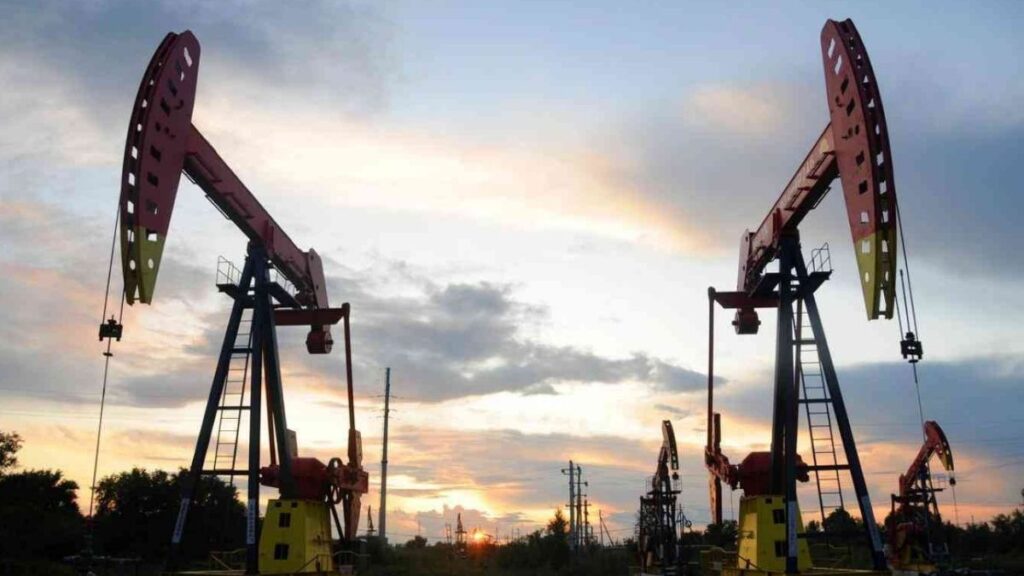

The US company “HKN Energy” has emerged as one of the most prominent potential players in Syria’s energy sector in the coming phase, following Enab Baladi’s report on the signing of a long-term contract to develop and invest in the Rmelan oil fields in Hasakah governorate, northeastern Syria.
While no final and comprehensive official details have yet been announced on the nature, size, or implementation mechanisms of the agreement, the company’s appearance in official Syrian and US meetings has renewed attention on its history, background, and ownership structure, especially its ties to a broader investment network led by the US “Hillwood” group.
Accelerating Interest in Syria
During the Syrian delegation’s participation in the Global Energy Forum held in the US capital, Washington, on June 9, Syrian Energy Minister Mohammed al-Bashir met with the president of “HKN Energy,” Mark Rollins, in the presence of the chairman of the US Chamber of Commerce, Ross Perot Jr.
Perot Jr. also holds a leadership position in “Hillwood,” a broad investment group active in real estate, aviation, logistics, and energy. It owns a specialized oil investment arm, “Hillwood International Energy,” which serves as the investment framework within which “HKN Energy” operates.
According to the Syrian Arab News Agency (SANA), the meeting discussed prospects for cooperation and investment in Syria’s energy sector, seen as an indication of the US company’s interest in exploring work opportunities in Syria after years of activity concentrated in the Kurdistan Region of Iraq.
This impression was reinforced by what the official Syrian al-Ikhbariya reported about an expanded working meeting at the Hasakah Fields Directorate in the city of Rmelan. The meeting brought together officials from the Syrian Petroleum Company and representatives of “HKN Energy” to discuss executive steps related to taking over the oil fields and beginning their operation.
The meeting discussed technical, operational, and security aspects related to managing the oil fields and ensuring continued production, as well as coordination mechanisms between the two sides in the coming phases.
With these understandings in place, according to what Enab Baladi reported, this marks the first direct and publicly declared operational presence of the US company on Syrian territory.
What Is HKN Energy?
“HKN Energy” defines itself as a privately owned independent energy company specializing in oil exploration and production, with its main operations currently concentrated in the Kurdistan Region of Iraq.
Although it is not classified among US oil giants such as “ExxonMobil,” “Chevron,” or “ConocoPhillips,” it has managed in recent years to consolidate its position as a medium-sized company with operational experience in developing onshore fields in politically and security-sensitive environments.
The company’s activity is primarily concentrated in the Sarsang and Atrush oil blocks, located within the oil-rich Zagros belt in northern Iraq.
The Sarsang block extends over an area of about 420 square kilometers and includes the Swara Tika and East Swara Tika fields, while the Atrush block covers about 269 square kilometers and includes the Atrush oil field.
The company says its current strategy is based on increasing production, strengthening oil infrastructure, and developing producing reservoirs in the two areas, in addition to expanding its operational experience in various environments around the world.
Mark Rollins, The Man Behind Oil Expansion
The company is currently led by Mark Rollins, who serves as chief executive officer and chairman.
Rollins is considered a well-known figure in the oil and gas sector, having accumulated long experience in managing exploration and production projects and developing oil fields in several regions around the world.
During his management, the company focused on expanding production in the Sarsang and Atrush fields, improving infrastructure linked to production and export, and enhancing operational efficiency in geographically and security-challenging environments.
He is also seen as one of the main officials behind the company’s expansion strategy in recent years, including its search for new investment opportunities outside its traditional areas of activity.
Company Ownership Network
“HKN Energy” is structurally affiliated with “Hillwood International Energy,” the specialized energy arm within the “Hillwood” group, owned by US businessman Ross Perot Jr.
Company data and US press reports show that “HKN Energy” operates within this investment framework linked to “Hillwood,” making it part of a wider system of companies affiliated with or managed within a single investment portfolio, rather than a fully independent entity outside this structure.
This affiliation is important for understanding the nature of the company’s expansion, as its major strategic decisions, especially in international oil projects, come within the context of a multisector investment group with interests in real estate, energy, and logistics inside and outside the United States.
The Political Dimension, Support for Trump and Republicans
Alongside investment activity, the owner of the “Hillwood” group, Ross Perot Jr., is known as a prominent political supporter within the US Republican Party.
According to data from the US Federal Election Commission (FEC) and reports by “Forbes” magazine, Perot Jr. made political donations to Republican candidates and committees in recent years, including contributions linked to US President Donald Trump’s 2020 election campaign.
The data indicate that these contributions amounted to hundreds of thousands of dollars through multiple channels, including direct donations and others through political action committees (PACs), as well as support for prominent Republican candidates in various states.
These details show that the owner of the group to which “HKN Energy” belongs is active within a Republican political funding network, adding an indirect political dimension to the company’s background.
After Rmelan Controversy, HKN’s Stakes in Kurdistan
After the high percentage attributed to “HKN Energy” in the Rmelan field in northeastern Syria sparked controversy and media questions about the size of the stake and the nature of potential partnerships, Enab Baladi traced the company’s operating structure and its usual stakes in the Kurdistan Region of Iraq as a reference point for understanding its pattern of operational participation and the nature of its contracts in similar environments.
Data from “HKN Energy” and its official reports indicate that the company operates in the Kurdistan Region of Iraq within a structure of specific oil concessions with clear participation percentages. In the Sarsang field, the company owns an operating stake of about 62% as the main operator of the concession, while smaller stakes belong to the Kurdistan Regional Government and another partner in the project, according to the company’s official documents on field concessions and production-sharing contract mechanisms.
By contrast, the company owns an operating stake of about 25% in the Atrush field after changes to the partnership structure, while the regional government retains a similar stake, and the other main partner owns the largest share, according to an official company statement on restructuring the operational partnership in the field.
Economic Influence Beyond Energy
Economic readings indicate that the network of relationships surrounding “Hillwood” extends into economic decision-making circles in the United States through diverse investments that go beyond oil and include real estate, infrastructure, and logistics.
According to press reports, this overlap between economy and politics is seen as a recurring feature of the model of major multisector US companies, where investment interests intersect with political influence networks, especially in international energy files.
In the case of “HKN Energy,” this dimension gains additional importance amid its potential entry into the Syrian market, where the oil file intersects with complex political and security considerations.
Between Ambiguity and Expected Developments
So far, official details on the nature of the understandings between Damascus and “HKN Energy” remain incomplete, and the company has not issued a detailed announcement on the signing of final operating contracts or the start of actual work inside Syria.
What is certain, however, is that the company’s name has become strongly present in discussions linked to the future of Syria’s oil sector, whether from the angle of investment or from the angle of the economic and political networks connected to it, making it one of the most closely watched names in the current phase.
As ambiguity continues over the legal and executive framework of the agreement, whose details were published by Enab Baladi, the “HKN Energy” file remains open to multiple possibilities, amid the overlap of international economic interests with the complexities of the Syrian scene.