
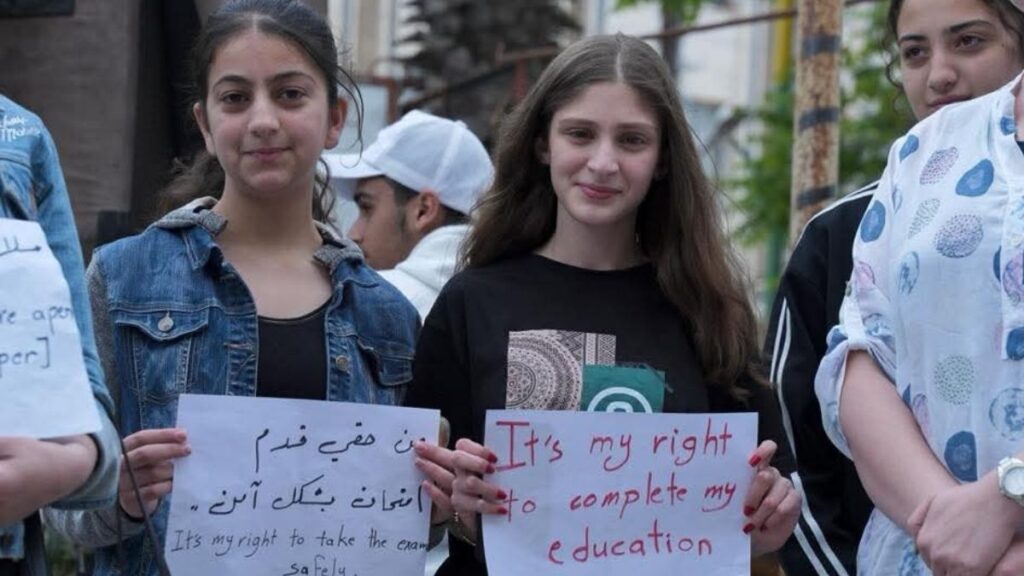

Since the start of the current school year, the education sector in the city of Suwayda (southern Syria) has faced unstable conditions, directly affecting school attendance and the regularity of the educational process.
The year saw repeated interruptions and holidays for students, delays in completing curricula within the set timeframe, and strikes by some teachers as a way to pressure authorities to obtain their financial dues, which have been repeatedly obstructed.
These conditions pushed a wide segment of students to rely on private lessons, educational institutes, and intensive courses as the only option to compensate for learning losses and prepare for exams, especially students sitting for the basic and high school exams, who know the importance of this academic stage and see it as a dividing line in their lives and futures.
But this reliance was not easy for many families because of deteriorating living conditions and the high costs of private education. Private lessons were, and remain, a financial burden on parents, especially displaced families or those economically affected.
Private Education, A Forced Solution
Reham A., a teacher in Suwayda, said demand for lessons this year was “somewhat lower than last year because of psychological and financial instability, and because some students may not sit for the exams in the first place,” noting that scientific subjects, such as mathematics, physics, and science, have been the most requested among students recently.
According to the teacher, psychological conditions have directly affected students, explaining that there is a state of distraction, confusion, and loss of passion for study, even among some outstanding students.
She believes that several students, especially displaced students, cannot afford private lessons, at a time when the cost of a home lesson may start at 80,000 Syrian pounds per hour for the 12th grade, while institute prices range between 10,000 and 25,000 Syrian pounds per hour for each student, depending on the subject.
Maya, a high school student in the scientific branch, spoke to Enab Baladi about her experience this year, explaining that she initially relied on lessons on YouTube, but she was unable to understand the subjects well, which pushed her to take some private lessons in physics and Arabic.
She added that her family’s financial situation does not allow her to enroll permanently in institutions.
The student said most students at her school stopped attending early, while some teachers continued giving lessons.
An Unfair Decision for Students
As the certificate exam date approached, the Syrian Ministry of Education announced that exams for students from Suwayda governorate would be held in Damascus and its countryside.
Many students and parents considered the decision a new challenge, while for those who fully opposed the move, it was “the end of the road.”
Students’ and parents’ fears grew further, not only because of the exams themselves, but because of the travel, accommodation, and transport costs accompanying them, amid the current economic conditions, for students wishing to sit the exams in the city.
A source in Suwayda’s education sector told Enab Baladi that 700 certificate students had moved their exam centers to Jaramana (Rif Dimashq, near Damascus) before the decision was issued.
The likely reason for issuing the decision and canceling the dispatch of the ministerial delegation to Suwayda is linked to threats circulated on social media by elements affiliated with local factions, as well as the rejection of the delegation’s entry accompanied by Public Security forces affiliated with the Damascus government.
According to a source in the Directorate of Education in Suwayda, who preferred not to be named for security reasons, the armed man Basil al-Shaer stormed the directorate building. He threatened employees to prevent the delivery of exam cards to students. He also threatened to cut the roads leading to Damascus, which could deprive about 13,000 students of sitting for the exams.
Some Students Remain Determined
Shams, a student in the literary branch, said the decision to move the exams did not push her to stop studying or taking private lessons, in the hope that a solution would be found to hold the exams within the governorate, or that her family would allow her to go to Damascus.
She confirmed that she follows up on her lessons daily, explaining that the philosophy subject, for which she receives private lessons at home with three of her friends, costs 25,000 Syrian pounds (≈ 2 US dollars) per student for one hour.
At the same time, she and her family have begun thinking about transport expenses to take the exams outside the city and the costs that come with that, amid difficult living conditions and widespread unemployment.
For his part, Hazem, a ninth-grade student, said he knew from the beginning of his studies that this year would be the hardest for him because it is the first certificate he will obtain, but he did not imagine that all these things would happen during his year.
What doubled Hazem’s anxiety was not knowing the fate of the exams, he said, explaining that his family had to enroll him in a follow-up institute for mathematics and science to strengthen him in those subjects, despite his need for lessons in other subjects, such as languages, but the high costs stood in his way.
Today, students who spent large sums during the year on private lessons and institutes find themselves facing the possibility of not sitting for the exams because of security fears or other reasons.
The decision also caused frustration among some students, who felt that the efforts they had made during the year, and the money their families spent on private education, could go “to waste.”
“I poured my heart into paying for my son’s lessons, hoping he would sit the exams,” one parent said in colloquial Arabic.
He explained his current confusion over deciding to send his son to Damascus, and his growing fears because of repeated security incidents on the Damascus to Suwayda road that have affected civilians.
Demands To Hold Exams Inside Suwayda
The days following the decision to limit exams to Damascus and Rural Damascus witnessed broad calls from civil society organizations inside Suwayda demanding that exams be held inside the governorate, and that education be considered a right that must not be tied to political and security conditions.
Parents, students, and teachers also called, during a protest on May 16, for guaranteeing students’ right to sit their exams inside the governorate, under UN and neutral educational supervision that ensures their safety and the integrity of the examination process.
Circulated statements and appeals focused on the fact that moving thousands of students to Damascus under the current security and economic conditions increases pressure on parents and threatens to deprive a segment of students of sitting for the exams.
Many questions also spread about the ability of Damascus centers to accommodate 13,000 students, and the mechanism for their arrival there.
In light of this reality, students sitting for the basic and high school exams in Suwayda appear to be facing not only an academic exam, but a series of psychological, living, and educational pressures that have accumulated over a full year, making reaching the exam hall a challenge in itself for many of them.
Previous Statements On Suwayda’s Exam Readiness
The Directorate of Education in Suwayda, affiliated with the Syrian Ministry of Education, had announced its full readiness to hold public certificate exams, according to approved ministerial instructions and regulations.
Liqa Ghanem, director of examinations at Suwayda Education, said this came out of concern for achieving the public interest and guaranteeing the right of Suwayda students to sit their exams in suitable conditions.
Ghanem revealed on Facebook on April 29 that the number of students registered for this exam session stands at about 13,500 male and female students.
Ghanem also confirmed the directorate’s full commitment to providing all requirements, logistical equipment, and necessary procedures to ensure the success of the examination process.