
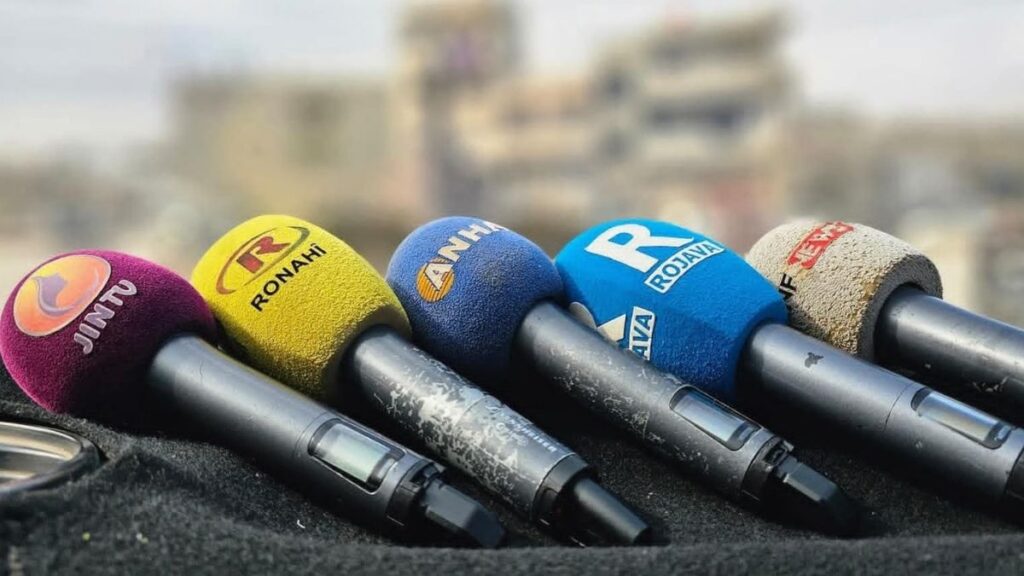

Over the past years, a broad media scene has emerged in areas controlled by the “Autonomous Administration” and the Syrian Democratic Forces in northeastern Syria, made up of news agencies, television channels, radio stations, and websites. It has become one of the most important tools for conveying the political and military discourse of the “Autonomous Administration,” while also becoming a source of debate over the limits of professionalism and independence.
This system includes several institutions, among them Hawar News Agency, Ronahi TV, Ronahi newspaper, Alyaum TV, JINHA news agency, North Press Agency, as well as local radio stations such as Khabour FM and Orkes FM. These outlets overlap in their coverage of political and military files, despite differences in their editorial styles.
Syrian journalist and researcher Samer al-Ahmad said understanding this scene “cannot be separated from the political and security structure within which these institutions operate,” noting that media in areas under the Autonomous Administration “emerged and developed within the context of a long conflict, which made it connected to the broader political discourse.”
By contrast, a Kurdish journalist from Hasakah (northeastern Syria), who preferred not to be named, said this system “cannot be understood only from the angle of the political structure, but also from the angle of control over the media space.” He explained that media “operates on different levels, some of it directly partisan, and some of it presented as independent while moving within the same environment.”
A Unified Discourse Between Politics and Media
A review of media material issued by outlets close to the “Autonomous Administration” shows a clear overlap in the terms used, whether in covering military, political, or administrative files. Descriptions such as “mercenaries of the Turkish occupation” continue to be used when referring to the Syrian National Army, along with political descriptions linked to the former Syrian opposition.
Samer al-Ahmad said this similarity in discourse “is not merely a linguistic coincidence, but reflects a unified political reference point that produces this language.” He explained that “the media language here is connected to a long war experience that produced its own vocabulary.”
The Kurdish journalist, however, said this similarity is “the result of an undeclared political ceiling,” adding that journalists “understand in advance the limits of permitted criticism and the red lines, which leads to the production of similar discourse even without direct instructions.”
He added that “the absence of daily guidance does not mean the absence of control, but rather the existence of a general framework that regulates media work and determines its direction.”
Professionalism Between Development and Political Limits
Some media institutions, such as North Press Agency, try to present themselves as more professional and independent platforms by adopting less sharp journalistic language compared with other outlets such as Hawar News Agency or Ronahi TV. Alyaum channel also adopts a style closer to this professional model.
Al-Ahmad said these differences “relate more to the degree of professionalism in presenting the discourse than to a difference in the discourse itself.” He explained that “some institutions developed their journalistic tools during the war against the Islamic State group, especially with openness to international media.”
By contrast, the Kurdish journalist said this professionalism “remains formal in some cases,” explaining that “the difference in style does not change the fact that the broad political lines remain the same, especially on sensitive issues.”
He added that “professionalism clearly declines when it comes to security and military files, where the discourse becomes closer to mobilization than journalism.”
Uneven Influence Within Society
Al-Ahmad said the influence of these media outlets “is not uniform across areas of northeastern Syria,” explaining that their presence is stronger in Kurdish areas because of the political and administrative influence of the “Autonomous Administration.”
In Deir Ezzor, Raqqa, and parts of Hasakah with an Arab majority, al-Ahmad said “people’s engagement with these outlets is more pragmatic,” as residents follow them to obtain service-related information without adopting their political narrative.
The Kurdish journalist added that this variation “is also linked to political trust,” explaining that “part of the audience follows these outlets as the only official source of information, while others deal with them cautiously or from a critical distance.”
Testimonies From Inside Media Institutions
A former journalist who worked for one of the media institutions affiliated with the “Autonomous Administration” in Raqqa, and who identified himself as “Ali,” said media work “was not based on individual initiative,” but was subject to “a clear political ceiling.”
Al-Ahmad said this type of organization “is closer to a media environment linked to political authority, where politics and media overlap significantly,” noting that “this does not negate the existence of professional attempts within some platforms.”
By contrast, the Kurdish journalist said these testimonies “reflect an important aspect of reality,” explaining that “the existence of indirect or direct instructions limits editorial freedom, even if the degree of implementation differs from one institution to another.”
He stressed that “some terms were imposed as mandatory, especially in political and military issues.”
Media’s Relationship With the Political Structure
In “Ali’s” account, the name of Democratic Union Party leader Aldar Khalil is repeatedly mentioned in the context of managing the media file, despite the absence of an officially declared structure defining the nature of this relationship.
Al-Ahmad said “media in this case is part of a broader political structure,” explaining that “media institutions operate within an influence network linked to the ‘Autonomous Administration,’ making the separation between media and politics complex.”
By contrast, the Kurdish journalist said the relationship “is not only political, but organizational as well,” adding that “cadres of the Kurdistan Workers’ Party control decision-making centers, making media part of an integrated system for managing public discourse.”
Accusations of Restrictions on Press Work
The “Autonomous Administration” has faced repeated criticism from rights organizations, including Reporters Without Borders, over restrictions on press freedom and arrests of journalists in recent years.
Al-Ahmad said these accusations “reflect the existence of a real problem in the media environment,” but added that “part of this is linked to the nature of the ongoing conflict and the region’s instability.”
The Kurdish journalist went further, saying “pressure on journalists clearly exists,” noting that “some journalists have been subjected to arrest or threats because of critical coverage.”
He added that “the absence of an independent media law makes the media environment vulnerable to security and political control.”
From War Media to Governance Media
Al-Ahmad said the war against the “Islamic State” constituted “a fundamental turning point” in the development of media in northeastern Syria, as limited local media outlets turned into a broad multilingual network.
He added that this transformation made media “part of the war narrative and the building of political and military legitimacy for the Syrian Democratic Forces.”
By contrast, the Kurdish journalist said this transformation “was not completed toward media of governance and accountability,” explaining that “media remained closer to tools of mobilization and did not turn into an independent oversight authority.”
Criticism and Its Limits Within the Media System
Both sides agree that limited criticism exists within media outlets affiliated with the “Autonomous Administration,” but they differ in explaining its limits.
Al-Ahmad said “criticism exists, but it is limited to service and administrative files,” noting that “security and military issues remain outside the scope of serious criticism.”
The Kurdish journalist said “criticism stops completely at sensitive files,” adding that “even simple topics may become subject to political considerations if they are linked to the broader context.”
Professional and Security Challenges
Journalists in northeastern Syria, according to both sides, face a set of challenges, including security pressure, weak funding, the absence of independent institutions, and threats linked to working in conflict areas.
Al-Ahmad said, “The most prominent challenges are the continued instability and the absence of a fully safe and independent media environment.”
By contrast, the Kurdish journalist stressed that “the biggest challenge is balancing personal safety with professional independence,” in an environment where “the media is viewed as part of the political conflict.”
Media Pluralism Under One Ceiling
Between Samer al-Ahmad’s view, which focuses on the political and historical structure of the media, and the Kurdish journalist’s view, which stresses the limits on freedom and the undeclared ceiling, it becomes clear that the media scene in areas under the “Autonomous Administration” combines plurality of platforms with unity in the broader framework.
While al-Ahmad believes professional development exists but is governed by the political context, the Kurdish journalist considers this same context to be what defines the essence of media work and limits its independence.
Between these two views, media in northeastern Syria remains a space where politics intersects with journalism, and where narrative overlaps with news, in an environment that has not yet settled on a clear media model between professionalism and mobilization.