
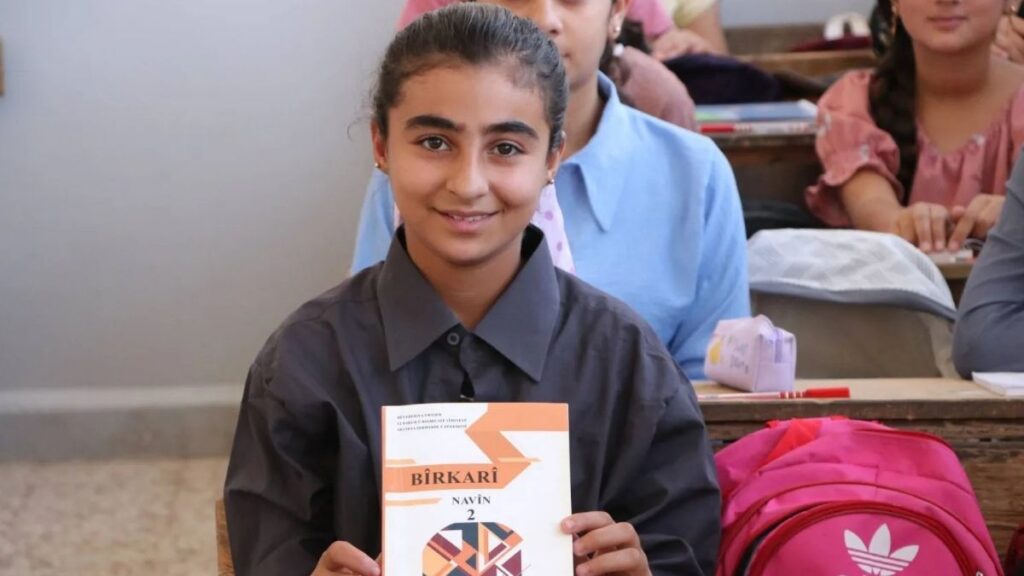

The Kurdish language has returned to the forefront of cultural and political debate in Syria after the issuance of Decree No. 13 and the accompanying discussion about openness to linguistic and cultural diversity, amid Kurdish hopes that it could mark the start of a new phase of recognition for Kurds within official and educational institutions after long decades of marginalization and exclusion.
Throughout the years of the former government’s rule, Kurdish remained outside Syria’s official framework despite its use among Syrian Kurds. Its presence was limited to oral and social use and some restricted cultural activities, amid the absence of specialized academic institutions or clear legal recognition.
The political changes Syria has witnessed after the fall of the former regime have revived old questions related to national identity and cultural diversity, including the future of the Kurdish language and its place within the institutions of the new state.
Kurdish writer and linguist Abdul Hakim Ahmed Mohammed, head of the Kurdistan Syria Writers’ Union, told Enab Baladi that Kurdish is “one of the ancient and deep-rooted languages of the Middle East,” explaining that it went through long stages of marginalization and attempts at assimilation, which affected its academic and institutional development.
He added that Kurdish remained for decades “a spoken language used only among Kurds,” even though the number of its speakers exceeds 40 million people worldwide. He considered it “one of the languages most subjected to injustice and assimilation,” but said it preserved its existence throughout history because of the Kurdish community’s attachment to it.
He noted that the roots of Kurdish go back to “the ancient Pahlavi language,” explaining that the language has seen notable development in recent decades, especially with increased interest in writing, publishing, and authorship in Kurdish.
He said the past 26 years have witnessed “greater development of the language,” as a result of Kurds gaining greater space to use and express themselves in it, after it had been “banned even in the streets,” according to him.
Linguistic and Academic Challenges
Despite this development, Abdul Hakim Ahmed Mohammed said Kurdish still faces major linguistic and academic challenges due to the absence of a unified reference authority and specialized institutions responsible for its scientific development.
He explained that “the absence of a Kurdish state that officially adopts the Kurdish language” was one of the main reasons for the weak institutional development of the language, adding that the dispersion of Kurds across several states directly affected the multiplicity of dialects, writing systems, and curricula.
He said Kurdish “does not yet have unified grammar rules approved by all Kurdish linguists,” noting that each researcher or linguist worked to develop the language “according to their own knowledge and experience,” leading to differences in grammar books, curricula, and terminology.
He added that most Kurds cannot write in their mother tongue because they grew up in countries that use other languages, such as Arabic, Turkish, and Persian, considering this “one of the biggest challenges facing the Kurdish language.”
Kurdish language teacher Mohammed Hassan believes that one of the most prominent problems facing Kurdish today is the absence of a “unified academic reference authority.” He explained that the multiplicity of dialects is not in itself a problem, but that the main issue lies in the absence of institutions capable of organizing this diversity within a unifying linguistic framework.
He added that differences in writing systems across Kurdish regions, whether using Arabic or Latin letters, have created disparities in educational curricula and tools for research and documentation.
Need for a Unified Language Academy
According to Abdul Hakim Ahmed Mohammed, developing Kurdish academically requires the establishment of a “unified language academy” that includes linguists and specialists from different Kurdish regions and dialects.
He explained that the success of any linguistic project requires “the presence of an authority or government that supports specialists academically, logistically, and economically,” allowing for the drafting of unified rules, the standardization of scientific and literary terminology, and the production of general curricula that can be more widely adopted.
He stressed that the multiplicity of dialects “represents richness for the language, not weakness,” but said the multiplicity of writing systems and educational curricula negatively affects the process of development and standardization.
He noted clear differences between the curricula and grammar used in different areas, explaining that Kurdish is written in Arabic letters in some regions, while other regions use Latin letters, which increases the need for a unified linguistic reference authority.
Kurdish intellectual Jawan Yousef said Kurdish still needs a “real academic project” that links literary production with scientific research and education, adding that most current efforts remain individual and scattered.
Absence of Institutions and Its Impact on the Language
Specialists who spoke to Enab Baladi believe that the absence of specialized academic institutions for long decades has had a direct impact on the development of Kurdish, whether in terms of scientific research, authorship, or the preparation of specialized cadres.
Abdul Hakim Ahmed Mohammed said that Kurdish, “despite its antiquity, is relatively modern academically,” explaining that the absence of universities and specialized institutions has hindered the development of the language, its grammar, and its curricula.”
He added that Kurdish literature continued to develop despite political conditions, but “scientific research and linguistic academia remained the weakest,” as a result of the absence of institutional support.
He pointed to the need to “coin Kurdish equivalents for scientific and literary terminology, write curricula and references in Kurdish, and adopt precision and scientific methodology,” considering these steps necessary to turn the language into a language of knowledge and scientific research.
Kurdish language teacher Mohammed Hassan, for his part, believes recent years have seen the emergence of dictionaries and linguistic and literary works in Kurdish, but they remain “insufficient” because of the absence of institutions capable of unifying this output and organizing it within an integrated academic framework.
Kurdish and Official Education
Specialists stress that including Kurdish within official educational and research institutions is a basic step toward preserving and developing it.
Abdul Hakim Ahmed Mohammed said the importance of introducing Kurdish into educational institutions lies in the fact that “children will be able to read and write in their language without fear,” adding that its presence within official curricula would allow it to be developed “academically and scientifically, not only through individual efforts.”
He noted that recognition of the language within official institutions would give it “the quality of continuity and development,” instead of leaving it confined to limited social or cultural uses.
Kurdish intellectual Jawan Yousef believes that any project to protect Kurdish needs “clear legal and constitutional guarantees” ensuring the continuity of its teaching and development inside schools, universities, and official institutions.
Decree 13, Between Hope and Caution
As talk grows about the future of cultural pluralism in Syria, Decree 13 has emerged as an important milestone for Kurds, despite differing assessments of its ability to bring about real change.
Abdul Hakim Ahmed Mohammed said the decree “represents a good beginning and an entry point for hope in building a democratic Syria that accepts all languages, ethnicities, and religions,” considering that it could form “a foundation that can be built on in the future to include the Kurdish language in the Syrian constitution.”
But he stressed that the decree “is not sufficient if it remains merely text on paper,” explaining that decrees can be changed or canceled, while constitutional rights remain more fixed and stable.
He added that the next phase needs “clear laws that protect all languages in Syria equally,” and that these laws must be reflected in the state’s educational, cultural, and linguistic policies.
Kurdish language teacher Mohammed Hassan believes that the future of Kurdish in Syria is tied to the new state’s ability to adopt the concept of cultural and linguistic pluralism within the framework of citizenship, instead of returning to previous policies of exclusion.
Kurdish intellectual Jawan Yousef believes that recognition of Kurdish should not be viewed only as a political issue, but as part of rebuilding Syrian identity based on cultural and linguistic diversity.
Amid the changes Syria is witnessing, many Kurds hope the next phase will open the door to a broader presence for their language within official, cultural, and educational institutions after long decades of marginalization, while the future of this issue remains tied to the shape of the new Syrian state and the nature of its approach to diversity and cultural rights.