
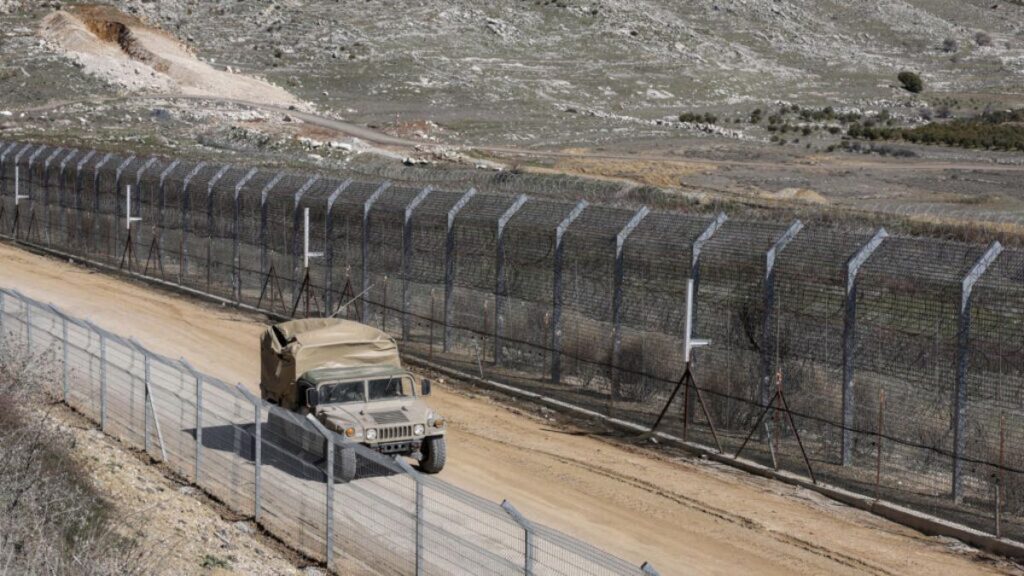

The Israeli army announced on Sunday, May 17, that ten Israeli civilians crossed the border into Syrian territory before its forces returned them to the occupied territories and arrested them.
The Israeli army said in a statement that soldiers at the site returned the civilians before handing them over to Israeli police.
The army considered the incident a “criminal offense,” stressing that it endangers civilians and Israeli army soldiers.
Settlement Protest at the Border
Israeli settlement groups carried out an action at the border strip with Syria, demanding permission to establish a new settlement inside Syrian territory.
Israeli media said dozens of members of the “Pioneers of HaBashan” movement arrived at dawn on Sunday at the border fence with Syria and organized a protest calling on the Israeli government to approve the start of settlement in the area they call “Mount Bashan.”
According to Israel’s i24 website, the action took place on the border separating the town of Majdal Shams in the occupied Syrian Golan and the town of Hader (Quneitra, southern Syria), inside Syrian territory at the foot of Mount Hermon.
While they were at the site, several participants tied themselves to the border fence in an attempt to prevent Israeli forces from quickly evacuating them from the location.
Public Calls for Settlement Inside Syria
Participants raised slogans calling for expanding Israeli settlements toward Syrian border areas, arguing that establishing a new settlement in the area would be a step toward strengthening the Israeli presence around the occupied Golan.
The movement also claimed, in a statement, that supporting Jewish settlement in the area constitutes a “response” to international accusations related to Israeli settlement activity.
The action comes amid escalating Israeli rhetoric linked to expanding military and security influence in border areas with Syria.
Moves Coincide With Field Escalation
Areas near the ceasefire line in the occupied Syrian Golan are witnessing repeated Israeli moves, including incursions into villages in the Quneitra countryside, the establishment of temporary checkpoints, search and arrest campaigns, and military fortification work at several border sites.
Israeli army forces have also recently been reinforcing their military positions in the area by building earth berms, extending new fortification lines, and bringing prefabricated units to sites near the Syrian border.
Previous Crossing Attempt
A group of Israeli settlers attempted on November 27, 2025, to cross the border from the occupied Golan into Syrian territory at two separate points, in Mount Hermon near another site that had previously been breached, and near the village of Beer Ajam in the Quneitra countryside.
The group, known as “Pioneers of HaBashan,” used electric saws to cut parts of the border fence before advancing into Syrian territory in vehicles, according to Israeli media. The Israeli army estimated the total number of those who crossed at 13 people, five of them at Mount Hermon and eight on the Beer Ajam axis.
Israeli army spokesperson Avichay Adraee announced that army units rushed to the two sites minutes after receiving the report and were able to locate the infiltrators and return them to Israeli territory.
The army said that some of those who crossed clashed and argued with soldiers during their arrest before all of them were transferred to the police to complete the investigation.
Israeli police later reported the arrest of five additional suspects near the breach point at Mount Hermon, confirming that extending their detention would depend on “the developments and results of the investigation.” Police recalled that crossing the border into Syria or Lebanon is a crime punishable by up to four years in prison.
Pioneers of HaBashan
The group carrying out the incursions is known as “Pioneers of HaBashan,” and its members are right-wing activists from the Samaria area, the northern part of the West Bank. They announced that their goal was to lay the cornerstone for the first Jewish settlement beyond the fence, named “Neve HaBashan.”
The “Northern Uri” movement published a statement titled “Laying the Cornerstone for Neve HaBashan Settlement, A Story of Pioneering and Devotion to the Homeland,” congratulating the “Pioneers of HaBashan” on their step at the time. It said families and children had taken part in a symbolic ceremony that included planting flowers and creating a memorial corner named after “Yehuda Dror Yahalom,” one of the Israeli soldiers killed, according to Maariv.
Activists in the movement said at the time that “the land of HaBashan is the inheritance of the ancestors, and empty spaces call for return and settlement,” calling on the Israeli government to “remove the enemy from the area and allow the pioneers to settle there.”
“Bashan” is a biblical name referring to an area east of the Jordan River that extends to the Golan Heights and includes areas of Hauran, the Golan, and al-Lajah in southern Syria. In the Jewish religious narrative, it is known as the fertile land that God gave to the Children of Israel, according to Manaa [CHECK ARABIC].
Israeli forces launched an operation named “Arrows of Bashan” on December 8, 2024, six hours after the fall of the regime of ousted President Bashar al-Assad.
Later, the leader of the Druze monotheist community in Suwayda, Hikmat al-Hijri, adopted the term and called Suwayda “Mount Bashan” instead of “Jabal al-Arab.”
Guterres, Israeli settlement in occupied Golan violates international law