
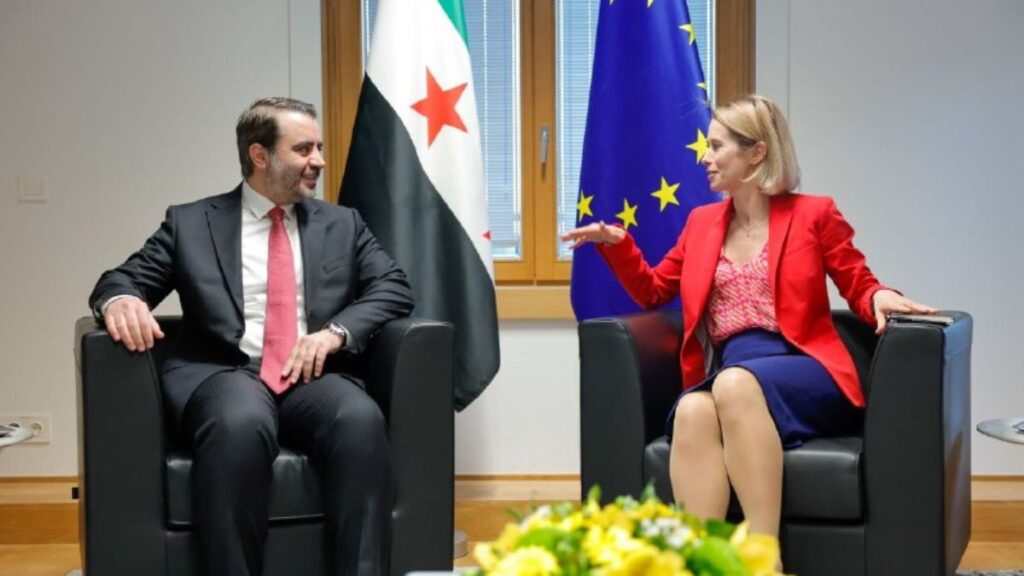

The Council of the European Union announced the removal of seven Syrian entities from the sanctions list, including the Ministries of Defense and Interior, without naming the other entities.
The Council of the European Union also decided on Monday, May 18, to extend sanctions imposed on individuals and entities linked to the ousted Assad regime until June 2027 after its annual review.
The EU said networks linked to the former regime still retain influence that could threaten the political transition and national reconciliation.
It added that those listed are subject to asset freezes, while EU citizens and companies are prohibited from making funds available to them. Individuals are also subject to travel bans preventing them from entering or transiting through EU countries.
Syrian Welcome
The Syrian Foreign Ministry welcomed the EU decision to lift sanctions on seven Syrian government entities, including the Ministries of Defense and Interior.
In a statement, the ministry praised the sanctions imposed on “figures of the Assad regime and those involved in violations related to the rights of the Syrian people.”
The Syrian Foreign Ministry said in a statement issued on Monday, May 18, that the European step “will contribute to supporting recovery and reconstruction efforts, and strengthening the ability of Syrian institutions to carry out their duties in serving citizens and consolidating security and stability.”
The ministry noted the Syrian government’s keenness to continue openness and cooperation with the international community based on mutual respect.
Suspension of Cooperation Agreement With Syria Ends
On May 11, the Council of the European Union issued a decision ending the partial suspension of the Cooperation Agreement between the European Economic Community and Syria, canceling the 2011 decision to suspend the agreement.
The council said it would fully reapply the cooperation agreement, which it described as “an important step toward strengthening bilateral relations between the EU and Syria.”
It said the previous suspension targeted specific trade provisions in the agreement in response to grave human rights violations committed by Bashar al-Assad’s government, including provisions that lifted quantitative restrictions on imports of some Syrian products, including oil and its derivatives, gold, precious metals, and diamonds.
The Council of the European Union said the return of the agreement aligns with the EU’s broader policy to support a peaceful and inclusive transition in Syria and facilitate the country’s social and economic recovery.
It also considered the decision a clear political message affirming the EU’s commitment to reengaging with Syria and supporting its economic recovery.
The council said the European Commission would notify Syrian authorities of the end of the partial suspension, which will enter into force from the date of its adoption.
The reinstated provisions of the cooperation agreement will take effect on the first day of the first month following the notification, allowing sufficient time for implementation, according to the Council of the European Union.
The council said the EU-Syria cooperation agreement, concluded in 1977, will provide the framework for economic and trade relations between the two sides.
European Support Packages and Planned Investment Conference
European Commissioner for the Mediterranean Dubravka Šuica confirmed that the EU is working to implement a financial package estimated at 175 million euros, in addition to providing a second package worth 180 million euros during the current year, as part of support for the Syrian government in reconstruction and recovery.
Speaking at a joint press conference with Syrian Foreign Minister Asaad al-Shaibani, she said European funding would help open investments in the public and private sectors and encourage European banks, as Syria seeks to rebuild and provide the services needed to facilitate the return of Syrian refugees.
Šuica said Europe is working to facilitate the voluntary and safe return of Syrian refugees, noting that an investment conference will be organized at the end of the current year to support Syria and the return of refugees.
She said the Syrian European meeting represents a “historic opportunity,” affirming Europe’s commitment to supporting Syria in achieving recovery and reconstruction and moving from crisis to recovery.
She added that Syria is among the most important countries in the eastern Mediterranean, and that its reconstruction requires joint cooperation, given the scale of the major needs.
She said European institutions are providing support for health institutions and infrastructure, in addition to accelerating economic and social recovery and institution-building.
She said recovery in Syria is achieved by “building the future and achieving resilience to instill hope in Syrians.”