
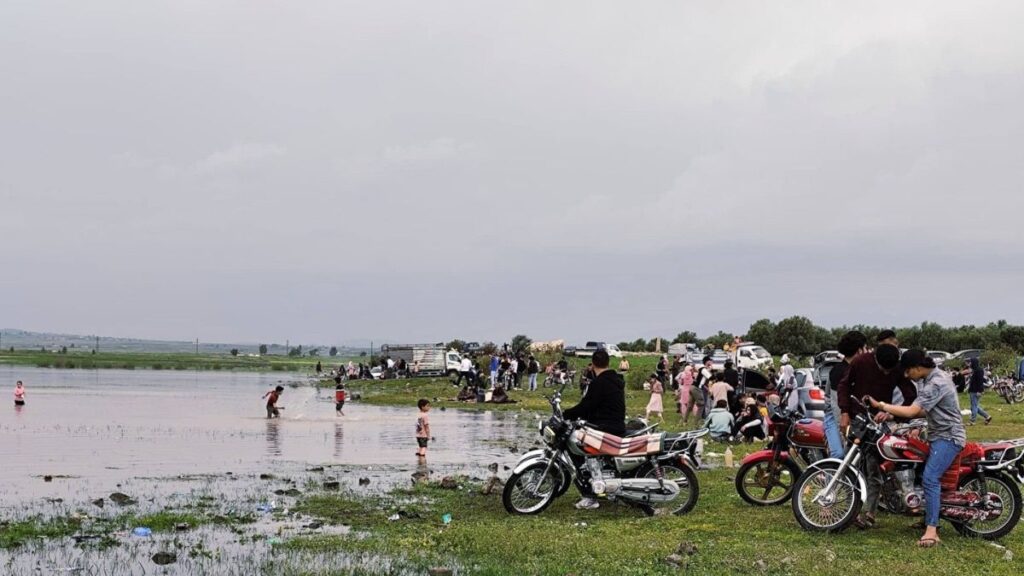

With the arrival of spring, Quneitra governorate (southwestern Syria) is regaining its presence as a preferred destination for popular, low-cost local tourism, as families flock to green hills, plains, dams, and water bodies.
However, this seasonal revival is colliding with security challenges that continue to cast a shadow over the tourism sector, while concerned authorities seek to revive tourism assets and attract investments, amid hopes of turning Quneitra into a diverse destination combining eco-tourism and popular tourism.
Amer al-Halqi, from the city of Jasim in western Daraa countryside (southern Syria), told Enab Baladi that he visits al-Hajjah Dam in southern Quneitra countryside with his family for picnics, describing the dam and its surroundings as a “wonderful” natural area.
Amer added that the site is close to Jasim, noting that he visits the area frequently. He also said many families from Daraa go there because of its beauty and geographic proximity.
In central Quneitra countryside, Kroum Jabah hill stands out as a natural open space that residents had missed during the years of the revolution, according to Mohammad al-Mutlaq, who lives in the town of Jabah.
Mohammad added that residents of his town found a major opportunity to enjoy the hill’s pleasant atmosphere after years of deprivation, following its conversion into a military zone by the Assad regime during the years of the revolution.
Israeli Incursions Are an Obstacle
Enab Baladi’s correspondent in Quneitra reported that a number of tourist sites in the governorate have become out of service or no longer witness noticeable tourism activity.
Among those sites is Ruwayhina Dam, where tourism activity has declined compared with previous years, as trips there have become risky due to Israeli incursions in the area, leading to a drop in visitor numbers.
The correspondent added that the Israeli army’s incursion into the buffer zone and the establishment of a military base near al-Mantara Dam and Golan Park, which overlooks the dam, caused the area to be isolated and declared a closed military zone to civilian movement.
Israeli measures led to the park going out of service after it had served as an outlet for popular tourism, especially for visitors from neighboring governorates.
The Golan Park project is one of the tourism projects that began in 2019. It is considered the first tourism project of its kind at the governorate level, and was implemented and supervised by the Syrian Tourism Company with support from the Ministry of Tourism.
It was put into service in 2022 and became a factor in attracting and naturally marketing tourism investment.
Tourism in Quneitra
Quneitra Tourism Director Hamza Suleiman spoke to Enab Baladi about the state of tourism, the challenges facing it, the current tourism infrastructure, plans to attract investments, and the involvement of the local community and its role in supporting the tourism sector.
Suleiman said the challenges facing tourism development in Quneitra are primarily centered on the security situation created by Israeli military interventions since the fall of the Assad regime.
He added that another factor is what he called the “old legacy imposed on Quneitra as a result of the governorate being besieged under the former regime for 50 years, under the pretext of the conflict with Israel, and the absence of tourism facilities that meet needs, such as restaurants and hotels, as well as infrastructure that takes into account the path of modern tourism.”
Suleiman explained that the current tourism infrastructure is at its minimum level because of these challenges, noting that it exists but needs improvements and development as the situation across the area improves.
Plans to Attract Investments
Quneitra Tourism Director Hamza Suleiman said the Tourism Directorate is working on practical plans to attract tourism investments to the area, including defining a clear tourism identity for Quneitra, such as popular, environmental, health, therapeutic, religious, archaeological, and heritage tourism.
He added that work is underway to present ready-made projects, not merely geographic sites, with economic feasibility studies, prepared tourism project designs, and strong investment incentives, such as a 10-year tax exemption, granting land through long-term contracts, and improving infrastructure.
Suleiman said these steps are accompanied by the launch of marketing campaigns and the involvement of the local community through the establishment of rural restaurants and guesthouses, and by addressing the factor of safety and stability. This comes in parallel with efforts to strengthen tourism marketing for Quneitra locally and internationally through domestic tourism, university and school trips, organizing events and festivals, and activating digital marketing and professional visual content.
He said the directorate is relying heavily on the local community to support the tourism sector, as it represents the living face of the tourist destination and its natural promoter.