
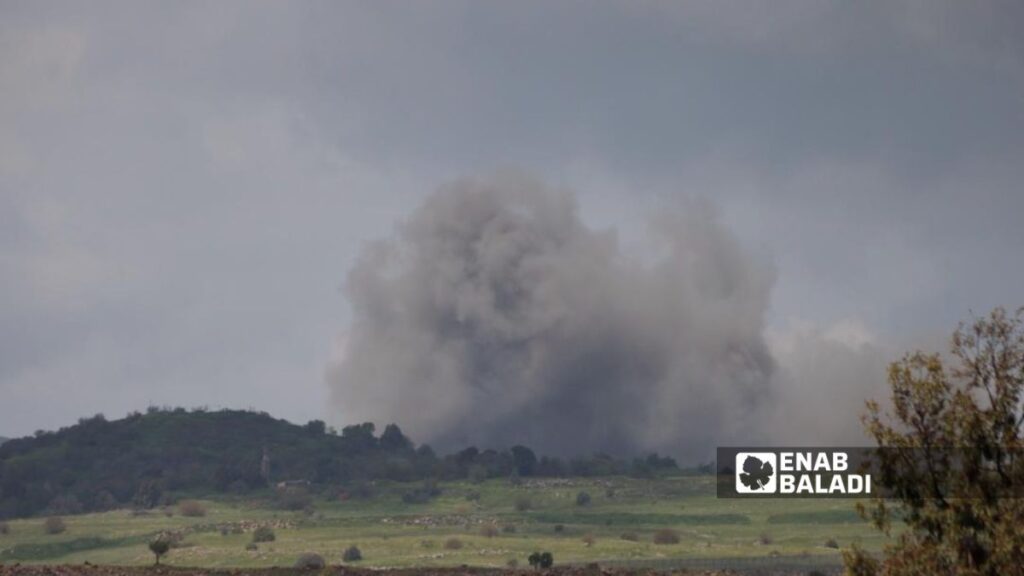

The Israeli army announced that it carried out a detonation operation involving about 700 land mines in the occupied Syrian Golan Heights.
The Israeli Ministry of Defense said on its X account on Monday, April 27, that the Mine Action Authority is carrying out operations to clear minefields in the Golan Heights area as part of a program extending over several years.
According to the Jerusalem Post, the authority cleared more than 6,700 dunams of land filled with mines and unexploded ordnance inside Israel over the past year.
The ministry said these operations aim to make land available for civilian, commercial, and industrial use, without specifying the exact date of the latest detonation.
In the same context, the Defense Ministry published video clips showing military engineering teams preparing explosives before carrying out the detonation.

Columns of smoke rise behind the Israeli army’s al-Adnaniyah base after mines were detonated in the area, April 20, 2026. (Enab Baladi/Anwar Asfour)

Columns of smoke rise behind the Israeli army’s al-Adnaniyah base after mines were detonated in the area, April 20, 2026. (Enab Baladi/Anwar Asfour)

Columns of smoke rise behind the Israeli army’s al-Adnaniyah base after mines were detonated in the area, April 20, 2026. (Enab Baladi/Anwar Asfour)
Israeli Fortifications in Quneitra
The Israeli army demolished al-Dagestan Mosque, the courthouse, and the buildings surrounding them in the destroyed city of Quneitra (southwestern Syria) on April 24.
The Israeli army demolished the Dagestan Mosque, the courthouse, and surrounding buildings in the ruined city of Quneitra (southwestern Syria) on the evening of Thursday, April 24.
Enab Baladi’s correspondent in Quneitra said the city witnessed the sound of explosions that shook the area, the first on Thursday morning and the second in the evening.
It later became clear that the explosions resulted from detonation operations carried out by Israeli army forces stationed in the ruined city of Quneitra. The operations destroyed what remained of the Dagestan Mosque, located in the city center, along with neighboring buildings.
According to the correspondent, these actions aim to further fortify the military base and to remove evidence of the brutality of the acts committed.
Local sources around the area told Enab Baladi that these actions are part of fortifications carried out by Israeli army forces, whether for the military base in the city or for the fortification works along the “Sufa” line, which involve digging trenches and raising berms along the ceasefire line.
The remaining buildings are currently being destroyed, while al-Andalus Cinema, al-Golan Hospital, and Ibn al-Haytham Secondary School were destroyed last January, according to the correspondent.
The Israeli army had destroyed parts of Quneitra city after its withdrawal following the October War in 1974.
Israeli army incursions continue in the Quneitra countryside, amid search campaigns, raids, and arrests, along with the installation of road checkpoints.
After the fall of the Assad regime on December 8, 2024, the Israeli army began a new campaign of incursions inside Syria, entering areas it considered closed military zones and taking positions there.
“Sufa 53” Road
About six months before the fall of the former regime, Israeli occupation forces built trenches and earth berms along the barbed-wire line from north to south on the western side, within the buffer zone, to establish a military road to serve their movements in the area.
The Israeli army gave the new military road inside Syrian territory the name “Sufa 53.”
The project is part of a military expansion along the border strip with the occupied Golan Heights and aims to facilitate the movement of military vehicles inside Syrian territory near the border.
Work on the road began in mid-2022, when an Israeli military force entered Syrian territory with six Merkava tanks and two military bulldozers, accompanied by several soldiers monitoring the border and the machinery, according to local correspondents in Quneitra governorate.
The work extends at least 100 meters into Syrian territory, while in some areas it reaches a depth of one kilometer, with bulldozers carving the road and clearing land along the route.