
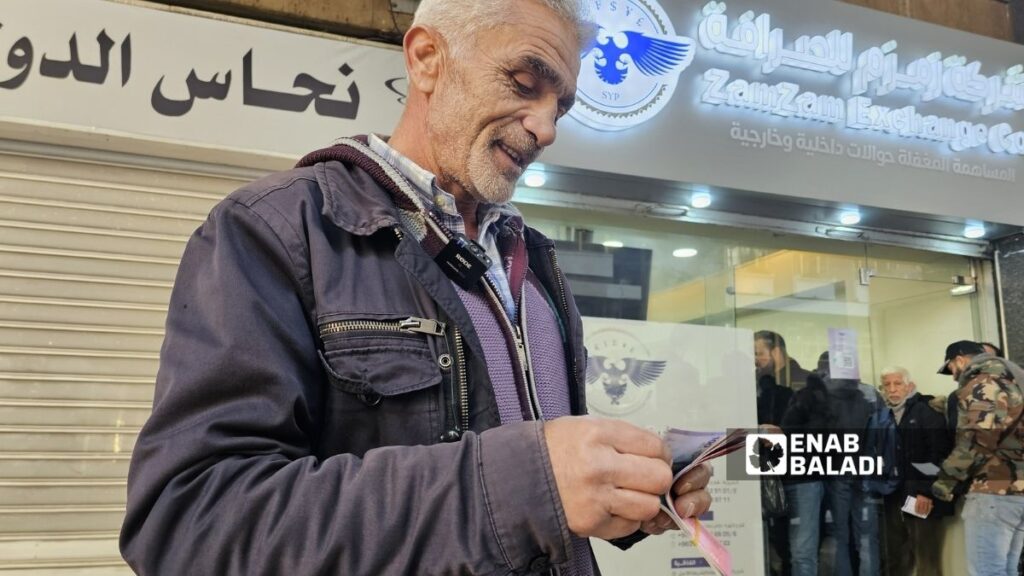

Seven corroborating sources who spoke to Enab Baladi revealed that the government has begun paying salaries and wages in Syrian pounds instead of dollars, in an effort to unify salary scales after months of paying salaries in both currencies.
Five sources in Syria’s Ministries of Defense and Interior told Enab Baladi that all salaries and wages for employees in the two ministries, whether longtime employees from before the fall of the regime or newly hired staff, are now paid in Syrian pounds instead of dollars.
The sources confirmed that the monthly salaries in question are the same net salaries previously set, but calculated according to the exchange rate of the Syrian pound against the dollar on the parallel market.
The sources explained that the shift to the Syrian pound took place two or three months ago, depending on the sector in which employees work.
Two other sources, one a branch director at a public entity who previously worked under the “Salvation Government” law, and another a contract employee appointed after the fall of the regime, revealed that all salaries for employees, whether they were from the “Salvation Government” or new contracts, have been paid in Syrian pounds since the beginning of 2026, with the start of the process of replacing the old currency with the new one.
The two sources said salaries, whether under old contracts or current hiring arrangements, are set in dollars at a rate of no less than $300 per month, but are paid in new Syrian pounds, according to the parallel market exchange rate plus 300 old Syrian pounds, about $0.02, per dollar.
A Shift From 2025 Salary Payments
Paying salaries to all state employees in Syrian pounds from the beginning of the year marks a shift from the period between December 8, 2024, and the start of 2026. Enab Baladi highlighted that period in a special file discussing salary imbalances in Syria’s public sector, the widening gap between employees, the reasons behind the absence of a unified wage scale, and its legal, economic, and social implications.
Before the beginning of 2026, employees contracted under the “Salvation Government” workers’ law and some new contractors with state institutions, appointed after the political and administrative changes, received salaries starting at $300 per month, paid in dollars. This was equal to two or three times the salary of an old employee holding a similar position at the same functional level.
50% Salary Increase for State Employees
In March, Syrian President Ahmed al-Sharaa issued a number of decrees increasing salaries and wages for employees in the state and joint sectors, along with some tax exemptions.
Under Decree No. 67 of 2026, 50% was added to the fixed salaries and wages in force on the date the decree was issued for employees in ministries, departments, public institutions, public sector companies and facilities, all administrative units, and public sector bodies.
The increase includes the promotion allowance due under Law No. 50 of 2004, as well as joint sector entities in which the state’s share of capital is no less than 50%.
However, this increase takes effect as of May 1.
Increase Does Not Apply to Former Salvation Government Workers
According to Article 2 of the decree, the decree covers monthly workers, daily workers, temporary workers, whether they are agents, casual workers, seasonal workers, contractors, workers under employment contracts, appointees under scoring tables, or under administrative instruments, as well as those working part-time, on a production basis, or on fixed and variable wages.
The increase specified in Article 1 of the decree automatically applies to Syrian contractors and those treated as Syrians, provided that the contracted monthly salary or wage does not exceed the monthly wage received by their counterparts who hold the same certificate or qualification and work permanently for the public entity contracting with them, taking into account the remaining period until their graduation or receipt of the qualification.
Excluded from the decree are civilian and military employees in ministries, departments, public institutions, public sector companies and facilities, and all administrative units who are covered by Basic Workers Law No. 53 of 2021, issued by the former Syrian Salvation Government.
It also does not apply to workers benefiting from special increases approved for several ministries and authorities.
The general minimum wage and the minimum wage for professions for workers in the public, private, cooperative, and joint sectors not covered by the Basic Law for State Employees No. 50 of 2004 and its amendments will be increased to 12,560 new Syrian pounds, about $0.97, per month.
Special Increase for Some Public Bodies
President Ahmed al-Sharaa also issued Decree No. 68 of 2026, which applies a special increase schedule to the salaries and wages of employees in several public bodies, including the promotion allowance due under Law No. 50 of 2004.
The public bodies include the Ministry of Health, the Ministry of Higher Education and Scientific Research, the Ministry of Education, the Ministry of Endowments, the Central Bank of Syria, the Central Commission for Control and Inspection, the Central Financial Control Authority, and the Atomic Energy Commission.